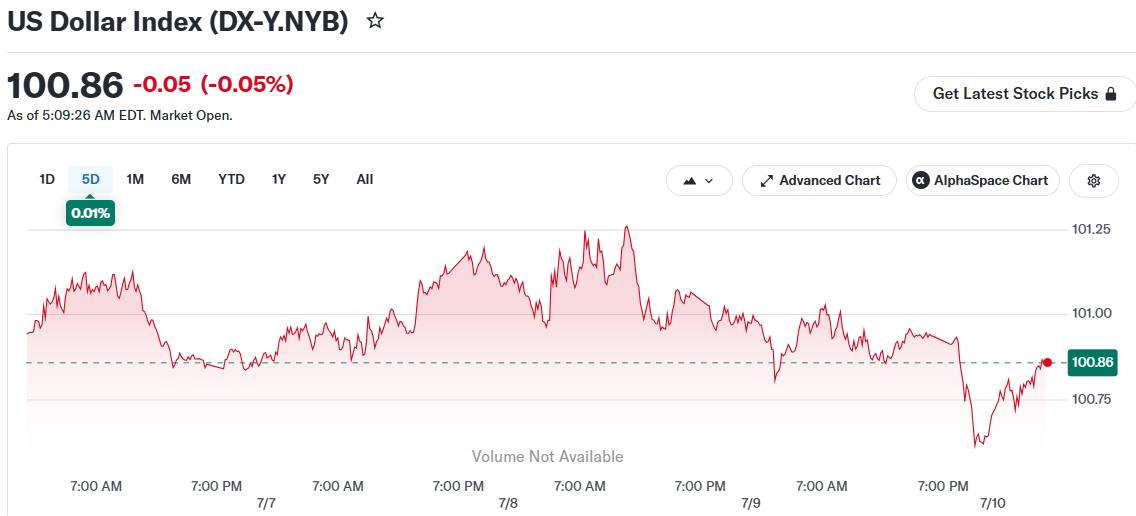
The US dollar fell on Friday, weighed down by a surging Japanese yen. The dollar index slipped 0.1%, marking its second consecutive weekly loss.
Japan’s Finance Minister Satsuki Katayama said Tokyo wants its Government Pension Investment Fund to put more money into domestic assets. That fund is the world’s largest pension fund, and any shift in its allocations tends to move markets.
The yen gained as a result. The dollar-yen pair dropped 0.6% to 161.44. Japanese 10-year bond yields also slid 3.4% following the announcement.
Japan also reported hotter-than-expected producer price index data for June, with the fastest growth in over three years. Higher producer prices tend to feed into consumer inflation, which could push the Bank of Japan to raise interest rates further.
Despite Friday’s gains, the yen remained near its weakest level in 40 years. Japanese authorities have stepped into currency markets before when the yen hit similar levels, and analysts say intervention risk remains high.
The US-Iran conflict added uncertainty to the currency markets this week. The US military struck around 90 Iranian targets on Thursday, and Iran responded with drone and missile attacks on US bases in Bahrain, Kuwait, and Qatar.
President Trump said a ceasefire was over early in the week, but later indicated Iran had reached out for further talks.
BREAKING: President Trump says Iran called him and “they want to make a deal so badly.”
US stock market futures turn green on the news. pic.twitter.com/1MkYnxxkCK
— The Kobeissi Letter (@KobeissiLetter) July 9, 2026
The conflict initially supported the dollar as a safe-haven currency. But a 2% drop in crude oil prices on Thursday eased inflation worries, reducing pressure on the Federal Reserve to raise rates.
Fed minutes from June showed policymakers were divided on whether to hike rates this year. Weak payroll data from the previous week had already lowered expectations for a hike. Markets are now pricing in just a 24% chance of a rate increase at the July 28-29 meeting.
US jobless claims fell 2,000 to a six-week low of 215,000, pointing to a still-healthy labor market. However, existing home sales dropped 2.4% in June to 4.09 million, missing forecasts.
Other currencies mostly strengthened against the dollar. The euro and pound each rose around 0.1%. The Chinese yuan gained 0.2% after inflation data showed continued pickup. The Australian dollar rose 0.3%.
The South Korean won was the exception, weakening 0.3% as local equity market volatility took a toll. South Korea launched 24-hour won-dollar trading earlier this week.
Gold rose 1.43% to close higher, and silver jumped 3.77%. Both metals were lifted by dollar weakness, lower bond yields, and Middle East tensions. China’s central bank added 320,000 ounces of gold to its reserves in May, its largest monthly increase in 17 months and its 19th straight month of additions.
The post Dollar Index Falls Second Week in a Row as Japanese Yen Rises on Pension Fund News appeared first on CoinCentral.





