TL;DR:
The ruble-backed stablecoin A7A5 has positioned itself among the top three tokens on the Tron network by daily transfer volume, according to data from the analytics portal Tronscan cited by Russian crypto media.
With nearly $175 million in daily transactions, the token surpassed Decentralized USD (USDD), which processed just over $153 million last Wednesday, though it still remains far behind Tether (USDT), the digital dollar that dominates the network by a wide margin. Its market capitalization exceeds $486 million.
Launched in early 2025 as a response to Western sanctions that severely limited access to global financial markets, A7A5 was presented from the outset as an instrument to circumvent those restrictions. In less than a year, it accumulated transactions exceeding $100 billion, according to data from forensic analytics firm Elliptic. Available on both Tron and Ethereum, it has more than 39 billion tokens in circulation according to DeFiLlama and represents nearly half of the global market for non-dollarized stablecoins.
Behind the project stands the Russian company A7, whose majority shareholding belongs to Ilan Shor, a fugitive Moldovan oligarch and Russian citizen. Issuance is handled by Old Vector, a firm registered in Kyrgyzstan, whose team claims the project operates in a “completely independent” manner. The token’s backing comes from ruble deposits at PSB, formerly Promsvyazbank, a sanctioned Russian state bank. Transactions are processed by the platform Tokeon, which is part of the PSB group.
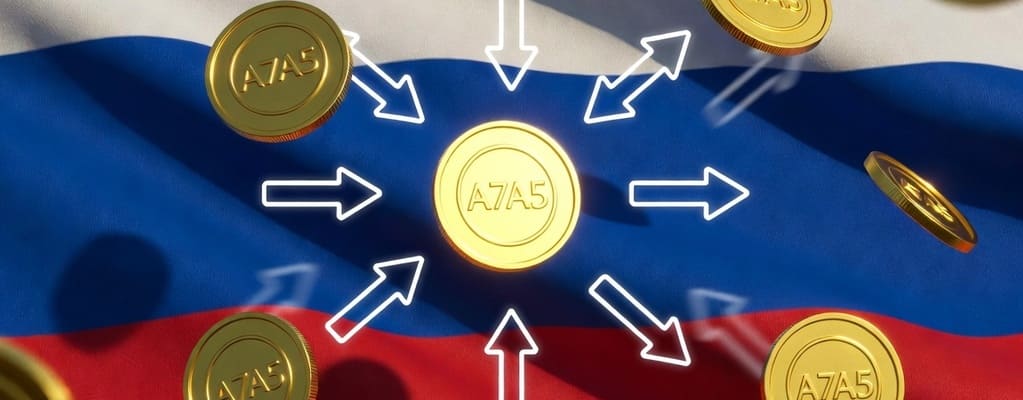
Both A7 and Old Vector, along with other entities linked to the token, were hit by Western sanctions. Among them is Grinex, the Kyrgyz successor to the Russian exchange Garantex, which was dismantled by authorities. Last September, the Central Bank of Russia recognized the token as a digital financial asset under local legislation, enabling its use in international payments.
Western analysts acknowledge that A7A5 has become an effective tool for cross-border transactions outside the regulated system, as reported by the business portal RBC. Ukraine’s allies continue attempting to block Moscow’s use of cryptocurrencies to finance its military operation and sustain foreign trade.





