The U.S. dollar climbed to its strongest level in a year this week, driven by growing bets that the Federal Reserve will raise interest rates in 2026. The dollar index, which tracks the greenback against a basket of currencies, briefly crossed 101.00 overnight before pulling back slightly to around 100.78 on Friday due to low liquidity from the Juneteenth public holiday.
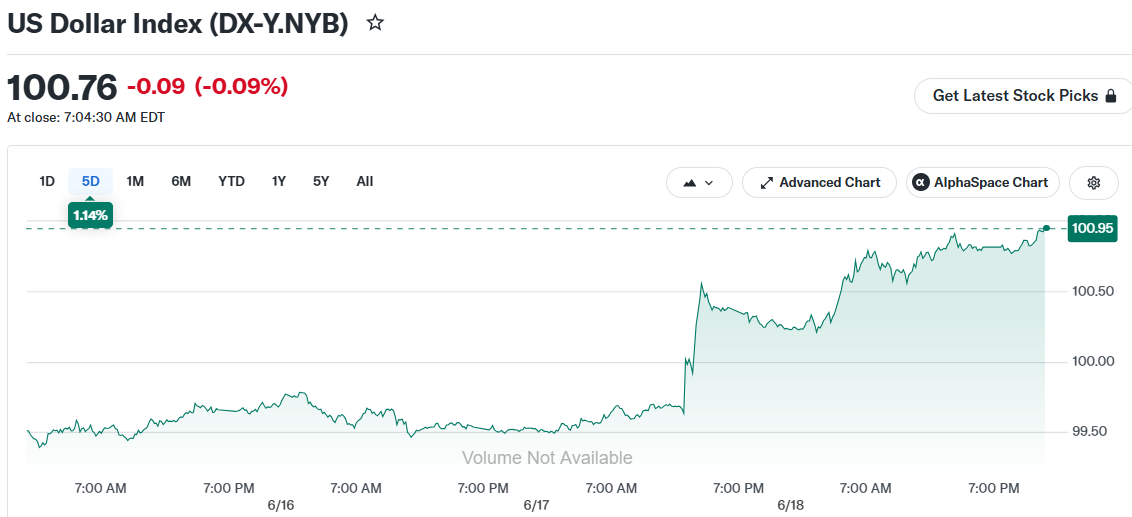
The move puts the dollar on track for its best week since 2024.
The spark came from new rate projections released by Fed officials on Wednesday. Several members now expect rate increases this year. Analysts at ING said markets are likely to fully price in two hikes by December at the next strong data release.
ING noted that while they view the chances of actual hikes as “overestimated,” the dollar may “enjoy post-Fed enthusiasm for a bit longer.”
A peace deal struck this week between parties in the Middle East removed one key reason investors had been buying dollars. The U.S. had benefited from safe-haven demand during the conflict, partly because American energy exports made it less exposed to oil supply disruptions tied to the Strait of Hormuz.
However, the deal’s durability is in question. Planned talks between the U.S. and Iran in Switzerland were cancelled on Friday after Vice President JD Vance scrapped his trip to Geneva. The Swiss foreign ministry confirmed the delay and said it remains ready to host the negotiations, which center on Iran’s nuclear program.
MUFG Bank analyst Derek Halpenny said the cancellation provided some safe-haven support for the dollar, but the hit to risk appetite looks modest and is unlikely to derail the peace process.
The sharpest story in currency markets this week is the Japanese yen. It fell to 161.82 per dollar, a level not seen in roughly 40 years. The yen steadied at around 161.26 on Friday, but pressure remains heavy.
Investors are watching closely for any sign that Japanese authorities will step in to buy the yen. The U.S. market holiday on Friday created thin trading conditions, which analysts at ING said is a window Japan has previously used to intervene.
“USD/JPY is already deep into intervention territory after breaking above the 2024 highs yesterday,” ING analysts said. They warned that without intervention, speculators could push the rate toward 162-163.
Japan’s Ministry of Finance has intervened before at around the 160 level.
The Bank of Japan raised interest rates to a 31-year high this week, but the move has done little to support the yen. BOJ Deputy Governor Ryozo Himino flagged risks around further hikes due to inflation pressures tied to the Middle East situation.
Government data released Friday showed Japan’s core consumer price index rose 1.4% year-on-year in May, below the BOJ’s 2% target for the fourth month in a row. Analysts at Capital Economics said the central bank may delay its next rate hike beyond their current October forecast.
The British pound rose 0.3% against the dollar to $1.3238, lifted by political news in the U.K. after Greater Manchester Mayor Andy Burnham won a by-election, setting him up as a challenger to Prime Minister Keir Starmer.
The post U.S. Dollar Hits One-Year High on Fed Rate Hike Bets as Japanese Yen Sinks to 40-Year Low appeared first on CoinCentral.





