TL;DR:
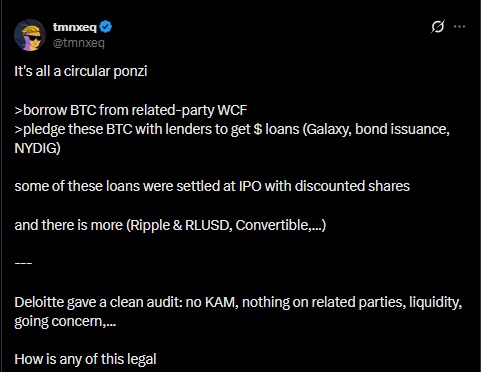
The exchange Gemini, co-founded by Cameron and Tyler Winklevoss, disclosed in its annual Form 10-K a related-party financing structure that drew immediate criticism on social media and among industry analysts.
According to the filing, Winklevoss Capital Fund (WCF), the brothers’ private investment vehicle, lent thousands of BTC and ETH to Gemini through open-term agreements with no fixed maturity date. The exchange used the cryptocurrencies as collateral with third parties: Galaxy Digital extended approximately $116.5 million in loans at rates between 11% and 12%, collateralized at 145–155%, and NYDIG contributed $75 million through a repurchase agreement at 8.5%. The funds obtained were allocated to operations and regulatory capital requirements.

When Gemini went public on Nasdaq on September 15, 2025, under the ticker GEMI, it set its IPO price at $28 per share. With the $456 million in net proceeds raised, it repaid the Galaxy Digital loan. However, the debt owed to WCF — $200 million in convertible notes and $475 million in term loans, plus accrued interest — received no cash payment. Instead, the exchange converted that liability into 31.1 million Class B shares at $22.40 per unit, a 20% discount to the price paid by retail investors that same day. Those shares represent 94.7% of the voting power of the company held by the co-founders.
As of December 31, 2025, the exchange still owed WCF 4,619 BTC, equivalent to approximately $400 million. During 2025, it paid $24.2 million in loan fees to WCF. Additionally, according to Arkham Intelligence data cited by researcher Emmett Gallic, WCF holds approximately 8,757 BTC in Gemini Custody addresses.
Deloitte signed a clean audit opinion on these financial statements, despite the fact that WCF could demand the return of the 4,619 BTC at any time with simple written notice.

The shares entered the market at $37.01 and reached a high of $45.89, before beginning a sharp decline. As of March 31, 2026, they closed at $4.42, after hitting a 52-week low of $3.91 the previous Monday. The market capitalization fell from over $3.8 billion to around $520 million. Citigroup, Cantor, Truist, and Evercore downgraded the stock to sell. A class action lawsuit also alleges that the company misled investors about its business strategy.





