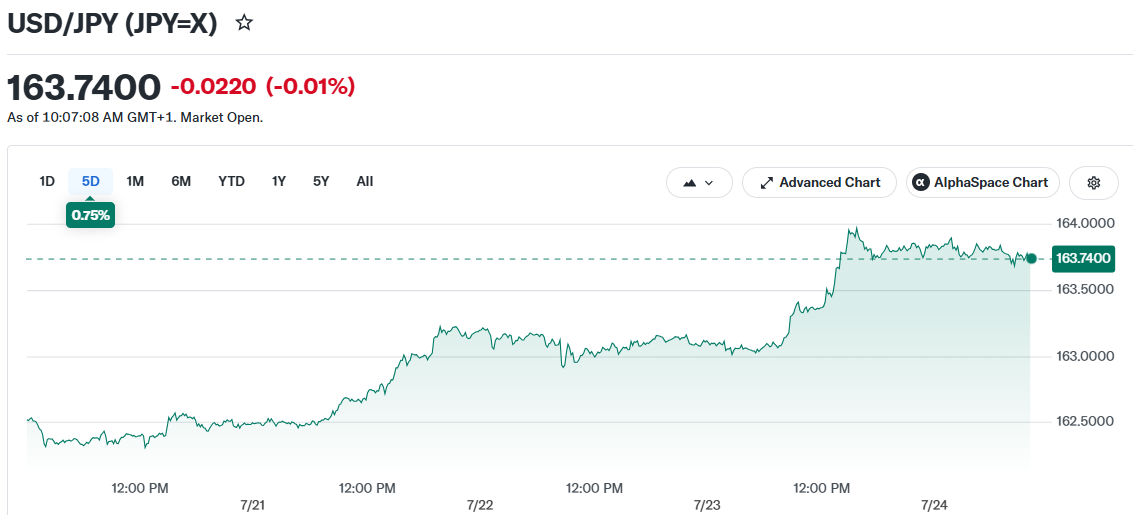
The Japanese yen is heading for its worst weekly performance since May, falling to levels not seen in roughly 40 years against the U.S. dollar. The USD/JPY pair was trading near 163.90 on Friday during early Asian trading.
Japan’s government has tried to calm markets with verbal warnings, but those efforts have done little to stop the slide. Finance Minister Satsuki Katayama warned this week that authorities were ready to take “appropriate and bold action,” but traders largely shrugged it off.
Analysts say even direct currency intervention would only delay the problem. Without faster rate hikes from the Bank of Japan, the yen’s weakness is likely to continue.
🚨 JAPAN MAY SOON BE FORCED INTO ANOTHER MASSIVE CURRENCY INTERVENTION.
USD/JPY hit 163.991 today, very close to 164, a level considered very critical for the Yen.
Earlier this year, Japan spent a record ¥11.7 trillion ($73 billion) defending the yen.
The intervention… pic.twitter.com/QXpTqNntYN
— Bull Theory (@BullTheoryio) July 24, 2026
The U.S. Treasury Department added pressure on Thursday, saying excessive currency volatility was unwelcome and calling on the Bank of Japan to act.
The dollar is set for a weekly gain of nearly 0.9%, its strongest weekly rise since May. The U.S. dollar index was last slightly lower at 101.35 on Friday.
Japan’s national CPI rose to 1.7% year-on-year in June, up from 1.5% in May. Core inflation also ticked up to 1.6%, its first rise since March.
The CPI data came just days before the Bank of Japan’s policy meeting, where rates are widely expected to stay on hold. Markets had little reaction to the inflation figures.
In the U.S., a positive June inflation report briefly raised hopes that price pressures were easing. But oil prices crossing $100 a barrel this week for the first time in nearly two months changed the mood.
Federal Reserve Chair Kevin Warsh has made clear the Fed is not backing down from its 2% inflation target. Portfolio managers are watching closely, noting that one good inflation print is not enough to change the Fed’s stance.
Geopolitical risk is also driving markets. President Trump said this week the U.S. would hold Iran responsible for Houthi attacks in the Red Sea and warned of a “major military punishment.”
That kind of uncertainty tends to support the dollar as a safe-haven currency, adding more weight to the yen.
The euro edged up 0.1% to $1.1388 on Friday. The European Central Bank kept rates unchanged but left the door open for a September hike. Traders are pricing in about a 30% chance of that move.
Sterling gained 0.15% to $1.3335. The 30-year U.S. Treasury yield stayed above 5%, while the 2-year yield hovered at 4.34%, its highest since February 2025.
The yen has now lost nearly 5% in 2026, in line with the Norwegian and Swedish crowns, and well behind the Swiss franc which is down just over 3%.
The post Japanese Yen Hits 40-Year Low as Dollar Surges on Inflation and Middle East Tensions appeared first on CoinCentral.





