TL;DR:
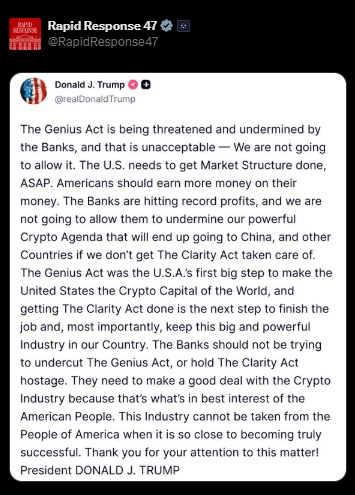
Donald Trump entered the legislative debate on stablecoins directly and attacked the traditional banking lobby for attempting to block the CLARITY Act and undermine the GENIUS Act, signed in July 2025. In a post on Truth Social, Trump declared that banks are holding the CLARITY Act “hostage” to protect their interests, and demanded that Congress move forward urgently on market structure regulation.
The GENIUS Act established the first federal framework for stablecoins, but prohibited issuers from paying interest directly to users. It left unresolved whether third-party platforms like Coinbase could pass yields on to their customers. Banks have aggressively lobbied to close that possibility in the text of the CLARITY Act, the bill that would define clear jurisdictions over digital assets.
Tensions reached a critical point in January when the CEO of Coinbase, Brian Armstrong, withdrew his support for the bill following amendments that would seek to ban passive yield on stablecoins. The White House set March 1 as a deadline for the parties to resolve their differences, but no public agreement was reached.
Trump was explicit: “Banks should not be trying to undermine the GENIUS Act or hold the CLARITY Act hostage. They need to make a good deal with the crypto industry, because that is what is good for the American people.” The forecast fueling banking anxiety had been laid out by Geoff Kendrick, global head of crypto research at Standard Chartered, who warned that stablecoins could absorb up to $500 billion in bank deposits by 2028.

Support for Trump from the industry was immediate. Brad Garlinghouse, CEO of Ripple, described the president’s words as “an extremely direct message about what is good for the American people.” Senator Cynthia Lummis urged Congress to act swiftly, and Eric Trump accused major banks of going into “massive panic” over losing the race in digital finance.
However, Charles Hoskinson, founder of Cardano, rejected the legislation in harsh terms, describing it as a “horrible and garbage bill” that, under its “security by default” framework, would subject new projects to SEC jurisdiction and “destroy all future American cryptocurrency projects.” Garlinghouse, for his part, argued that “clarity beats chaos” and that the industry cannot let “perfect be the enemy of progress.”