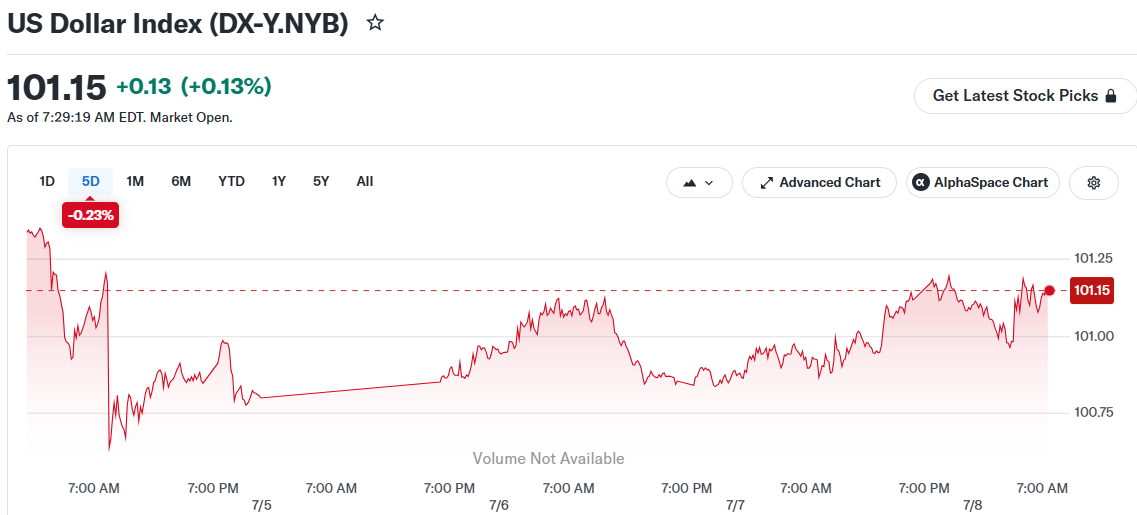
The U.S. dollar extended its rally on Wednesday after President Donald Trump declared the interim agreement with Iran finished, triggering a wave of safe-haven buying and sending oil prices sharply higher.
Speaking at a NATO summit in Turkey, Trump said the framework deal was “over” after Iran’s Revolutionary Guards attacked U.S. military sites in Bahrain and Kuwait. Iran said the strikes were retaliation for U.S. airstrikes on Iranian territory and Washington’s decision to revoke sanctions waivers on Iranian oil exports.
“We make a deal, and everyone’s agreed. No nuclear weapons. They go outside, talk to the press, they say we never even talked about it. As far as I’m concerned, it’s over,” Trump said.
The U.S. Dollar Index, which tracks the dollar against six major currencies, edged up 0.2% to around 101.17. That put it near its highest level since July 2.
Brent crude surged 6.24% to $78.82 a barrel, extending gains for a second straight day. The rise came directly after Trump’s remarks and news of Iranian military strikes on U.S. sites in the region.
U.S. Treasury yields also moved higher. The 2-year yield climbed to 4.24%, while the 10-year yield touched a one-month high of 4.60%. Analysts attributed the moves to markets pricing in higher energy costs over the longer term.
Jane Foley, head of FX strategy at Rabobank, said the market has learned to weigh Trump’s comments carefully. “The remarks may be meant to bring the opposition to the table. Nevertheless, they will raise anxiety levels another notch,” she said.
Beyond the Middle East tensions, traders were focused on two other events Wednesday.
The Reserve Bank of New Zealand raised its official cash rate by 25 basis points to 2.5%, in line with expectations. The bank said further tightening may be needed to bring inflation under control. The New Zealand dollar rose following the decision.
The Australian dollar also gained modestly, while the Japanese yen remained under pressure. The dollar rose against the yen for a fourth consecutive day, hovering near 162.48. That level has previously prompted warnings from Japanese authorities about possible intervention.
Bank of Japan board member Toichiro Asada said clearer signs of demand-driven inflation are needed before Japan moves on further rate increases.
Later in the day, markets were set to receive the minutes from the Federal Reserve’s June meeting — the first under new Chairman Kevin Warsh. Warsh has already trimmed the Fed’s policy statement and withheld his own rate projections, breaking from recent practice. Nine of 18 FOMC members recently projected at least one more rate hike before year-end.
Francesco Pesole, FX strategist at ING, said he expects the minutes to reinforce a hawkish tone, which would support further dollar strength.
The post U.S. Dollar Rises to One-Week High After Trump Says Iran Deal Is Over appeared first on CoinCentral.





