TL;DR:
Uniswap published a financial summary detailing the protocol treasury activity, UNI token distribution and funding allocations across its ecosystem initiatives. The document covers activity through early 2026 and stands as one of the most comprehensive analyses of the decentralized exchange’s internal financial operations to date.
During fiscal year 2025, approximately 129.8 million UNI tokens were released from the protocol’s timelock. Of that total, around 77% was directed to burn mechanisms introduced through governance proposals, while the remaining 23% — roughly 29.8 million UNI — was allocated to operating expenses and ecosystem incentives. This distribution reflects the dual role the protocol treasury fulfills: managing circulating supply and supporting ecosystem development.
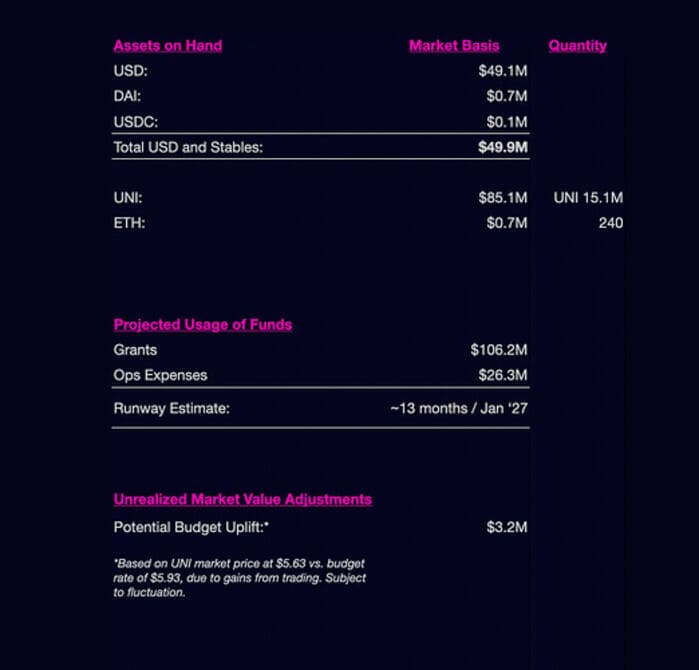
Programs led by the Uniswap Foundation accounted for approximately 93.6% of spending-related outflows, focused on liquidity incentives, developer grants and user growth initiatives. The report also details that the majority of previously approved budgets have already been deployed or committed, indicating a relatively high level of capital utilization across governance initiatives.
Separately, Uniswap recorded fiat-linked inflows into accounts associated with the protocol’s governance. Approximately $0.89 million in new inflows were recorded during the latest period. Cumulative inflows total roughly $10.6 million. While these figures are modest compared to token-denominated movements, they reflect a gradual diversification in the treasury’s composition.

The report also addresses the treasury distribution structure, in which funds released from the timelock are channeled through intermediary structures to ensure controlled disbursements tied to predefined milestones and proposals approved by governance. The document warns, however, that the use of these intermediate accounts may give rise to legal and tax considerations due to regulatory frameworks that continue to evolve across jurisdictions.
Strategically, a significant portion of capital continues to flow toward sustaining liquidity and incentivizing user activity, in line with the competitive dynamics of decentralized exchanges. Additional funds were allocated to governance operations, developer tooling and protocol infrastructure.





