Oil prices jumped at the start of the week after U.S. forces carried out strikes on Iranian rocket launchers near one of the world’s most critical shipping lanes.
The U.S. military hit two Iranian launchers on Larak Island on Sunday. The island sits close to the Strait of Hormuz, through which a large share of global oil supply passes. It was the first known American strike on Iran since late July.
🚨🇺🇸🇮🇷 BREAKING:
U.S. official, speaking to Axios:
"Earlier today U.S. forces struck two Iranian launchers on Larak Island.
Islamic Revolutionary Guard Corps forces were observed preparing to launch rockets with sea mines into Strait of Hormuz."
Source: @BarakRavid, Axios,… pic.twitter.com/xyAh2PNU6Z
— Mario Nawfal (@MarioNawfal) August 30, 2026
A U.S. official said Iranian Revolutionary Guard forces had been preparing to launch rockets carrying sea mines into the strait before the strike took place.
Brent crude for November delivery climbed 2.5% to $90.28 per barrel in Asian trade on Monday. West Texas Intermediate rose 2.2% to $85.24 per barrel.
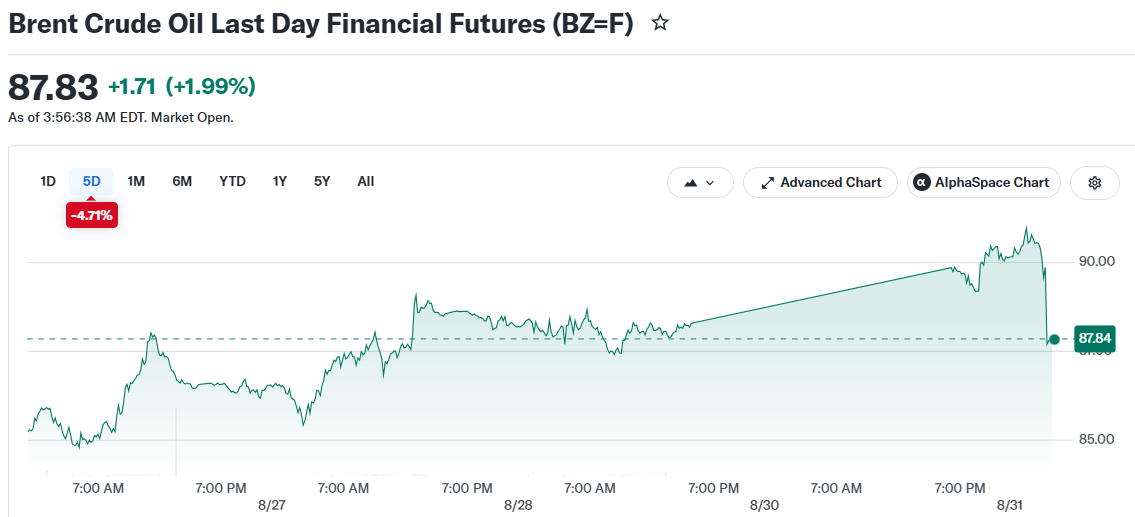
The move capped a volatile month for Brent, which had swung across a range of nearly $17 per barrel through August as fighting continued and peace talks stalled.
Iran responded to the Larak Island strikes by launching missiles at U.S. forces in Jordan. A report from Fox News, citing a U.S. source, said nearly all incoming missiles were intercepted. No casualties were reported.
Analysts at ING said the key question now is whether both sides launch further rounds of strikes and whether shippers become hesitant to pass through the strait.
Earlier in August, Brent hit its highest closing level since late July after doubts grew over progress in U.S.-Iran peace talks. Iran had said the strait would stay closed unless Washington changed its approach.
Despite the ongoing tension, traders tracking cargo movements said between 6 and 8 million barrels per day were still moving through Hormuz. Iran’s semi-official Mehr news agency reported that some vessel traffic was moving on a limited basis, with ships paying tolls along an approved route.
Oil producers in the region had grown more comfortable using the strait in recent weeks, with an average of around 5 million barrels per day transiting the chokepoint before Sunday’s events.
Analysts noted that U.S. actions have not fully satisfied market expectations, with some saying Washington’s efforts to pressure Tehran have been underwhelming so far.
On the supply side, President Donald Trump said Sunday that the U.S. would begin refilling the Strategic Petroleum Reserve using oil obtained through a new agreement with Venezuela.
Markets will now watch closely for any further military exchanges and whether shipping companies change their routes in response to the renewed fighting near Hormuz.
The post Oil Prices Jump After U.S. Strikes Iranian Launchers Near Strait of Hormuz appeared first on CoinCentral.





