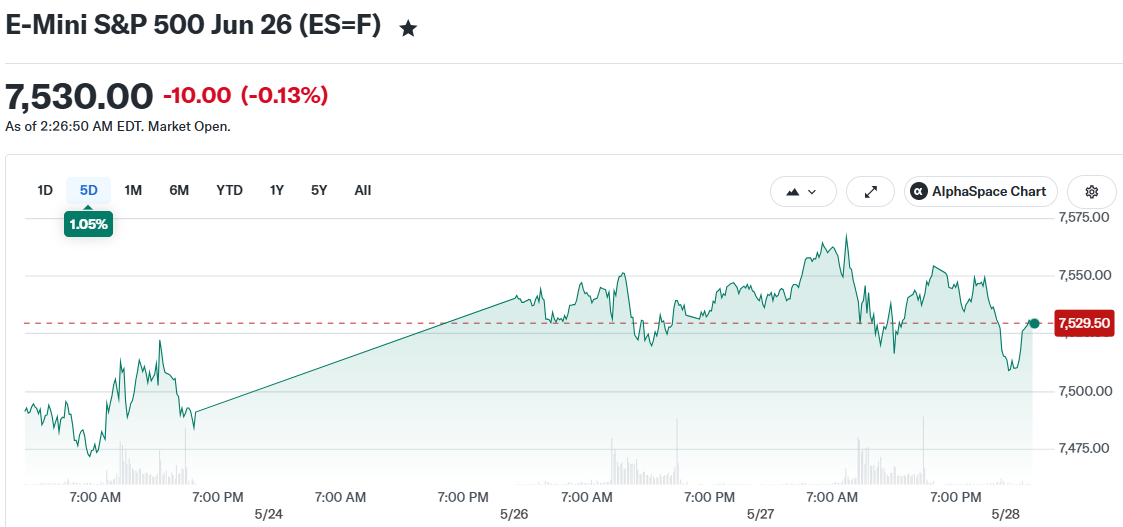
US stock futures dropped Thursday morning after the US military launched fresh strikes on Iran near the Strait of Hormuz, raising fears about the fragile ceasefire between the two countries.
Futures tied to the Dow Jones Industrial Average fell 0.2%. S&P 500 futures dropped 0.4%, and Nasdaq 100 futures declined 0.8%.
US forces shot down Iranian drones and hit a drone-control station near Bandar Abbas late Wednesday, according to the Wall Street Journal. Officials described the strikes as defensive, not an escalation.
All three major indexes closed at record highs on Wednesday before the overnight developments. The gains came despite a slowdown in the semiconductor rally.
Hargreaves Lansdown analyst Matt Britzman said markets had already priced in the conflict staying contained. “Positive headlines now have less power to lift sentiment, while any setback can quickly take the shine off,” he said.
He added that renewed hostilities and uncertainty over shipping traffic and Iran’s nuclear programme had brought caution back to markets.
Treasury yields and the dollar both ticked higher. The 10-year Treasury yield rose 2 basis points to 4.51%. The dollar edged up 0.1% against a basket of peer currencies.
Oil prices climbed sharply on fears of disruption to shipping through the Strait of Hormuz. Brent crude rose 2.8% to $94.86 a barrel. West Texas Intermediate gained 2.8% to $91.20 a barrel.
On the earnings side, Snowflake reported strong results after the bell on Wednesday and announced a $6 billion deal with Amazon Web Services. Its stock rose more than 30% in after-hours trading.
Marvell and HP also posted strong results, with both companies pointing to AI as a driver of spending on chips, cloud, and computers.
Salesforce beat Wall Street expectations but gave a cautious forecast. That raised investor concerns about AI disrupting the software business.
Thursday brings more earnings from Costco Wholesale, Dell Technologies, Dollar Tree, Best Buy, and The Gap.
The Federal Reserve’s preferred inflation measure, the Personal Consumption Expenditures index, is also due Thursday. The reading will show whether price pressures are building in a way that could push the Fed toward raising interest rates.
Markets remain broadly confident that the US and Iran will reach a peace deal. But analysts say the latest flare-up gives investors a reason to take profits after a strong AI-driven rally in recent weeks.
The post Pre-Market Update: Stocks Slip and Oil Spikes After US Launches New Strikes on Iran appeared first on CoinCentral.





