TL;DR
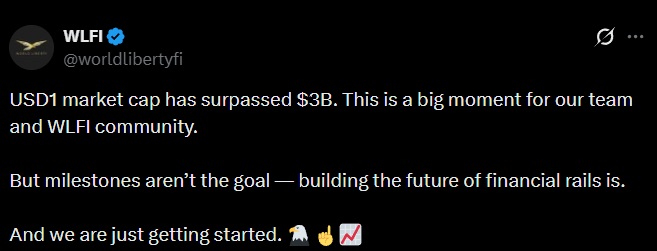
USD1 has crossed the $3 billion mark in market capitalization and entered a new phase of consolidation within the stablecoin market.
With a valuation close to $3.12 billion, the token issued by World Liberty Financial now ranks as the sixth-largest stablecoin and the 32nd-largest cryptocurrency by market cap. The surge did not come from gradual adoption, but from targeted decisions that concentrated liquidity in a very short period of time.

Binance was the decisive factor. The exchange launched a Booster Program offering a 20% APR on flexible savings products using USD1, a yield far above the sector average. At the same time, Binance began converting all collateral backing BUSD-linked tokens into USD1 on a 1:1 basis. That move positioned it as the core stablecoin within the exchange’s ecosystem and secured its use across trading, lending, and other high-volume products. The result was structurally driven demand rooted in infrastructure, not in retail spot market activity.
World Liberty Financial played a different role. While Binance supplied liquidity, WLFI focused its strategy on distribution and use cases. The project defines USD1 as a payment- and transfer-oriented stablecoin rather than a speculative vehicle. It also signed agreements with Coinbase and FalconX, extending it’s reach to both retail users and institutional players, and formed partnerships with Bonk and Raydium that opened the door to on-chain capital on Solana, where flows typically move through USDC.
However, the expansion has been shaped by a heavy political backdrop. A key flashpoint was a $2 billion payment from Abu Dhabi–based MGX fund to Binance, executed entirely in USD1. The transaction took place shortly before Donald Trump granted a pardon to Binance co-founder CZ, fueling suspicion in Washington. Senator Elizabeth Warren pointed to that connection to challenge the GENIUS Act, warning that the regulatory framework could be vulnerable to political deals that might favor private projects such as WLFI.
USD1 will now need to prove it can sustain its market capitalization without relying on extreme incentives like a 20% APR. With new rules approaching and under heightened scrutiny, the market will begin to assess whether demand reflects real, durable usage or an artificial boost driven by short-term mechanisms