TL;DR
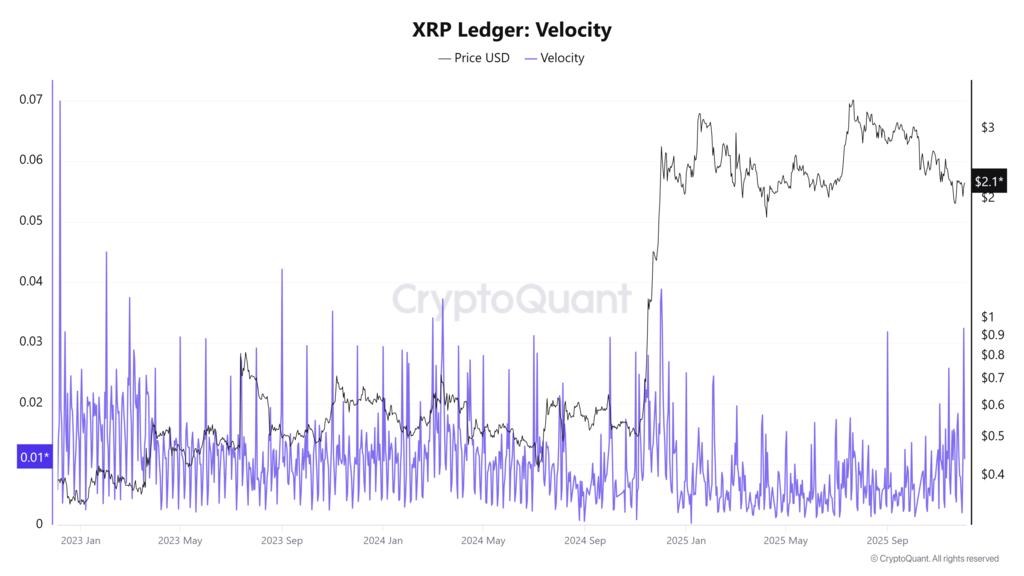
Late 2025 brings a clear change for XRP. After several weeks of muted network activity and weak sentiment among retail traders, on-chain data show a strong rebound in XRP velocity, the indicator that tracks how frequently tokens move between wallets in a given period. In early December, the metric touches a yearly high and signals a brief but intense increase in on-chain economic activity and transaction volume.
The jump in on-chain velocity points to more transfers and faster rotation of coins between market participants. Activity does not come only from small holders. Data point to an active role for XRP whales, which once again move large volumes after months dominated by selling pressure from big addresses and absorption by retail buyers.
In parallel, open interest in XRP derivatives recovers from recent lows near $1.23 billion and climbs to around $1.39 billion. The move suggests more open positions in futures and perpetual contracts, as traders return to XRP for leveraged exposure and hedging strategies.
For most of 2025, XRP trades inside a narrow band. Price now sits close to $2.17, a level the market already knows well, with frequent rebounds above $2 after each downturn. The pair holds firm, although many retail traders still hold bags from higher entries and face long periods of sideways action with unrealized losses.
Under that surface, the spike in on-chain velocity breaks the previous pattern. Ripple’s ledger velocity reaches a high for the year and moves in line with fresh signals of whale re-accumulation. Flows between wallets show inflows toward large addresses, which suggests fresh buying at relatively low levels inside the current range.
Several factors help explain renewed whale interest in XRP:
Changes in XRP velocity do not only reflect internal reshuffling. On-chain history usually links sharp spikes in activity with phases where the market injects liquidity, opens fresh positions and searches for volatility. In the current phase, the key difference lies in timing: the signal appears after a long stretch of weak sentiment and heavy supply from big holders.
The rebound in open interest from $1.23 billion to around $1.39 billion complements the rise in on-chain metrics. A higher notional value in contracts implies more capital at risk in XRP derivatives. The data set does not reveal a clear long or short bias, although it confirms that XRP once again attracts futures traders in size.
At the same time, price action remains tight around $2.17. Each drop below $2 quickly meets buyers that push XRP back over that level. Current conditions mix three elements:
Such a setup usually prepares the ground for a new volatility phase, even if direction remains open. In that context, whale positioning on-chain and the pace of large transfers often carry more weight than short-term retail flows.
Trading does not fully explain the change in demand for XRP. New products also help shape network usage. Firelight launches a liquid staking platform for XRP, which allows holders to lock their tokens and receive a derivative asset (stXRP) that preserves liquidity for other operations in DeFi.
Firelight converts $FXRP, wrapped through @FlareNetworks’ trust-minimized FAssets bridge, into productive security.
Users deposit into a single launch vault for $stXRP and Firelight Points. $stXRP is fully fungible and usable across DEXs, lending, and yield markets on Flare. pic.twitter.com/6cSTaPdA2D
— Firelight (@Firelightfi) November 21, 2025
The arrival of XRP liquid staking creates several additional use cases:
Risk, however, rises along with potential yield. Use of stXRP in decentralized platforms usually exposes users to liquidation risk. Sharp price drops in XRP, liquidity stress or design flaws in protocols may erase the entire collateral position. Holders assume not only the volatility of the base asset, but also the possibility of smart contract failures and aggressive liquidation cascades.
From a regulatory angle, Ripple continues to build presence in Asia. The firm secures a payment service license in Singapore, a key financial hub where authorities work on clear rules for digital assets and payment solutions.
The license strengthens the case for XRP as a settlement asset in remittance corridors and cross-border flows in the region, although the market still measures the real impact on aggregate demand for the token.
The full picture looks different from the pattern that dominated previous months:
Market participants now track whether on-chain activity remains elevated or fades back to prior levels.
Crypto Economy analysts also watch the trend in open interest, flows into and out of stXRP across DeFi, and the ability of XRP to hold price levels above $2 without generating new pockets of trapped liquidity for late buyers.