TL;DR:
The blockchain investigator ZachXBT published a series of posts on X accusing Broox Bauer, a senior business development employee at onchain trading platform Axiom Exchange, of having abused internal tools to track private user wallets and execute trades using privileged information. The investigation was commissioned to ZachXBT by a source that was not publicly identified.
According to the investigator, Bauer used Axiom’s internal dashboards to access sensitive user data, including wallet addresses, transaction histories and linked accounts. In audio recordings included in the thread, a person identified as Bauer claims to be able to track “any Axiom user” via referral code, wallet address or UID, and describes having started with queries of between 10 and 20 wallets before gradually scaling up “so it doesn’t look suspicious”.
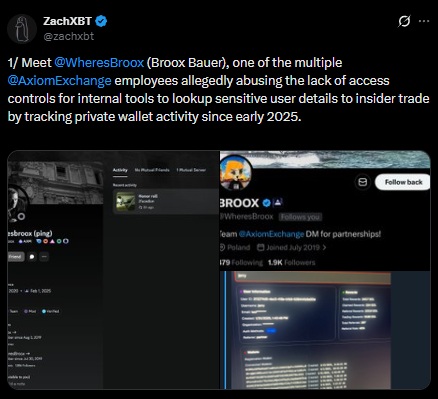
ZachXBT states that Bauer shared screenshots of Axiom’s internal panel in April and August 2025, containing data from private wallets linked to specific traders. He also notes that the group compiled a Google Sheet with wallet addresses of multiple key opinion leaders (KOLs) in the sector, obtained through that privileged access. Several of the mentioned KOLs independently confirmed the accuracy of the data attributed to them.
Axiom, founded in 2024 by developers known as Mist and Cal and a member of Y Combinator’s Winter 2025 program, has accumulated over $390 million in revenue since its launch. In response to the accusations, the company declared being “surprised and disappointed” by the misuse of customer support tools and announced that it removed the involved access privileges. The platform committed to conducting an internal investigation and promised to hold those responsible accountable.

ZachXBT identified the primary wallet attributed to Bauer and mapped related addresses whose funds flowed into accounts at centralized exchanges. He clarified, however, that without access to Axiom’s internal records it is difficult to establish with high certainty specific cases of insider trading based exclusively on onchain data. Additionally, he noted that there was “little to no monitoring or access controls” to prevent that type of abuse, regardless of whether company leadership had any knowledge of the events. The case could fall under the jurisdiction of the U.S. Attorney’s Office for the Southern District of New York if criminal conduct is determined to exist.