In recent months, we’ve witnessed an explosion of interest in “computer use” capabilities powered by generative AI. Companies like Anthropic, OpenAI, and various startups are racing to develop systems where AI agents can interact with computers just like humans do.
The typical approach? Multimodal vision models that take screenshots, analyze on-screen options, decide on actions, and execute code snippets to perform tasks.
The accuracy hovers around 70% — impressive, but far from perfect. We’ve also seen the rise of “AI browsers,” where agents navigate web interfaces autonomously based on user instructions.
But here’s the question that keeps me up at night: Is this really the most efficient way forward?
Think about every application you’ve ever installed on your laptop or desktop.
At their core, these apps are just interfaces — beautiful or utilitarian front-ends that communicate with your computer’s hardware: camera, microphone, speakers, keyboard, file systems, and processing logic.
Most applications are paid because development costs are astronomical. Even “free” apps carry hidden costs in development time, maintenance, and distribution.
What if I told you we don’t need to install any applications?
What if your operating system could generate fully functional apps on-demand, instantly, based on your needs?
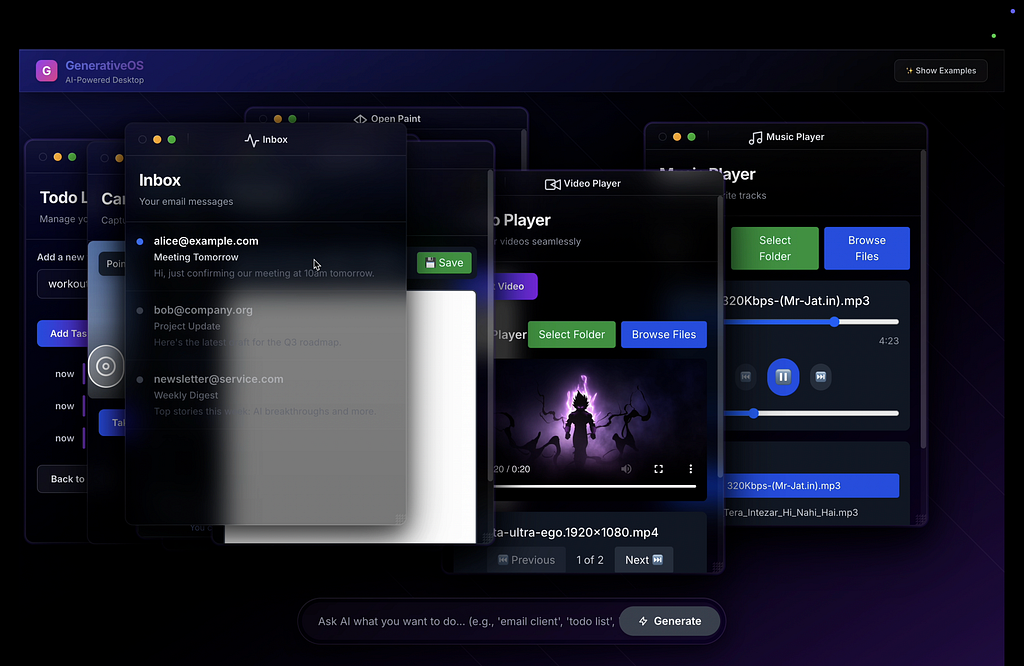
Welcome to GenerativeOS — a paradigm shift where applications are created dynamically by AI.
Want to use your camera? Just say it.
The OS generates a camera interface instantly, captures photos, and saves them to your file system.
Need a photo gallery? Say “show my photos” — the OS creates a browsing interface in a window.
Close it, and the interface disappears.
No permanent installation. No bloat.
The apps are as simple or complex as you want.
Need a calculator? Generated.
Todo lists? Generated.
Video player to view local files? Generated.
This isn’t just about convenience — it’s about fundamentally rethinking how we interact with computers.
At its heart, GenerativeOS uses AI to transform natural language requests into structured application schemas.
User Input → AI Model → AppSchema (JSON) → Dynamic Renderer → Functional App
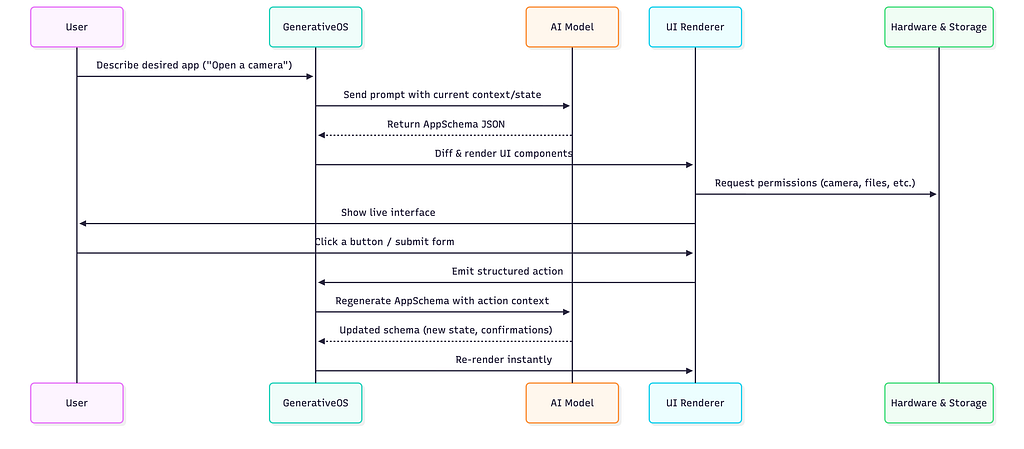
Every button, tab, or gesture in the generated window triggers this loop.
The OS feeds the current app state, stored data, and user action back to the model — ensuring each regeneration feels coherent and stateful.

Every generated app becomes a window inside the OS — a container that adapts to any app type.
Whether it’s a local tool or a web interface, the presentation layer is generated on-the-fly.
For web experiences, GenerativeOS can create custom interfaces by fetching API data from authorized domains.
Imagine shopping sites sending product data and your OS rendering it in a personalized interface.
No more generic browsers — just dynamic, purpose-built experiences.
This is the lazy-loading of interfaces.
Nothing exists until you need it. Nothing lingers once you close it.
I’ve built a functional prototype that demonstrates this vision.
The MVP runs in modern browsers and showcases how generative apps can be born instantly.
The MVP proves that generative apps can be just as functional as traditional ones — but infinitely more flexible.
FactorTraditional AppsGenerativeOSPre-development CostHigh (months)Low (AI trained once)Per-App CostHighNear-zeroMaintenanceOngoingMinimalDistributionMediumNoneUser StorageHighNone
MetricTraditional AppsGenerativeOSCPU UtilizationHighLowMemory UsageHighLowStorage BloatHighNoneUpdate OverheadMediumNone
Just like Netflix shifted from downloading to streaming, GenerativeOS shifts from installing to generating.
This approach extends to the internet itself.
Instead of rigid websites, we could have dynamic feeds rendered as custom interfaces.
GenerativeOS can also run entirely locally, ensuring privacy and open-source transparency.
No API calls. Just local AI shaping your digital world.
GenerativeOS isn’t just another AI feature — it’s a paradigm shift.
Instead of pre-built apps, we get adaptive, generative interfaces that form in real time.
The current AI browsers simulate interaction.
GenerativeOS creates interaction.
The MVP proves it’s possible — not a concept, but working tech today.
Welcome to the era of Generative Operating Systems — the OS that builds itself. 🚀
GenerativeOS is an open-source project available on GitHub. Try the demo, explore the code, and join us in building the future of computing.
Explore the full codebase on GitHub → Gen-os
GenOS: The Future of Operating Systems with Generative Apps. was originally published in Coinmonks on Medium, where people are continuing the conversation by highlighting and responding to this story.





