Token incentives can help a DePIN network solve the cold-start problem. A DePIN project needs contributors before the product is fully useful. Wireless networks need coverage before customers rely on them. Storage networks need capacity before buyers trust them. Compute networks need providers before developers can deploy. Mapping networks need enough routes before the map becomes commercially valuable.
Tokens can pull that early supply into the system, but rewards alone do not prove that a business exists. They can create participation, hardware deployment, and community attention. They can also mask weak demand. A network that pays contributors through emissions without growing customer revenue is not monetizing infrastructure. It is subsidizing supply and hoping demand catches up.
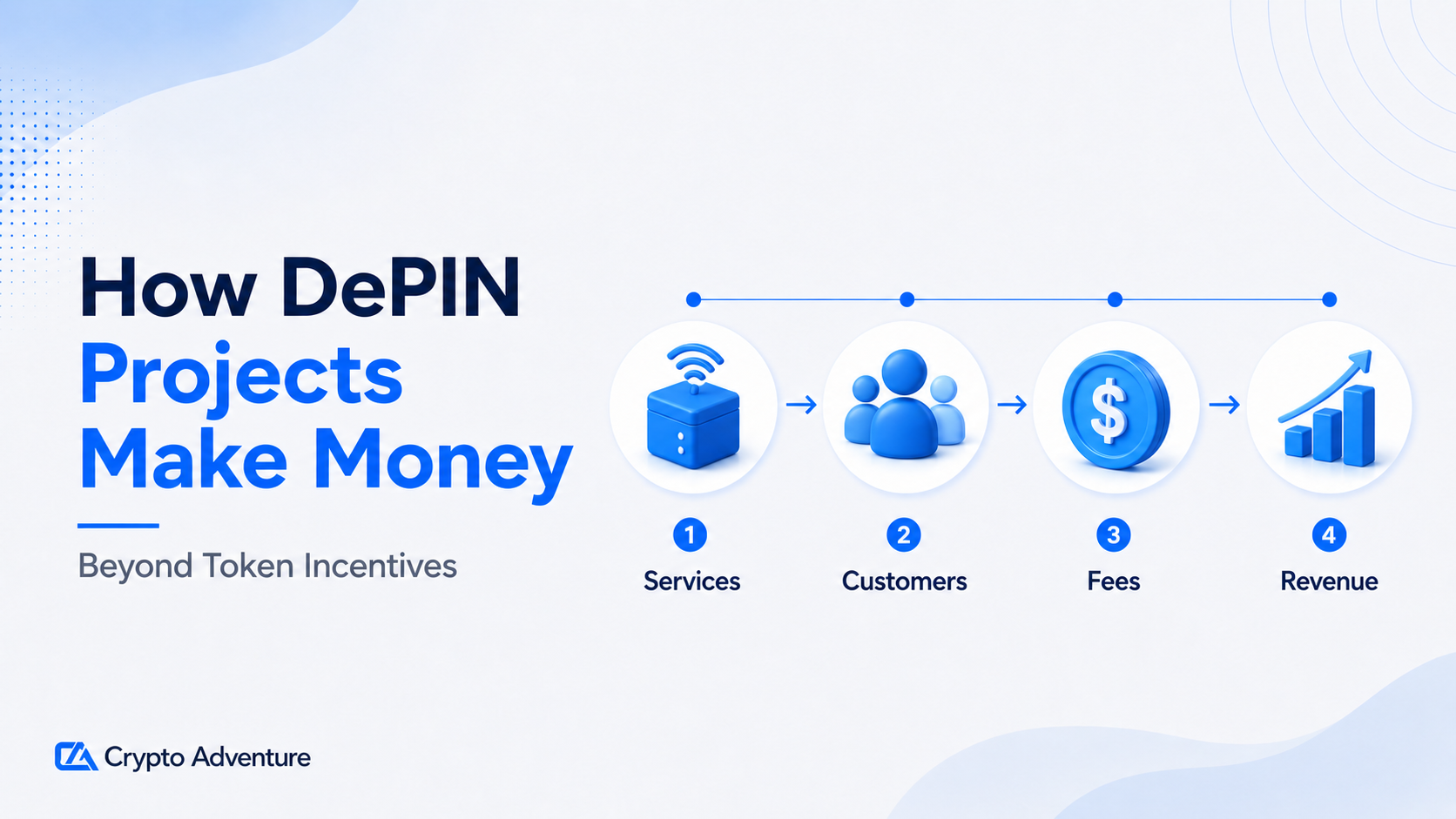
The stronger DePIN model is different. Tokens bootstrap the network, then real users pay for the service. That payment may flow through credits, burns, marketplace fees, subscriptions, data access, enterprise contracts, or protocol-level usage charges. The project becomes more credible when revenue moves from speculative incentives toward repeatable demand.
The cleanest DePIN revenue comes from customers paying to use the network. In wireless, that can mean paying for data transfer. In storage, it can mean paying for capacity and retrieval. In compute, it can mean paying for GPU time, rendering, container deployments, or AI workloads. In mapping, it can mean paying for map images, APIs, data layers, or fresh road intelligence.
Usage fees are powerful because they reveal demand. A customer paying for the output has a different meaning from an operator earning emissions. The customer is buying a service. If the service is cheaper, broader, faster, fresher, or more flexible than alternatives, revenue can continue even after reward programs decline.
Helium offers a clear example through Data Credits, which are used for network usage across the IoT and Mobile subnetworks. HNT remains central to the wider token economy, but the customer-facing unit is designed around usage. That distinction matters because infrastructure customers usually need predictable service pricing more than token exposure.
Some DePIN networks use burn-and-mint mechanics to connect usage with token economics. In these systems, customers or applications pay for credits, tokens are burned or converted, and contributors receive emissions or re-minted rewards based on network rules. The goal is to link service consumption with the asset that coordinates supply.
Helium’s HNT model uses Data Credits produced by burning HNT. Render Network uses a Burn Mint Equilibrium design to connect GPU service usage with contributor rewards and pricing. Hivemapper ties map data consumption to Map Credits created through HONEY burns, with part of that activity flowing back into contributor rewards.
These models are more sophisticated than simple token payments because they try to balance service pricing, contributor compensation, and token value capture. They are not automatically sustainable. The model still depends on enough real usage, disciplined emissions, fair reward rules, and a service people want to buy repeatedly.
Many DePIN systems resemble marketplaces. Providers bring supply. Users bring demand. The network coordinates matching, pricing, reputation, payments, and settlement. A marketplace can monetize through take rates, protocol fees, transaction fees, deployment fees, service fees, or premium access.
Akash is a useful example because it frames decentralized compute as an open marketplace where providers compete to supply compute and GPU resources. The economic opportunity is not only token rewards for providers. It is the matching layer between buyers that need infrastructure and sellers that can provide it.
A DePIN marketplace has to be careful with fees. If fees are too high, buyers may return to centralized alternatives. If fees are too low, the network may struggle to fund operations, development, security, support, and ecosystem growth. The right fee model depends on the service margin, switching cost, buyer urgency, and how differentiated the decentralized supply really is.
Some DePIN projects monetize by turning physical contribution into data products. Mapping networks, sensor networks, mobility networks, weather networks, energy networks, and device networks can all generate datasets that buyers may value. The business model is no longer only “rent infrastructure.” It becomes “sell data produced by distributed infrastructure.”
This model can be attractive because data can compound. A single contribution may have value once, but a continuously refreshed dataset can become more useful over time. Hivemapper fits this pattern because contributors build and refresh map data that can be consumed through map products and APIs.
The risk is data quality. Buyers care about accuracy, freshness, coverage, standardization, and integration. A token reward can attract contributors, but it cannot guarantee that the dataset is commercially useful. Successful data-focused DePIN projects need strong verification, clear customer segments, and product packaging that makes the data easy to buy.
Some DePIN projects may make money through enterprise service layers around the open network. That can include dashboards, analytics, support, integration work, compliance tooling, managed deployments, service-level wrappers, and custom data packages. The protocol may coordinate open participation, while a company or foundation-adjacent business sells software and services around it.
This split is important. Protocol revenue, token value accrual, and company revenue are not always the same thing. A company may earn from SaaS or enterprise contracts while the token captures little value. A token may capture usage burns while the company relies on grants or treasury funding. A network may look commercially active while the economic link to token holders remains weak.
Serious DePIN analysis should separate these layers. Who receives customer payments? Does the protocol collect fees? Does the token burn, stake, meter access, secure work, or govern usage? Does the operating company have its own revenue stream outside the token economy? These questions matter more than broad claims about adoption.
Some DePIN projects also touch hardware economics. A network may sell devices, certify hardware, finance installations, earn distribution margins, or partner with manufacturers. This can create real revenue, but it can also create misleading incentives.
Hardware sales may prove interest, but they do not prove network demand. A project can sell devices to contributors chasing rewards even if customers are not yet paying for the service. That creates a risk path where hardware revenue looks strong in the early phase, while the protocol’s long-term demand remains uncertain.
The healthiest hardware model connects devices to useful customer demand. A hotspot, sensor, dashcam, GPU node, or energy device should be valuable because it helps the network sell a service, not merely because it qualifies the buyer for token rewards.
The difference between usage revenue and incentive rewards mirrors the wider distinction between real yield and incentive yield. Real yield comes from users paying for a product. Incentive yield comes from emissions, points, or subsidies. DePIN often blends both, especially during early growth.
That blend can be healthy if incentives build supply that later earns from demand. It becomes dangerous if emissions remain the main economic engine. Operators may earn attractive rewards for a while, but the system becomes fragile when token prices fall, emissions decline, or hardware costs rise.
The same caution applies to token structure. Tokenomics research should focus on emissions, unlocks, sinks, fee flows, burns, demand, treasury control, and whether the network can survive after speculative attention fades.
High-quality DePIN revenue has several traits. It comes from users who need the service, repeats over time, grows with useful supply, and does not depend entirely on token price. It also connects clearly to the protocol, the token, or the company in a way that can be understood.
Weak revenue signals are easier to spot. Hardware sales without service demand, emissions presented as income, vague enterprise interest, points systems with unclear conversion, and token burns without meaningful customer usage should all be treated carefully. A DePIN project can have exciting infrastructure and still have poor value capture.
The strongest question is simple: would anyone pay for the service if token incentives were much lower? If the answer is yes, the project may have a business. If the answer is no, the token may be funding activity that has not yet become demand.
DePIN projects make money beyond token incentives when customers pay for the service the network produces. That can happen through usage credits, burn-and-mint systems, marketplace fees, API access, data products, enterprise services, hardware-related revenue, or protocol fees.
Token rewards are useful when they help build the early supply side of the network. They become dangerous when they replace real demand. The best DePIN projects use incentives as a bridge toward usage revenue, not as a permanent substitute for a business model.
A credible DePIN economy should make the flow of value easy to follow: who contributes supply, who pays for demand, what the token does, what the protocol captures, and whether customer revenue can support the network after the subsidy phase fades.
The post How DePIN Projects Make Money Beyond Token Incentives appeared first on Crypto Adventure.





