Tokenization makes an asset easier to represent, transfer, and settle on blockchain rails. It does not automatically create buyers. This is the most important liquidity lesson in real-world asset crypto.
A tokenized private credit loan can still be hard to sell. A tokenized real estate interest can still have few buyers. A tokenized fund share can still require redemption windows. A tokenized Treasury product can be easier to exit, but only if the issuer, custodian, market makers, and secondary markets support that exit.
Liquidity is not only a technical feature. It is market structure. It depends on demand, pricing, eligible buyers, legal transfer rules, redemption mechanics, settlement timing, market makers, and trust in the underlying asset.
Liquidity means a holder can convert an asset into cash or another useful asset quickly, with limited price impact, low friction, and predictable settlement. In crypto, users often expect liquidity through AMMs, order books, aggregators, and 24/7 transfers. In real-world assets, liquidity often depends on business days, legal documents, investor eligibility, fund administrators, asset managers, and redemption rules.
This mismatch creates the central problem. A token can move at blockchain speed, but the asset behind it may move at traditional finance speed. If the underlying asset is a short-term Treasury bill, the mismatch may be manageable. If the asset is private credit, real estate, or a locked fund interest, the mismatch can be much harder.
Many RWA tokens cannot be freely sold to everyone. They may be restricted to qualified investors, whitelisted wallets, specific jurisdictions, KYC-approved users, or institutions. Those restrictions can protect compliance, but they also shrink the buyer pool.
A normal crypto token can trade globally if a DEX has liquidity and users are willing to buy. A tokenized fund or private credit token may require transfer-agent approval, identity checks, investor classification, or issuer permission. The token may be technically transferable but legally restricted.
That smaller buyer pool directly affects liquidity. If only a narrow group can buy, spreads can widen and exits can slow. RWA projects need to balance compliance with market depth. Too little compliance creates legal risk. Too much restriction can kill secondary-market activity.
RWA holders can exit through secondary trading or redemption. These are different paths. Secondary trading means selling the token to another buyer. Redemption means returning the token to the issuer, fund, or platform in exchange for cash or the underlying settlement asset.
Redemption is often more important than trading for RWAs. A thin secondary market can still work if redemptions are reliable. A liquid-looking market can break if redemption rules are unclear.
Users should check redemption windows, notice periods, minimum sizes, fees, gates, settlement currency, KYC requirements, and whether the issuer can delay or suspend exits. A tokenized private credit product with quarterly redemptions should not be compared to a 24/7 stablecoin pool.
Different RWAs have different natural liquidity.
Tokenized Treasuries are usually easier because the underlying assets are liquid and standardized. Treasury bills and money market funds can often support smoother settlement than private loans or property interests.
Private credit is harder. Loans may be bespoke, borrowers may be private, collateral may be difficult to value, and exits may depend on repayment schedules or refinancing.
Real estate is even slower. Property sales can take months, valuations can lag, and legal transfers depend on local rules.
Commodities sit somewhere in the middle. Tokenized gold can be more liquid when custody, redemption, and vault reporting are strong. More specialized commodities can face storage, insurance, and logistics constraints.
The token wrapper cannot erase the natural liquidity of the asset underneath it.
Market makers are essential for RWA liquidity. They provide bids and offers, absorb short-term imbalances, tighten spreads, and help users enter or exit without extreme price impact.
RWA market making is harder than ordinary token market making. A market maker needs confidence in the issuer, redemption path, asset value, settlement timing, transfer rules, and compliance requirements. If redemption is slow or uncertain, market makers will demand wider spreads or avoid the asset entirely.
This is why high-quality tokenized assets still need professional liquidity infrastructure. A token contract and a dashboard are not enough. The market needs buyers, sellers, pricing data, redemption clarity, and capital willing to intermediate trades.
Liquidity depends on pricing. A tokenized Treasury product can reference observable Treasury and money market pricing. Private credit, real estate, and some funds are harder because pricing may depend on appraisals, NAV updates, borrower reports, or manager calculations.
If pricing is stale, buyers demand a discount. If NAV is unclear, sellers may not know what fair value means. If the underlying asset has not traded recently, the token can become difficult to price.
The RWA.xyz data model captures fields such as yield, supply, holders, transfers, custody, ratings, issuer details, and credit metrics because liquidity needs more than token balances. Serious RWA markets need reliable metadata and valuation data.
DeFi composability can improve liquidity by making RWA tokens usable as collateral, liquidity pool assets, or treasury management tools. If a tokenized Treasury can be accepted in lending markets, used in structured products, or routed through aggregators, demand can grow.
Composability can also create risk. If a token with weak redemption becomes collateral across several protocols, one liquidity problem can spread. If NAV data lags, collateral values can be wrong. If transfer restrictions block liquidations, lending markets can fail under stress.
RWA liquidity needs conservative integration. DeFi protocols should understand transfer rules, redemption mechanics, oracle design, and market depth before accepting a token as collateral.
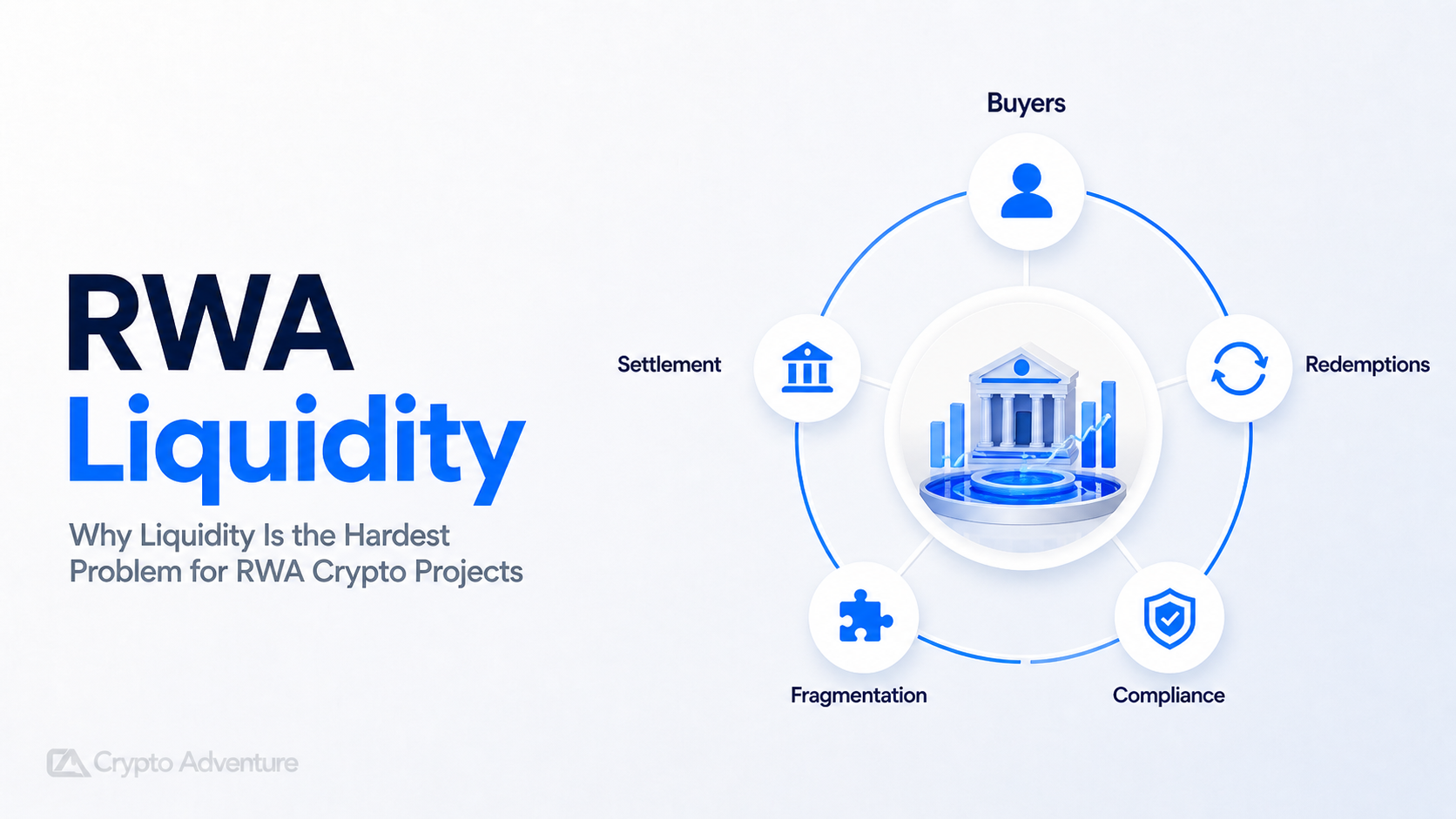
RWA liquidity usually fails for one of five reasons.
These failures can appear during normal markets, but they become more serious during stress. When many holders want to exit at once, the difference between token transferability and real liquidity becomes obvious.
Good RWA liquidity starts with clear redemption. Holders should know how to exit, when they can exit, what it costs, and what currency they receive.
It also needs eligible buyers. A compliant but empty market is not liquid. Projects need distribution, investor onboarding, transfer-agent processes, and market-maker support.
Pricing should be credible. NAV, yield, collateral, reserves, asset reports, and pricing methodology should be easy to understand. The more opaque the asset, the larger the discount buyers will demand.
Finally, DeFi integrations should be conservative. A token should not become broad collateral until its redemption, transfer, oracle, and market-depth risks are understood.
Users should start with the exit path. Can the token be redeemed, sold, or only held until a future asset event? If redemption exists, how often does it happen and what can delay it?
Next, users should check trading depth. A token listed on a DEX is not necessarily liquid. The important details are pool size, daily volume, spreads, slippage, market-maker presence, and whether the buyer pool is permissioned.
Then comes asset type. A tokenized Treasury product should have a different liquidity expectation than tokenized real estate or private credit. Higher yield often comes with slower exits.
Finally, users should check stress behavior. A product that works when deposits are rising may behave differently when redemptions rise, market makers step back, or the underlying asset becomes harder to price.
Liquidity is the hardest problem for RWA crypto projects because tokenization improves transfer mechanics, not underlying market depth. A token can settle quickly while the asset behind it remains slow, restricted, hard to price, or difficult to redeem.
The strongest RWA projects will not only tokenize assets. They will build real liquidity through clear redemption rules, credible pricing, broad eligible buyer access, strong market makers, conservative DeFi integrations, and transparent asset reporting. Until then, users should treat every RWA token as a financial claim with its own exit risk, not as a liquid crypto asset simply because it exists on-chain.
The post Why Liquidity Is The Hardest Problem For RWA Crypto Projects appeared first on Crypto Adventure.





