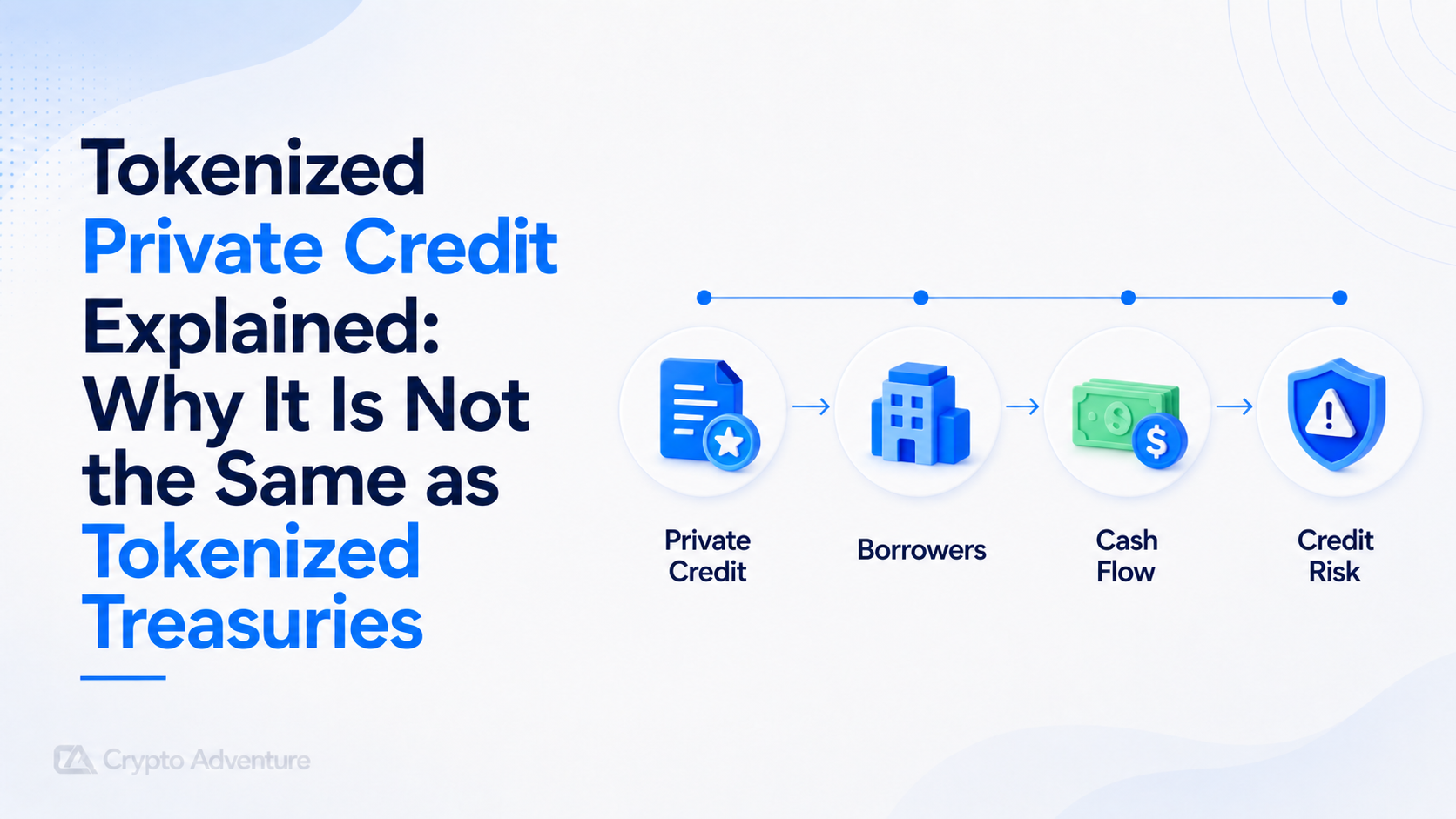
Tokenized private credit brings private debt exposure onto blockchain rails. The underlying asset is usually a loan, credit facility, receivable, asset-backed financing arrangement, or private lending pool. The token represents access to the economic exposure or fund structure tied to that credit product.
The category sits inside the broader real-world asset market, but it behaves differently from tokenized government debt. For example, RWA.xyz’s tokenized credit dashboard tracks non-sovereign debt, including private credit, onchain lending, corporate credit, structured credit, and specialty credit. That is a much wider risk universe than short-dated U.S. Treasury bills or Treasury-focused money market funds.
Private credit is about borrower risk, collateral quality, underwriting, legal claims, covenants, servicing, defaults, recoveries, and cash-flow timing. Tokenization can make the asset easier to distribute and monitor, but it does not remove the credit work.
Tokenized Treasuries are blockchain-based representations of U.S. government debt exposure. They may hold Treasury bills, notes, bonds, Treasury ETFs, or Treasury-focused money market funds inside a legal wrapper. The token gives eligible holders access to that underlying exposure.
RWA.xyz tracks products built around U.S. government debt, including market caps, APY, holders, issuers, managers, custodians, domicile, and regulatory framework. These products are often treated as the lower-risk end of tokenized finance because the underlying exposure is tied to government debt rather than private borrowers.
That does not make tokenized Treasuries risk-free. They still carry wrapper risk, custody risk, issuer risk, smart contract risk, redemption terms, fund fees, and eligibility restrictions. The key difference is the underlying asset. A Treasury product depends mainly on government debt exposure and fund operations. A private credit product depends on borrower repayment.
Tokenized private credit and tokenized Treasuries both use blockchain rails, but they do not price the same risk. A tokenized Treasury product usually starts with liquid government debt. A private credit product starts with loans that may be less liquid, more bespoke, and harder to value.
That changes everything. Treasuries usually have clearer market pricing and deeper secondary markets. Private credit often relies on loan-level underwriting, payment schedules, collateral monitoring, servicer performance, and default management.
A token can make ownership easier to transfer, but it cannot turn an illiquid loan into a risk-free cash instrument. If the borrower misses payments, the blockchain record will not create cash flow by itself. Recovery still depends on legal claims, collateral enforcement, servicing, and the structure behind the token.
Private credit usually offers higher yield because it takes more risk. Borrowers may be private companies, fintech lenders, real estate vehicles, trade-finance businesses, or structured credit pools. The yield compensates investors for credit risk, liquidity risk, complexity, and weaker access to public-market pricing.
Tokenized Treasuries usually offer lower yield because the underlying assets are more liquid and backed by U.S. government debt exposure. Their yield mostly follows Treasury market conditions, fund expenses, and platform fees.
The mistake is comparing APYs without comparing risk. A private credit token with a higher yield is not automatically better than a Treasury token. It may simply be taking borrower risk that a Treasury product does not take.
Tokenized Treasuries can be easier to redeem because the underlying assets are generally more liquid. Treasury bills and Treasury money market funds can be sold or rolled more predictably than bespoke private loans.
Private credit liquidity is structurally harder. Many private loans do not trade every day. Some are locked into monthly, quarterly, or event-based redemption schedules. RWA.xyz’s allocation vault research highlights the mismatch between traditional private credit terms and onchain markets, where private credit funds may have monthly subscriptions and quarterly redemptions while DeFi users expect faster liquidity.
That mismatch is the core user risk. A token may be transferable, but redemption still depends on the underlying fund terms. If many users want out at once, the asset manager may need to follow gates, queues, notice periods, or delayed redemption mechanics.
Tokenization improves transparency, but not equally across asset classes. Treasury products can usually disclose the type of debt, fund manager, custodian, yield, domicile, and market value more easily because the underlying assets are standardized.
Private credit needs deeper reporting. Investors need borrower exposure, collateral type, loan maturity, default status, seniority, servicer quality, concentration, payment history, and recovery assumptions. Platforms such as Centrifuge and Maple show how tokenized credit infrastructure can bring asset management, lending, compliance, and reporting onto blockchain rails, but the credit risk remains inside the underlying loans.
The strongest private credit products are not only tokenized. They are well-underwritten, clearly reported, properly serviced, and legally enforceable.
Redemption risk is where many users misread tokenized private credit. A token balance can update instantly, but the underlying credit cash flows may not.
Treasury products can often support smoother redemptions because the underlying market is more liquid. Private credit funds may need borrower repayments, loan sales, reserve liquidity, new subscriptions, or scheduled redemption windows to meet exits.
This is why the redemption section of any tokenized private credit product matters more than the headline APY. Users should look for notice periods, lockups, gates, withdrawal queues, fund reserves, default handling, and whether secondary transfers are allowed.
Tokenized Treasuries carry interest rate risk, issuer-wrapper risk, custodian risk, regulatory risk, and operational risk. Private credit adds borrower default risk.
That borrower risk is the main difference. A private borrower can miss payments, breach covenants, refinance late, enter restructuring, or default. Collateral can lose value. Recoveries can take months or years. Servicers can underperform.
A tokenized private credit product should therefore be reviewed like a credit fund, not like a stablecoin or Treasury bill. The right questions are about underwriting, collateral, borrower concentration, duration, seniority, legal enforceability, and recovery procedures.
Tokenized private credit fits investors who understand credit risk and want higher-yield exposure through onchain access. It can be useful for institutions, funds, sophisticated allocators, and users who can evaluate risk reports.
It is less suitable for users who only want cash-like yield, instant exit, or Treasury-style safety. Higher APY can look attractive, but the real test is how the product behaves when defaults rise, liquidity tightens, or redemptions increase.
Tokenized Treasuries fit users who want more conservative RWA exposure. They still need due diligence, but the underlying risk is closer to government debt and fund operations than private borrower performance.
Tokenized private credit is not the same as tokenized Treasuries. Both use blockchain rails, but they expose users to different assets, liquidity terms, yield drivers, and risk engines.
Tokenized Treasuries are usually built around liquid government debt exposure. Tokenized private credit depends on borrower repayment, collateral quality, servicing, legal enforcement, and redemption design. The higher yield can be attractive, but it is compensation for more complexity. Users should compare credit products by underwriting, liquidity, redemption terms, borrower risk, and reporting quality before treating any private credit token like a Treasury substitute.
The post Tokenized Private Credit: Why It Is Not The Same As Tokenized Treasuries appeared first on Crypto Adventure.





