A few years back, our security lead printed out both audit checklists side by side just to prove a point to the rest of us. Same access review questions. Same incident response walkthrough, word for word in some places. Same vendor risk section. Two different auditors, two different PDFs, two different invoices for what was basically the same conversation twice a year.
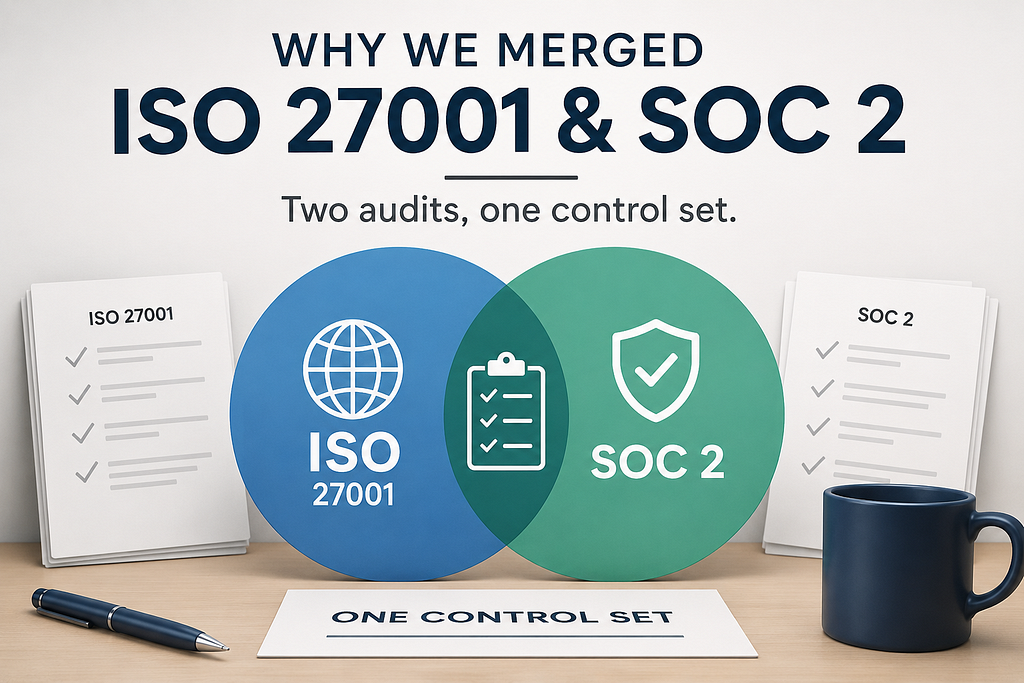
Nobody had ever actually sat down and asked if that was necessary. It wasn’t. Once you look closely, ISO 27001 and SOC 2 aren’t really competing standards. They’re the same underlying idea wearing different clothes.
Both frameworks exist to answer one thing: can this company be trusted with sensitive data? They just approach it from different angles.
ISO 27001 is the international one, a certification built around a full Information Security Management System, heavy on documentation, and the one European or APAC clients tend to ask for by name. SOC 2 isn’t technically a certification at all. It’s an attestation, built on the AICPA’s Trust Services Criteria, and it’s the one you’ll hear about constantly if you sell SaaS to U.S. companies.
Strip away the labels, though, and the controls underneath overlap more than most teams realize access control, encryption, incident response, onboarding and offboarding, vendor due diligence. Different numbering systems. Basically the same requirements.
This isn’t about favoring one framework and letting the other one slide. It’s building one control environment that happens to satisfy both auditors without extra translation work.
Here’s roughly what that looked like for us:
Small stuff individually. Adds up fast.
This is honestly the whole reason platforms like Vanta, Drata, Secureframe, and Sprinto took off. Configure a control once, and the platform maps it across ISO 27001, SOC 2, sometimes HIPAA and GDPR too, without you touching it again per framework.
The time savings are nice. What actually matters more is visibility when an offboarding ticket sits open three days too long, you see it’s a problem for both frameworks at once, not just whichever one an auditor happens to be looking at that quarter.
Nothing dramatic happens overnight. But over a couple of cycles, teams that do this properly tend to see:
Here’s the part I’d push back on if someone tells you to just collapse the two frameworks entirely. Don’t. ISO 27001 wants a documented ISMS, formal management review cycles, a Statement of Applicability, none of which SOC 2 asks for. And SOC 2 is scoped to a specific window, usually six to twelve months for a Type II report, while ISO certification is more of a snapshot with annual surveillance visits.
Merge the shared 80%. Fine. Keep the other 20% clearly labeled as framework-specific and don’t let anyone tell you it’s redundant just because it’s annoying.
Already certified in one and chasing the other? Skip the part where you rebuild everything from scratch.
Compliance was never supposed to be a twice-a-year performance for two different audiences. Merge the frameworks properly, and it stops being theater, it just becomes part of how the company runs.
Why We Finally Merged Our ISO 27001 and SOC 2 Programs was originally published in Coinmonks on Medium, where people are continuing the conversation by highlighting and responding to this story.





