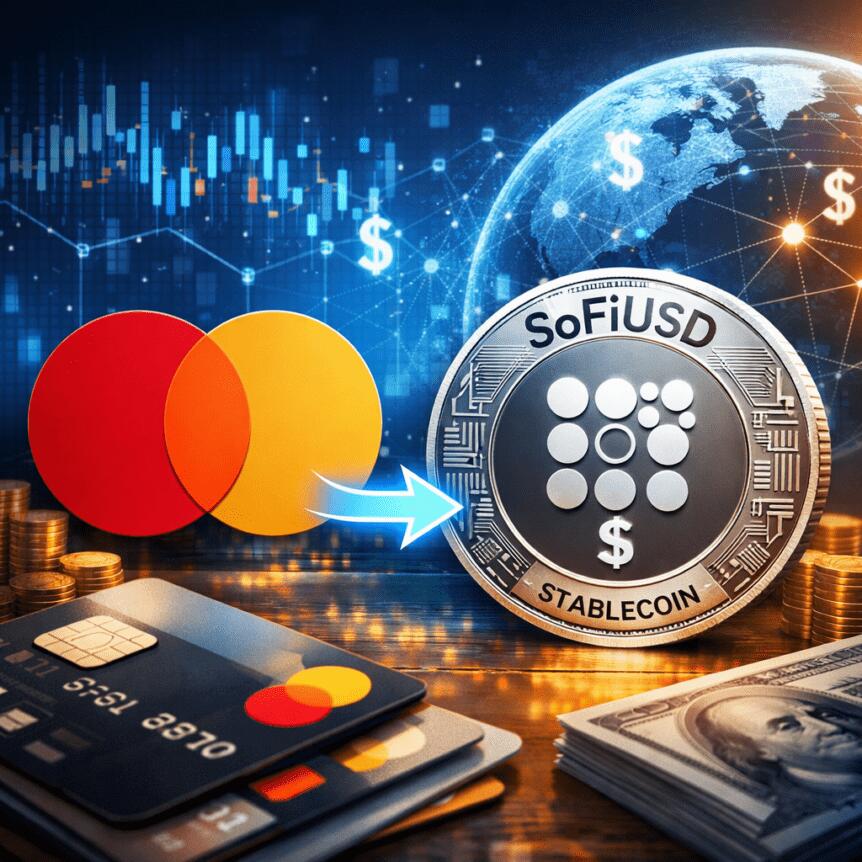
Two financial technology powerhouses are accelerating the integration of tokenized money into everyday payments. SoFi Technologies and Mastercard unveiled a partnership that will allow settlement of Mastercard card transactions using SoFiUSD, the dollar-backed stablecoin issued by SoFi Bank N.A. Across Mastercard’s global network, so-called stablecoin settlement could run around the clock, enabling 24/7 processing. In practical terms, SoFi Bank will settle its own Mastercard credit and debit transactions in SoFiUSD, while SoFi’s Galileo payments platform will give issuer banks and card programs the option to use the stablecoin for settlement across Mastercard’s network—the second-largest processor in the world. SoFiUSD, which launched in December, is issued by an OCC-regulated insured depository institution and is backed 1:1 by cash reserves. The move signals a deeper push by major rails to incorporate bank-issued digital dollars into everyday financial activity, expanding the reach of tokenized money beyond niche crypto use cases.
The announcement clarifies that the SoFiUSD settlement capability is designed to operate on a public, permissionless blockchain, underscoring the growing interplay between traditional banking infrastructure and programmable digital currencies. Mastercard’s Multi-Token Network is expected to support the stablecoin alongside fiat currencies, tokenized deposits, and other digital assets, enabling seamless, near real-time settlement across a broad base of merchants and cardholders. In addition to the technical integration, the parties indicated they will explore further use cases that could amplify efficiency and liquidity, including cross-border remittances, business-to-business transfers, programmable treasury applications, and stablecoin-enabled card programs—though these initiatives will be subject to applicable regulatory requirements and Mastercard network rules.
The collaboration arrives as Mastercard has been tightening its focus on stablecoins and tokenized payments. Earlier in the year, the payments giant partnered with Thunes to bring stablecoin payouts to the mainstream via Mastercard Move, enabling near real-time transfers to regulated stablecoin wallets through Thunes’ Direct Global Network. The broader context is reinforced by parallel activities from Visa, which has been expanding stablecoin settlement and payout infrastructure across its network. In September, Visa began testing a stablecoin-based cross-border settlement pilot that used Circle’s USDC ((CRYPTO: USDC)) and another token, EURC, to pre-fund international transfers, a capability that Visa subsequently broadened to support four stablecoins across four blockchains and more than 25 fiat currencies. A separate Visa Direct pilot in November has started enabling businesses to send funds directly to recipients’ stablecoin wallets, so freelancers and marketplaces can receive USD-backed tokens instead of traditional bank transfers. And Europe-based Quantoz Payments recently joined as a Visa principal member, enabling it to issue Visa-branded debit cards backed by regulated e-money tokens and to support stablecoin-linked products regionally.
Tickers mentioned: $USDC, $EURC
Sentiment: Neutral
Price impact: Neutral. The news centers on settlement infrastructure and utilization of a bank-issued stablecoin, with no immediate price guidance given.
Trading idea (Not Financial Advice): Hold. The development underscores ongoing infrastructure improvements rather than a near-term price catalyst for mentioned assets or networks.
Market context: The move sits within a broader trend of traditional payments networks embracing tokenized digital cash, as stablecoins and bank-issued digital dollars become more embedded in everyday settlement, remittance, and payout flows. Regulatory clarity and network rules will shape how quickly and widely these capabilities roll out across banks and merchants. The momentum from Mastercard and Visa complements industry data showing growing stablecoin usage in both retail and enterprise contexts, while total stablecoin market activity continues to scale alongside mainstream financial rails.
The SoFi-Mastercard settlement arrangement underscores a practical transition from purely fiat settlement to tokenized digital dollars within established card networks. For card issuers and merchant acquirers, this reduces settlement latency and potentially lowers liquidity costs, especially for cross-border transactions that traditionally require multiple intermediaries. By enabling 24/7 settlement on Mastercard’s rails, SoFiUSD could improve cash flow matching for partners and suppliers and broaden the use of their own stablecoin beyond consumer wallets and crypto exchanges.
From a regulatory perspective, the use of a bank-issued stablecoin on a public blockchain adds a familiar governance layer: an OCC-regulated issuer with cash-backed reserves, combined with a trusted payments network. The collaboration also reinforces the role of banks as the backbone of tokenized money: even as blockchain-native settlement grows, the need for regulated, insured custody and robust compliance remains a central requirement for large institutions. In this sense, the partnership serves as a proof of concept that banks can participate in tokenized settlement without ceding control of risk management to decentralized finance-native models.
For fintech ecosystems, the initiative expands the potential for programmable treasury operations—allowing corporate treasuries and fintech platforms to automate liquidity moves, optimize working capital, and route funds with greater precision. That, in turn, could spur new product configurations, such as stablecoin-enabled card programs or cross-border remittance corridors, that leverage existing consumer banking infrastructure while leveraging the speed of digital dollars. The broader landscape—where Visa and Mastercard actively push stablecoin payouts and cross-border settlement—suggests a more interconnected payments environment where digital dollars move with the same confidence and traceability as traditional currencies.
What makes this development noteworthy is the explicit bridging of a bank-issued stablecoin to a major card network’s settlement rails. If banks can settle card transactions in stablecoins with the same certainty and risk controls as fiat settlements, the path to broader tokenized money adoption becomes more tangible for mainstream merchants and large issuers. The architecture—cash-backed, bank-issued stablecoins moving on permissioned and public networks—offers a balance between regulatory oversight and the efficiency gains associated with tokenized payments.
At the same time, the pace and scope of these pilots will hinge on regulatory clarity and network governance. While 24/7 settlement promises improved liquidity management, financial institutions will scrutinize contingency plans, risk controls, and consumer protections as stablecoins become more deeply integrated into everyday spending. The collaboration also signals a broader strategic play by Visa and Mastercard to reshape settlement and payout flows—particularly across borders and in enterprise contexts—where the speed of liquidity delivery can translate into meaningful cost savings and new business models.
This article was originally published as Mastercard Adds SoFiUSD as Settlement Option for Card Issuers on Crypto Breaking News – your trusted source for crypto news, Bitcoin news, and blockchain updates.





