

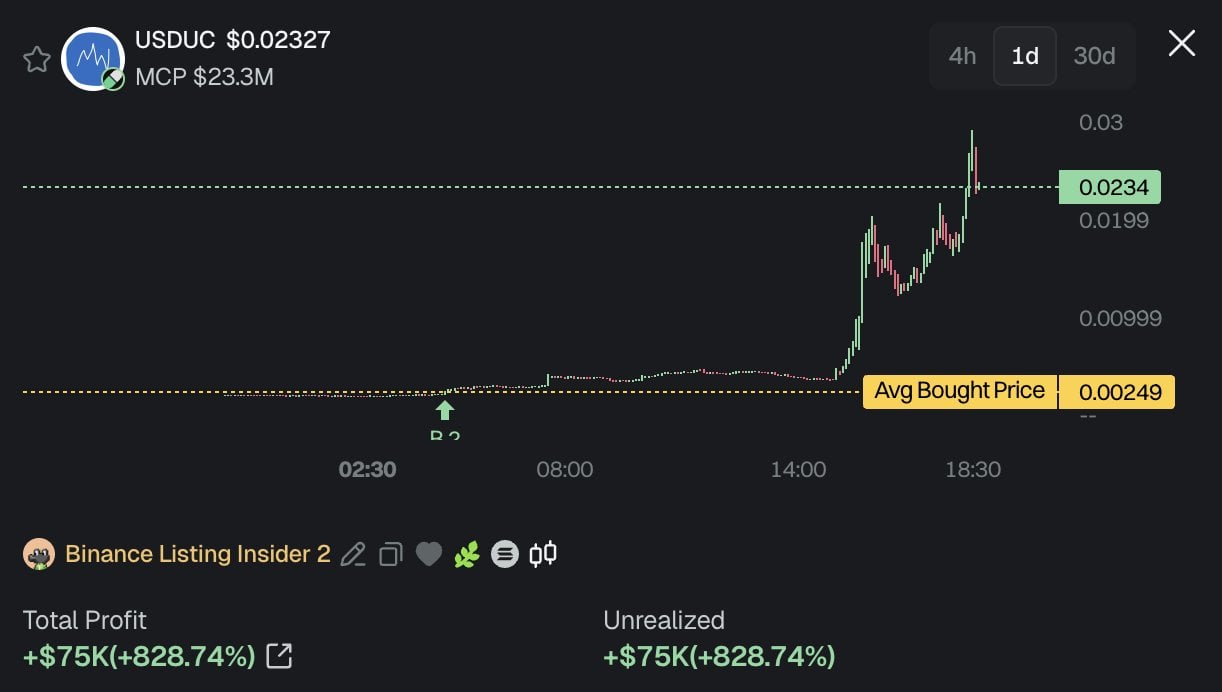
Two newly created Solana wallets allegedly made about $216,000 from USDUC after buying the token before its Binance.US trading window. Onchain tracker Dethective flagged the activity, identifying one wallet that bought 214 SOL worth of USDUC at 03:01 and another that bought 104 SOL worth of USDUC at 02:59.
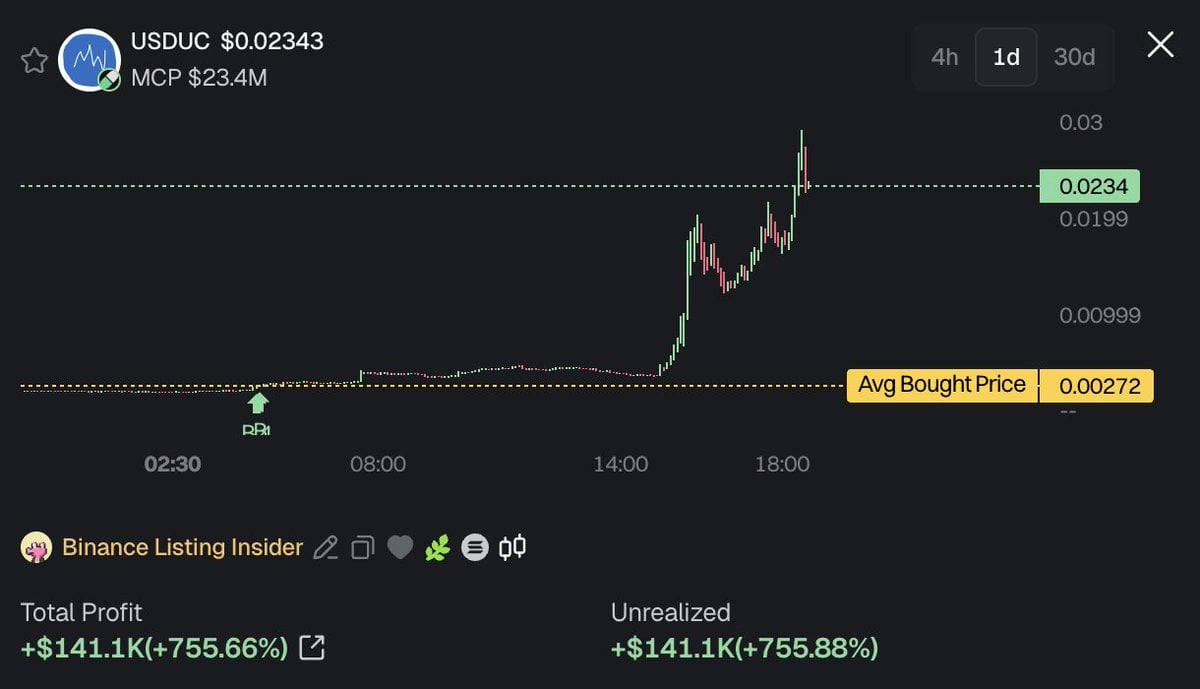
The tracker framed the trades as a perfect front-run of the Binance.US listing. The wording is sharp, but the public evidence should still be treated carefully. The timing looks unusual, especially because the wallets were newly created, but wallet activity alone does not prove insider access, exchange involvement, or leaked listing information.
Binance.US listed Unstable Coin (USDUC) with deposits open on the Solana network. USDUC/USDT trading is scheduled to begin on May 07 at 4 a.m. PDT / 7 a.m. EST. Binance.US describes USDUC as a satirical, community-driven memecoin built as a parody of traditional stablecoins, with volatility treated as part of the identity rather than something to avoid.
The claim sits in a sensitive part of crypto market structure. Centralized exchange listings can redirect attention and liquidity into tokens that were previously trading mostly through decentralized pools or smaller markets. In thin Solana memecoin pairs, early positioning can become highly profitable when a major exchange listing adds a new demand channel.
At the latest check, USDUC was trading near $0.024 on CoinGecko, up more than 1,000% over 24 hours, with a market capitalization around $24.5 million and daily volume above $25 million. DEX Screener showed the main Solana pair with roughly $1.1 million in liquidity and more than $11 million in 24-hour volume, underlining how fast token flows moved after the listing catalyst hit.
The term front-running is being used more loosely in this case. Classic onchain front-running usually involves seeing a pending transaction and getting ahead of it through ordering, fees, or MEV routing. This case is closer to alleged pre-announcement positioning, where the suspected edge would come from buying before a public exchange catalyst becomes widely known.
Solana meme coins have continued to react sharply when major exchanges add new markets. The same dynamic appeared when dogwifhat jumped after Upbit opened WIF trading in South Korea, giving the token direct access to one of the most active retail trading markets in crypto.
That listing effect explains why wallet timing now draws so much scrutiny. Traders and onchain analysts watch wallet age, funding paths, first buys, transaction size, sell timing, and links between wallets to decide whether a profitable trade looks like normal speculation or unusually precise positioning.
No public evidence currently ties the wallets to Binance.US, any employee, or any confirmed leak. A profitable trade before a listing can come from luck, aggressive speculation, social chatter, or private information, and those possibilities require different standards of proof.
The USDUC case still adds pressure around how listing information moves before it becomes public. Newly created wallets, concentrated pre-listing buys, and quick six-figure profits create an uncomfortable pattern for traders watching centralized exchange pipelines. For USDUC, the scrutiny now sits on the narrow gap between ordinary memecoin speculation and trades that looked unusually precise before a listing catalyst reached the wider market.
The post USDUC Listing Sparks $216K Wallet Profit Questions Before Binance.US Trading Starts appeared first on Crypto Adventure.





