Two ways to earn on your dollars onchain. One asks you to trust a company. The other asks you to verify.
There is one phrase older than almost any product in crypto. Not your keys, not your coins.
It sounds like a slogan. It is closer to a warning.
When you hold a stablecoin on an exchange and collect rewards, the balance on your screen is real.
What sits behind it is a promise. The company holds the keys. You hold a claim on the company.
Most of the time that claim pays out fine. Sometimes it does not. FTX, Celsius, and Mt. Gox turned that abstract risk into locked accounts and headlines, and the lesson keeps getting relearned.
A clear primer on the difference lives here.
Roughly 65% of global crypto transactions still flow through centralized platforms. So this is not a niche question. It is the default most people never stop to examine.
Stablecoins have gone mainstream. They settle payments, park treasury cash, and move across borders in seconds.
As they do, the question of custody stops being a hobbyist debate and becomes a plain money decision.
This piece looks at two ways to earn on dollars onchain. Coinbase’s USDC rewards, a custodial program.
And the Sky Savings Rate, a non-custodial way to put your stablecoins to work through sky.money.
The point is not to crown a winner on this month’s rate. It is to show what you are actually agreeing to in each case.
Not your keys, not your coins. It sounds like a slogan. It is closer to a warning.
Custodial rewards are easy to use. That is the whole appeal.
You hold USDC on the platform. The platform pays you a reward. Nothing to sign, no wallet to manage, no seed phrase to lose.
For a small balance you actively trade, that convenience is worth a lot.
But it helps to read how these programs are actually built:
How does the exchange pay you? Usually the same way a money market fund does.
Idle cash gets parked in short-term instruments, and a slice of the return comes back to you. It works.
But you are a step removed from all of it. You never see the assets, and you cannot move them without asking first.
Here is where it stops being abstract. In December 2025, Coinbase moved its USDC rewards behind a paywall. Non-subscribers stopped earning.
Only Coinbase One members, at $4.99 a month, kept the rate (DL News). The reward did not shrink for them. For everyone else, it simply vanished.
Then in July 2026, a service disruption briefly hit transfers, card transactions, and onchain services (Coinbase).
Coinbase’s own rewards terms state plainly that the program is funded by the company and can change.
Neither event is a scandal. Both are reminders. When one company controls the keys and the rules, the terms can change on a Friday. Convenience and control are not the same thing.
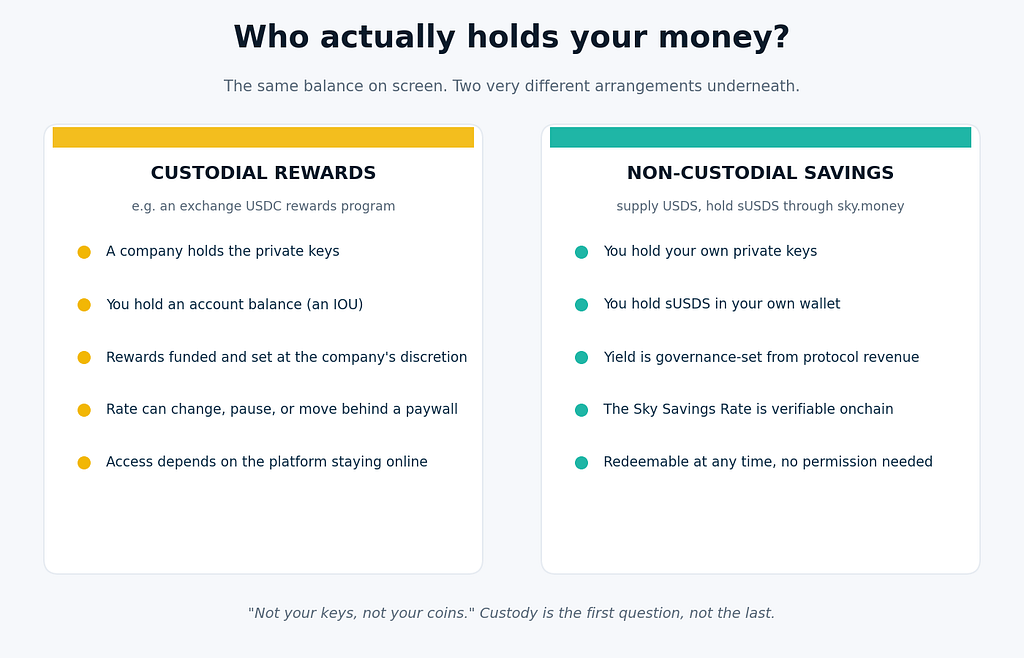
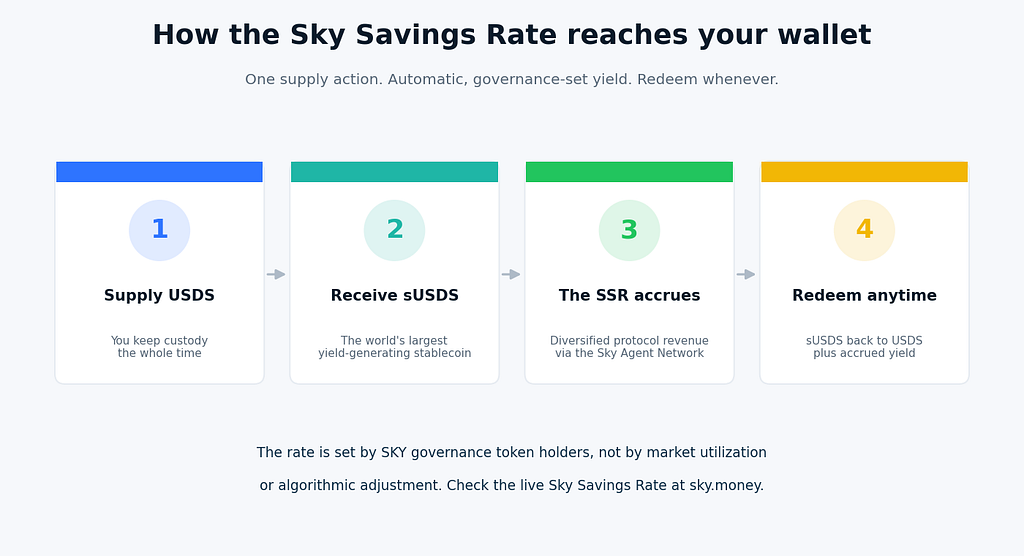
Now the other model. Through sky.money, you supply USDS and receive sUSDS. That sUSDS sits in your own wallet. You hold the keys the entire time. No platform stands between you and your balance.
sUSDS is the flagship. It is described as the world’s largest yield-generating stablecoin, and per Sky’s Q2 2026 report it is the largest rate-bearing stablecoin by supply.
Hold it, and it quietly accrues the Sky Savings Rate with instant liquidity and zero fees.
The mechanics stay clean:
No lockups. No minimum to unlock the rate. No subscription gate. The yield is not a favor a platform grants you. It is a governance-set rate you can read onchain.
Put it plainly. A custodial reward is an IOU that pays. sUSDS is a bearer asset that earns. The distinction stays quiet until the day it is not.
A custodial reward asks you to trust a company. Non-custodial savings ask you to verify a system.
A fair question follows fast. If nobody is subsidizing me, where does the yield come from? Not from a marketing budget. Not from a lending pool’s utilization swings.
The Sky Savings Rate is generated by the Sky Agent Network. Independent capital allocators borrow USDS liquidity and compete to deliver risk-adjusted returns.
They deploy across diversified strategies: fixed income, structured credit, onchain capital markets, and infrastructure financing. Returns flow back to Sky Protocol, and governance sets the rate.
Two details matter here.
There is a second-order benefit here. Because the rate comes from real protocol revenue rather than token emissions or leverage, its performance is structurally uncorrelated to speculation.
When markets get loud, the rate does not have to chase them.
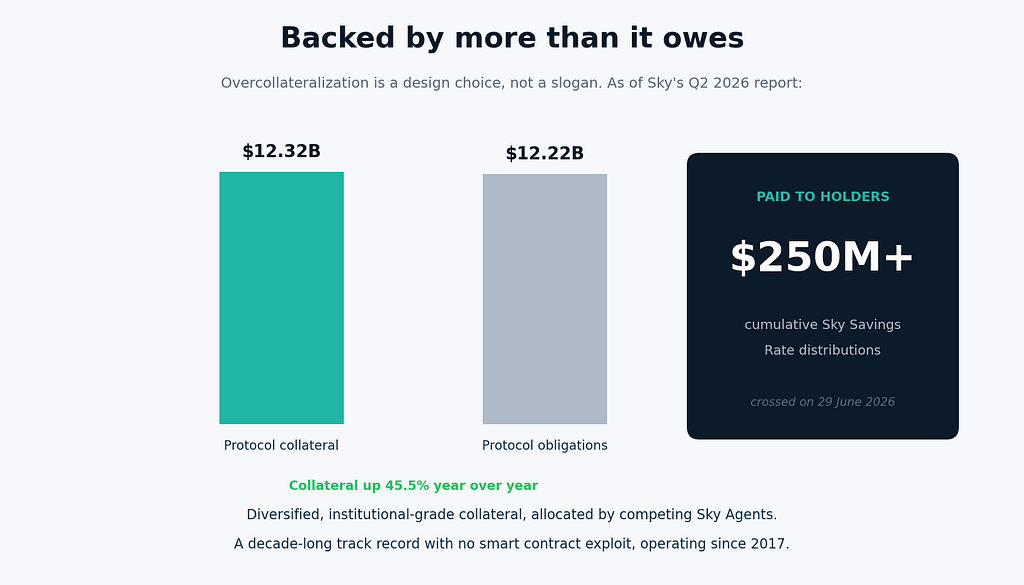
As of Sky’s Q2 2026 report, protocol collateral stood at $12.32 billion against $12.22 billion in obligations, up 45.5% year over year (Sky Q2 2026).
Some of it sits in institutional-grade allocations across managers the traditional world would recognize. That is what diversified, institutional-grade yield means in practice.
Not a phrase, but a structure you can inspect on DeFiLlama.
Numbers age. Track records compound.
The team behind Sky Protocol has operated continuously since 2017, through every market condition.
In Rune Christensen’s words, that is a decade-long track record with no smart contract exploit.
Add an S&P credit rating and a governance decision to build a $150 million solvency reserve, and the picture reads less like a new experiment and more like something built to be boring on purpose.
The recent figures back the story up:
This is a protocol that funds its yield from revenue it actually earns, not from incentives it hopes to sustain.
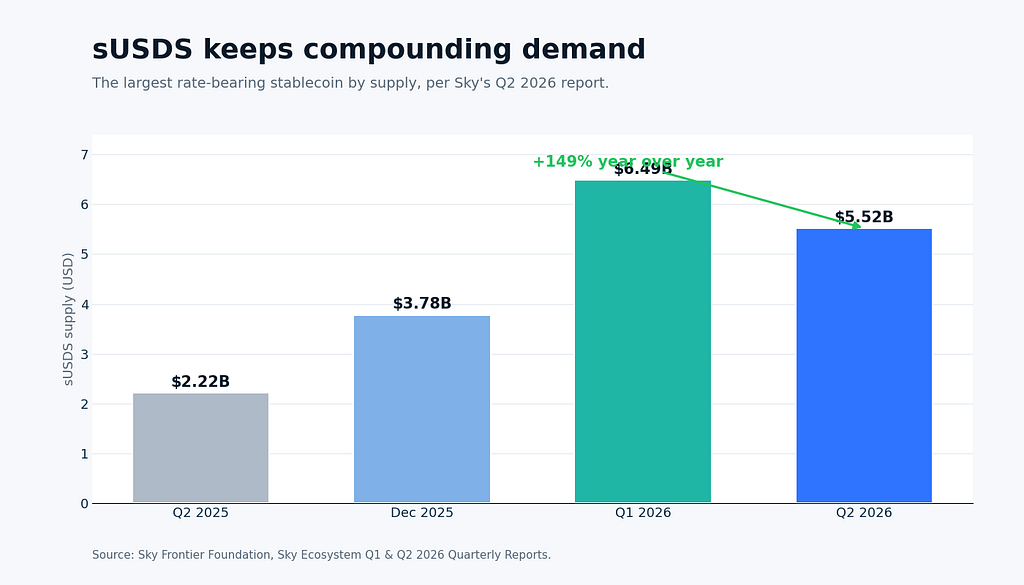
Neither model is better in the abstract. They answer different needs.
Custodial rewards make sense when:
Non-custodial savings through sky.money make sense when:
Plenty of people use both. An exchange to buy and move. A non-custodial position for the dollars they intend to keep.
One thing worth saying plainly. Non-custodial does not mean risk-free. Smart contracts, governance, and market conditions all carry risk.
sUSDS simply sits at the low end of that curve by design, not by promise, which is exactly why it is the baseline rather than the moonshot.
If you go the second route, sUSDS is the baseline: lowest risk, fully liquid, the flagship.
Higher on the risk curve, Sky Vaults (deployed on Morpho) and stUSDS exist for users who choose more risk for more reward, alongside SKY staking and ecosystem rewards.
The anchor never changes. Supply, hold, verify.
Stablecoins are not built to sit still. The real question is who holds them while they work.
A custodial reward is a company’s offer. It can be generous. It can also be paywalled, paused, or quietly repriced.
The Sky Savings Rate is a system’s output. It is governance-set, backed by diversified collateral, and readable onchain by anyone who cares to look.
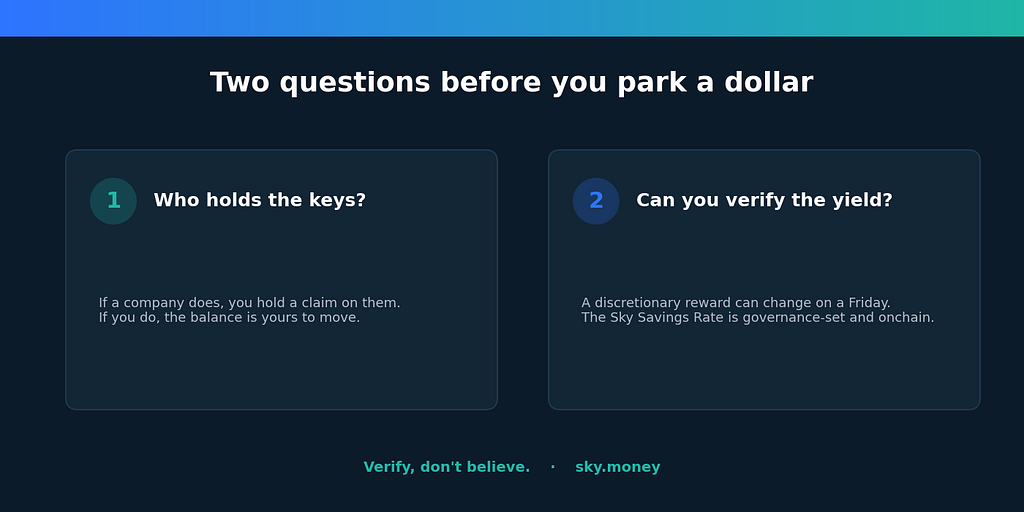
So before you park a dollar, ask two things. Who holds the keys? And can you verify the yield?
If those answers matter to you, the path is short. Supply USDS through sky.money, hold sUSDS, and check the live Sky Savings Rate yourself.
Verify, don’t believe.
Coinbase USDC vs Sky sUSDS: Custodial Rewards or Non-Custodial Savings? was originally published in Coinmonks on Medium, where people are continuing the conversation by highlighting and responding to this story.





