Quick note: this is editorial. I built positions in both strategies, ran the numbers against live protocol dashboards, and verified APYs at the time of writing. Yields move constantly, so check before you deploy. Some links in this article are referral links; if you sign up through them I may earn a small commission at no extra cost to you. None of this is investment advice.
For most of last year, my answer to “how do I get leveraged SOL exposure” was looping jitoSOL on Kamino. It worked. The yields were good. I told friends about it.
Then Drift got drained for $285M on April 1.
Drift wasn’t a smart contract bug. It was a multi-month social engineering attack against the protocol’s Security Council, a fake collateral token, and twelve minutes of irreversible withdrawals. About a dozen Solana protocols had downstream exposure. The hack didn’t directly touch Kamino, but it forced me to think harder about something I’d been waving away: when you loop on a lending protocol, you are betting on that protocol’s admin keys, oracle infrastructure, and governance hygiene staying clean. Not just its smart contracts.
So I did what I should have done sooner. I ran the numbers on jitoSOL looping versus xSOL, the no-liquidation leveraged token from Hylo. Both give you amplified SOL exposure. They get there completely differently.
Here’s the math.
You deposit jitoSOL on Kamino, borrow SOL against it, swap that SOL for more jitoSOL, deposit, borrow again, repeat. Kamino’s Multiply vault automates the loop in a single transaction. You pick a leverage target and the protocol handles the rest with flash loans.
The yield comes from the spread between two numbers:
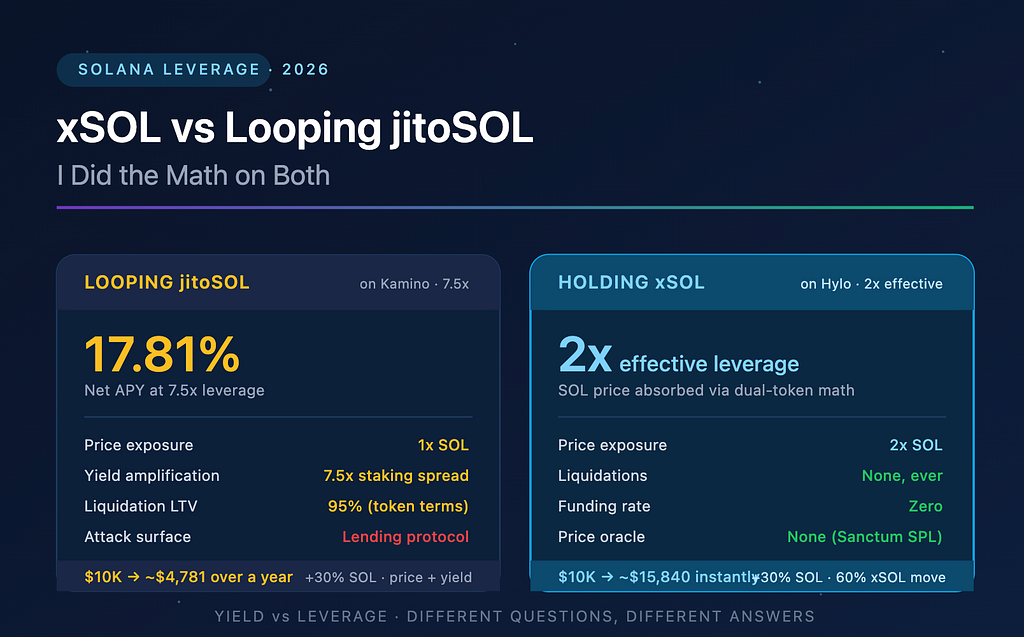
Multiply that spread by your leverage. At 5x leverage on the JitoSOL/SOL Multiply vault, you’ve historically earned around 14.49% net APY. At the new 7.5x cap, that climbs to roughly 17.81%. With eMode pushing LTV to 90%, you can theoretically loop up to 10x and earn approaching 27% in optimal conditions.
The catch sits in three places:
Liquidation risk is reduced but not gone. Kamino’s new LST oracle infrastructure prevents jitoSOL depegs from triggering liquidations. Worth quoting Kamino directly: a SOL Multiply position has never been liquidated on Kamino at 2x or 5x leverage. The remaining theoretical risk is sustained spikes in SOL borrow rates above the LST yield, where Kamino’s analysis suggests it would take 23+ days at 100% utilization to liquidate. The 95% liquidation LTV gives meaningful headroom.
You inherit Kamino’s operational security. Same risk class as Drift. Different protocol, different team, clean track record so far, but the structural shape is identical. Compromised admin keys, malicious governance, oracle exploits. Looping wraps your position inside a lending protocol, and you carry that protocol’s full attack surface.
Yield is borrow-rate dependent. When SOL borrow rates spike, your spread compresses. In quiet markets, you might earn 17%. When everyone wants to borrow SOL, that drops fast and can briefly invert. Each Multiply transaction also routes swaps through Jupiter, so larger positions absorb more cumulative slippage on entry and exit.
xSOL is a leveraged SOL token from Hylo. The mechanism is structurally different from looping in a way that takes a moment to wrap your head around.
Hylo runs a dual-token system. hyUSD is a stablecoin backed by Solana liquid staking tokens. xSOL is the leveraged side of that same collateral pool. The math underneath both is one equation: total LST collateral value equals hyUSD market cap plus xSOL market cap. When SOL goes up, the LST pool gains value, hyUSD stays at $1, and all the upside flows to xSOL. When SOL goes down, the reverse happens, and xSOL absorbs the loss.
Effective leverage falls out of that equation as Collateral TVL divided by xSOL market cap. Today it sits around 2x. It’s not fixed. It moves with protocol activity. As more hyUSD is minted relative to xSOL, leverage on xSOL goes up. As xSOL is minted, leverage comes down. The protocol’s risk management caps how high it can drift.
The features that matter:
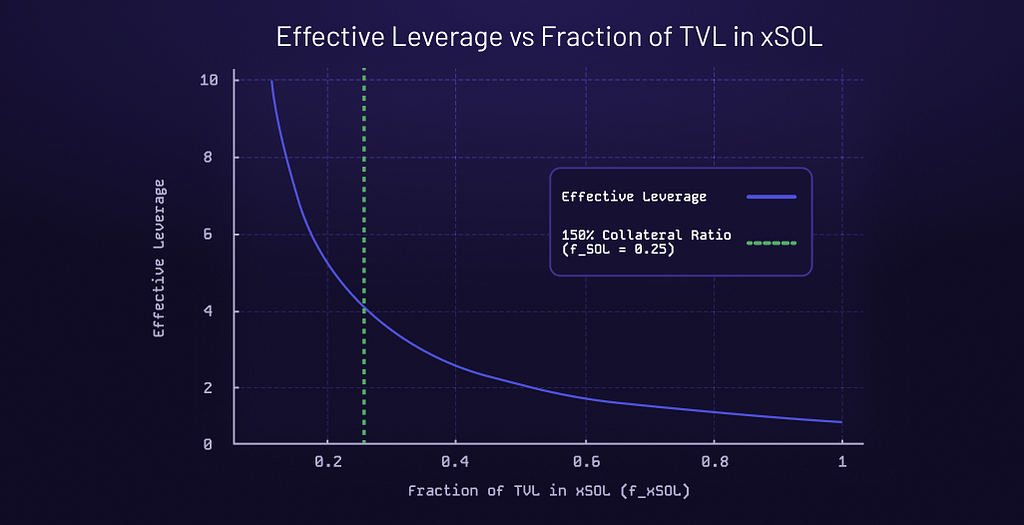
Hylo has two stability modes built in. Below 150% CR, fees adjust to incentivize behavior that strengthens the system. Below 130%, the stability pool activates and converts staked hyUSD into xSOL to defend the peg. This happened in Q1 2026 and the mechanism worked as designed.
The structural difference from looping is that you’re not borrowing anything. You hold a token whose price falls out of a closed-loop equation between the stablecoin and the leverage token. Mechanical leverage, not credit-based.
Let me work through both with concrete numbers. SOL at $150 for the example.
You deposit $10K of jitoSOL. The vault loops you to a 7.5x position, controlling roughly $75K of jitoSOL exposure backed by $65K of SOL debt.
You buy $10K of xSOL. After about 1% mint fee, you start with $9,900 of effective position controlling roughly $19,800 of SOL-equivalent exposure.
The math: looping gives 1x SOL price exposure plus amplified yield (~17.81% net APY at 7.5x). xSOL gives 2x SOL price exposure with no yield. On a 30% one-year SOL move, looping returns ~48%; xSOL returns ~60%. In a flat market, looping returns ~17.81%; xSOL returns 0%.
Three places, and they all matter more after the Drift hack than before.
Attack surface. Looping requires the lending protocol’s contracts, price oracles, admin keys, governance, and operational hygiene to all stay clean for as long as you hold. xSOL requires Hylo’s contracts, Sanctum’s stake pool integration, and the underlying LSTs to stay clean. Drift’s specific attack vector (whitelisting a fake token through compromised admin keys) doesn’t apply to Hylo — the protocol’s pricing math requires real staked SOL underneath any accepted collateral. Smart contract risk is real on both sides; OtterSec audited Hylo.
Cost in volatile markets. Looping yield is the spread between LST APY and SOL borrow rate. In quiet markets, fat. In volatile markets, compresses or inverts. xSOL has no funding rate, no borrow rate. Fees stay manageable in normal conditions, adjust only when the system needs to defend its peg.
Mental load. This sounds soft but it matters. With looping, you’re checking your LTV, watching utilization rates, monitoring whether borrow APY has spiked above your LST yield. With xSOL, you buy, you hold, you sell when you hit your target. There’s no position management because there’s no position to manage.
Two places, and they’re real.
Yield in good markets. If SOL chops sideways for a year, jitoSOL looping prints. You earn the spread regardless of price action. xSOL doesn’t pay you to hold it. xSOL is a directional bet; if you’re wrong about SOL going up, you don’t earn yield as a consolation.
Volatility decay risk. xSOL is path-dependent. In choppy sideways markets, dynamic rebalancing can erode value even if SOL ends where it started. Classic leveraged-token decay. Hylo acknowledges it openly. If SOL grinds sideways with high volatility, looping outperforms.
Both. Different positions, different sleeves of capital.
For the sleeve that wants stable yield through both up and down markets, jitoSOL looping on Kamino at moderate leverage (3x to 5x) still works. Yield is real, liquidation risk is materially lower than it used to be, and Kamino’s track record is clean.
For the sleeve that wants directional SOL exposure with structural certainty of no liquidation, xSOL is the cleaner instrument. The 2x effective leverage is meaningful, no funding rate means I don’t pay to hold through a chop, and the absence of admin-key-whitelisting risk got more attractive after Drift, not less.
If I had to pick one for a friend who’d never used either, I’d send them to xSOL first. Not because the yield is better (it usually isn’t) but because the cognitive load is lower. Buy, hold, sell. No LTV monitoring, no eMode, no borrow rate watching. Just price exposure with a known floor of behavior.
You can try Hylo with my referral link below. I get a small share of your XP if you do; you get a 5% boost on your own.
Pick by the question you’re actually trying to answer. “Earn yield on my SOL” and “long SOL with leverage” are different questions, and they have different right answers.
If this saved you some research, a clap on Medium helps it find other Solana DeFi traders. Got a different take? Drop it in the comments. I read every reply.
Editorial comparison, not financial advice. APYs and protocol parameters based on each protocol’s documentation and dashboards at time of writing. Verify before deploying capital. Leveraged products carry real risk including total loss. Some links above are referral links; if you sign up through them, I may earn a small commission at no extra cost to you. This does not influence the views above.
xSOL vs Looping jitoSOL: I Did the Math on Both was originally published in Coinmonks on Medium, where people are continuing the conversation by highlighting and responding to this story.





