Keir Starmer announced his resignation outside 10 Downing Street on June 22, 2026 — less than two years after leading Labour to a historic landslide. For traders, this isn't just politics: UK gilt yields already moved on Friday, and political instability of this scale has historically rattled GBP pairs and risk assets.
Here's what most reports aren't telling you — and what the next 72 hours could mean for your portfolio.
British Prime Minister Keir Starmer announced Monday that he will resign, paving the way for the country's seventh leader in a decade, after facing an internal uprising within his centre-left Labour Party.
In a televised statement outside Downing Street, Starmer said: "I will resign as leader of the Labour Party. I have spoken to His Majesty the King this morning to inform him of my decision."
He confirmed he would remain in the job as caretaker until a new Labour leader is chosen.
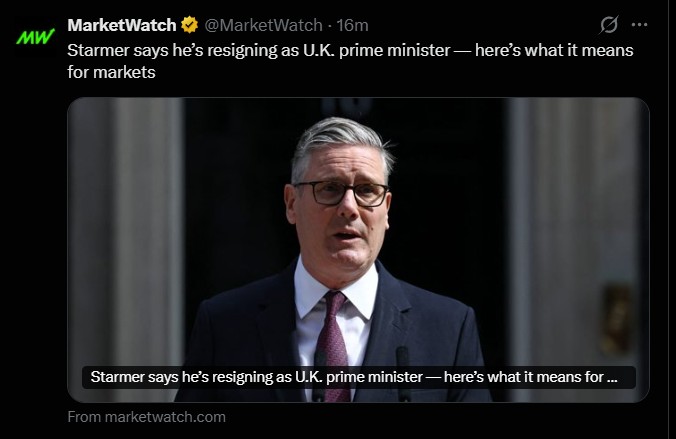
Source: MarketWatch X
The resignation did not come from a single event. It was the result of compounding political failures over nearly two years.
Many in the Labour Party had written to Starmer asking him to step down following local elections in May, which saw the party lose more than 1,000 seats on local councils — widely interpreted as a voter repudiation of Labour's performance.
He struggled to deliver promised economic growth, repair public services, and ease the cost of living, and faced repeated missteps, including appointing Peter Mandelson — a scandal-tarnished associate of Jeffrey Epstein — as UK ambassador to the United States.
Labour was simultaneously losing liberal voters to the Green Party and facing a rising Reform UK, the Nigel Farage-led anti-immigration party that consistently led in national opinion polls.
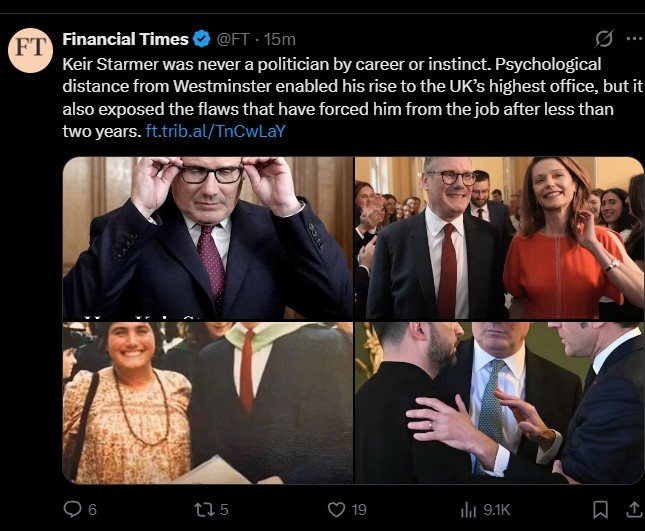
Source: X
A strange pattern has quietly shadowed British politics for years — every Prime Minister who resigned was photographed in a car shortly before their departure, often looking exhausted, distant, or unaware of what was coming.
Thatcher, Blair, Cameron, May, Johnson, Truss, Sunak — and now Starmer. A nighttime photo of a visibly tired Starmer surfaced on social media days before his announcement, sparking the familiar whispers.
Coincidence or pattern, the internet has already made its verdict. The car, it seems, never lies.
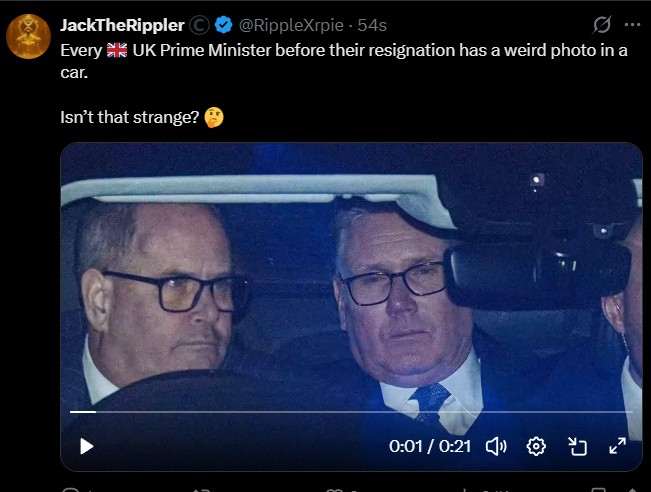
Source: X
The Burnham Factor: The By-Election That Broke Starmer
The announcement cleared a path to power for Starmer's likely successor, Andy Burnham, the popular ex-Mayor of Greater Manchester, who secured a return to Parliament last week by winning the Makerfield by-election decisively.
Burnham had planned to challenge Starmer and is widely seen as the best option to turn around the ruling party's fortunes.
In the Labour leadership contest now triggered, candidates need the backing of 20% of Labour MPs to qualify. If more than one clears that threshold, a vote goes to party members and supporters — but Burnham is the overwhelming favourite.
This isn't just a UK domestic story. Political transitions at the head of a G7 government move markets — and crypto is not immune.
UK gilt yields jumped on Friday following Burnham's by-election win, signalling that bond markets were already pricing in leadership change. Sterling volatility and gilt moves historically correlate with short-term risk-off positioning that can spill into BTC and ETH.
The Block noted that Starmer's resignation landed on the same day the Bank of England published draft stablecoin rules — doubling the regulatory significance of June 22 for UK crypto markets.
June 22, 2026: Starmer officially announces resignation; remains caretaker PM
Late June: Andy Burnham expected to formally enter Labour leadership race
By September: A new Labour leader and PM is expected before Parliament returns
Ongoing: Bank of England stablecoin draft rules open for consultation; watch for GBP/USD and UK gilt volatility as political uncertainty plays out
Traders should monitor GBP pairs, UK-listed crypto firms, and any BoE policy signals that may shift under a new government.
For context, Starmer's Labour Party won a landslide election victory in July 2024, delivering a historic majority in the House of Commons. Yet the political momentum collapsed within 18 months.
Since the 2016 Brexit vote, the UK has cycled through Cameron, May, Johnson, Truss, Sunak, Starmer — and now stands on the verge of a seventh Prime Minister. Before Brexit, the country had just three PMs across 20 years.
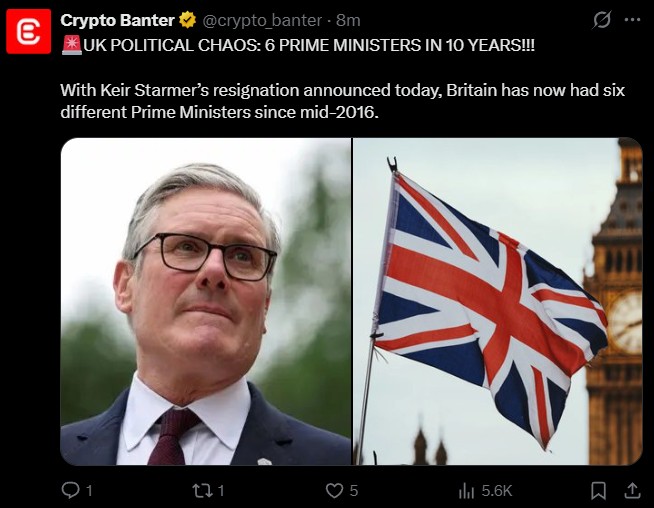
Source: CryptoBanter X
UK Prime Minister Keir Starmer's resignation on June 22, 2026, closes a turbulent chapter for British politics and opens a period of uncertainty that markets — including crypto — are already pricing in. Andy Burnham is the frontrunner, but a contested Labour leadership race before September could keep GBP volatile. For traders, the story isn't over — it's just beginning.
Disclaimer: This article is for informational purposes only and does not constitute financial or investment advice. Cryptocurrency investments carry significant risk. Always conduct your own research before making any investment decisions. CoinGabbar is not responsible for any financial losses incurred.





