
Weekend trading refers to market activity outside standard trading hours, mainly in cryptocurrencies and selected CFD instruments. While most traditional markets are closed, certain assets remain accessible, although trading conditions may differ from weekday sessions.
Liquidity is typically lower during weekends, which may result in wider spreads and higher volatility. In these conditions, short-term price movements are often influenced more by positioning and sentiment than by fundamental drivers.
This article explains how weekend trading works, which markets remain accessible, and how trading conditions differ from standard sessions.
Can you day trade on the weekends? Weekend trading is possible, but limited to specific markets. Cryptocurrencies operate continuously, while forex and equity markets remain closed from Friday to Sunday. Some brokers also offer restricted weekend CFD trading, primarily linked to crypto instruments.
Market conditions during weekends differ from standard sessions. Liquidity is typically lower due to reduced institutional participation, which often results in wider spreads and less consistent order execution.
Market data from major exchanges indicates that even cryptocurrency trading volumes typically decline during weekends, reflecting reduced participation compared to weekday sessions.
Price behaviour also changes in thinner markets. Reduced order book depth can lead to less efficient price action, where short-term moves are driven more by positioning and sentiment than by fundamental factors. As a result, false breakouts and abrupt price spikes may occur more frequently.
At the same time, lower participation can produce temporary range-bound conditions, particularly in major cryptocurrencies. In such environments, mean reversion strategies may become more relevant than trend-following approaches.
News flow is generally lighter over the weekend. However, digital assets remain sensitive to social media activity, regulatory headlines, and macro developments, which can still trigger sharp volatility.
For experienced market participants, weekend trading is less about capturing sustained trends and more about managing execution risk, liquidity constraints, and short-term inefficiencies.
Forex and equity markets follow structured trading schedules aligned with global financial centres and institutional participation. As a result, weekend stock trading is generally unavailable, as activity across banks, exchanges, and liquidity providers declines.
These closures allow financial institutions to perform operational processes, including system maintenance, clearing, and risk management. In addition, most economic data releases and corporate announcements are scheduled during standard weekday trading hours.
Major exchanges, such as the New York Stock Exchange and the London Stock Exchange, operate within defined regional business calendars. This means that the stock market weekend period remains inactive, with trading in equities and related instruments paused until markets reopen.
In the context of Wall Street weekend activity, trading desks are typically inactive, reflecting the broader closure of US financial markets. This contributes to reduced liquidity and limited price discovery in traditional asset classes during this period.
Cryptocurrency markets operate differently, as they are decentralised and do not rely on centralised exchange schedules. This allows continuous trading regardless of time zones or traditional market hours.
Market | Weekend Availability | Notes |
Cryptocurrencies | Open (24/7) | Continuous trading across global exchanges |
Forex | Closed | Reopens Sunday evening (approx. 22:00 GMT) |
Stocks | Closed (exchange trading) | Some brokers may offer limited CFD trading |
Indices | Closed (exchange trading) | Some brokers may offer limited CFD trading |
Commodities | Closed (exchange trading) | Some brokers may offer limited CFD trading |
Market | Trading Hours |
Cryptocurrencies | 24/7 |
Forex | Sunday 22:00 GMT – Friday 22:00 GMT |
Indices | Monday – Friday (exchange-specific hours) |
Commodities | Monday – Friday (exchange-specific hours) |
Stocks | Monday – Friday (exchange-specific hours) |
If you want to trade over 700 forex, stock, commodity, and index CFDs with tight spreads and low commissions (additional fees may apply), you can consider opening an FXOpen account.
Weekend trading, particularly in cryptocurrency, demands specific tools that are used to analyse lower liquidity and heightened volatility. Here are tools and resources that are used by traders when trading over weekends.
Market analysis platforms are used for monitoring real-time price changes, viewing historical data, and identifying trends. Platforms like FXOpen’s TickTrader offer advanced charting capabilities with indicators and drawing tools to analyse price patterns, used to track critical support and resistance levels even over weekends.
Sentiment analysis tools monitor public sentiment and news around assets, which can be especially useful in cryptocurrency markets where social media and news influence price moves. Tools like LunarCrush track mentions and sentiment for various crypto coins, allowing market participants to monitor sentiment shifts across digital assets.
Weekend trading can be volatile, making risk management tools important. Position-sizing calculators and volatility indicators are used to assess the optimal trade size and potential market risks. Tools like CryptoRank’s volatility tracker allow traders to stay informed on price fluctuations, used to monitor volatility conditions during lower liquidity periods.
FXOpen provides cryptocurrency CFD trading* with continuous access to real-time market data, a stable trading interface, and responsive customer support. This ensures that traders can execute trades smoothly and respond to any sudden market changes, even during off-peak hours.
Weekend trading is characterised by lower liquidity and more volatile price behaviour compared to standard trading sessions. In such conditions, strategies are typically applied with a focus on short-term price dynamics and execution constraints.
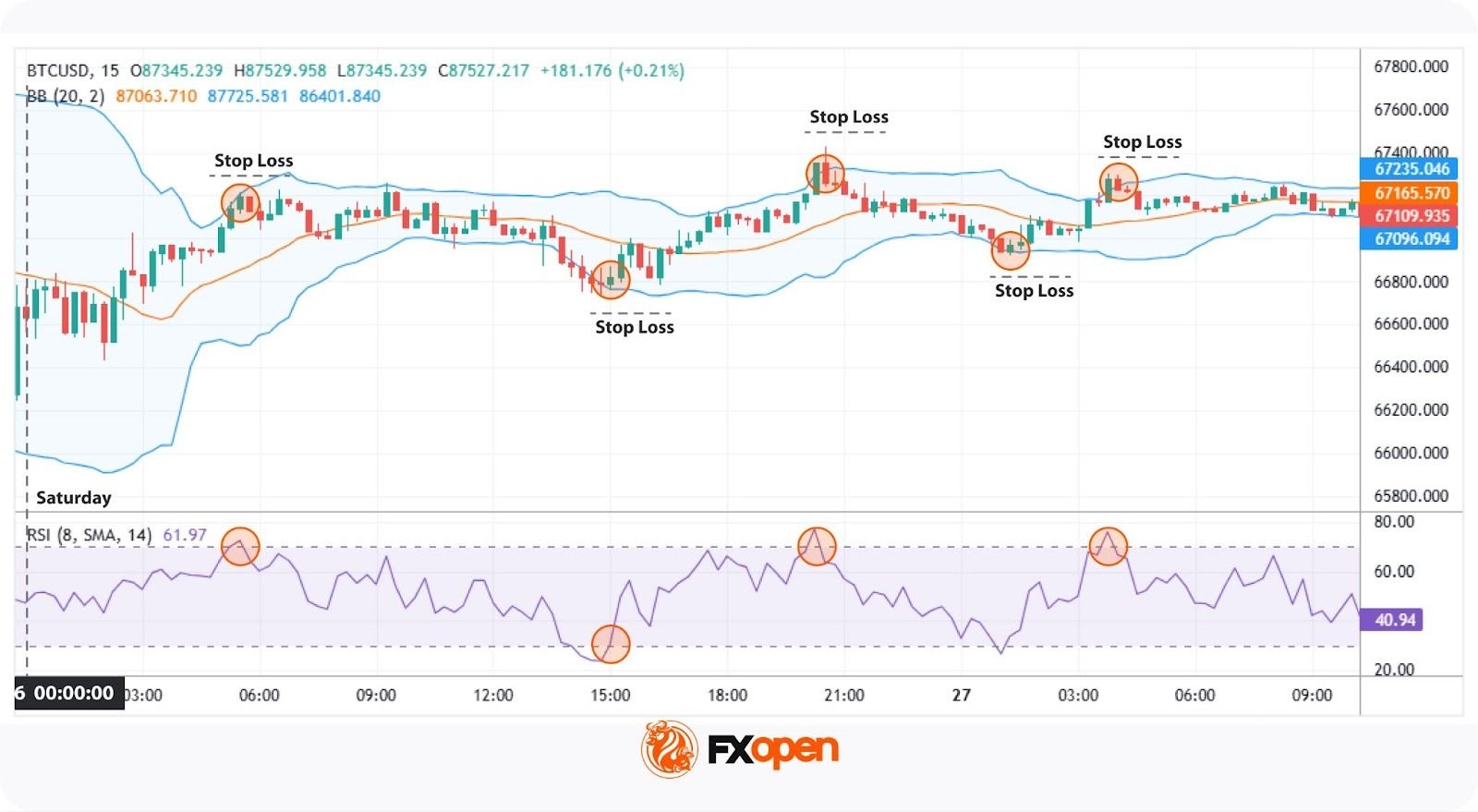
This weekend trading strategy combines Bollinger Bands and the Relative Strength Index (RSI) to analyse price behaviour in low-liquidity environments. During weekends, reduced order book depth can cause higher price volatility and increase the frequency of short-term mean reversion.
Bollinger Bands are used to identify deviations from average price levels, while RSI helps assess momentum extremes. Some market participants adjust RSI sensitivity by using shorter lookback periods to reflect reduced market activity.
When price touches the outer bands and RSI moves out of extreme zones, this may indicate an entry point in the direction of the mid-band or opposite range boundary of the Bollinger Band indicator, depending on prevailing conditions. Stop-loss levels are often placed beyond recent swing highs or lows to account for increased intraday volatility.
Note: signal reliability may be lower, as reduced liquidity can increase the likelihood of false breakouts.
Typical Workflow
Traders usually:
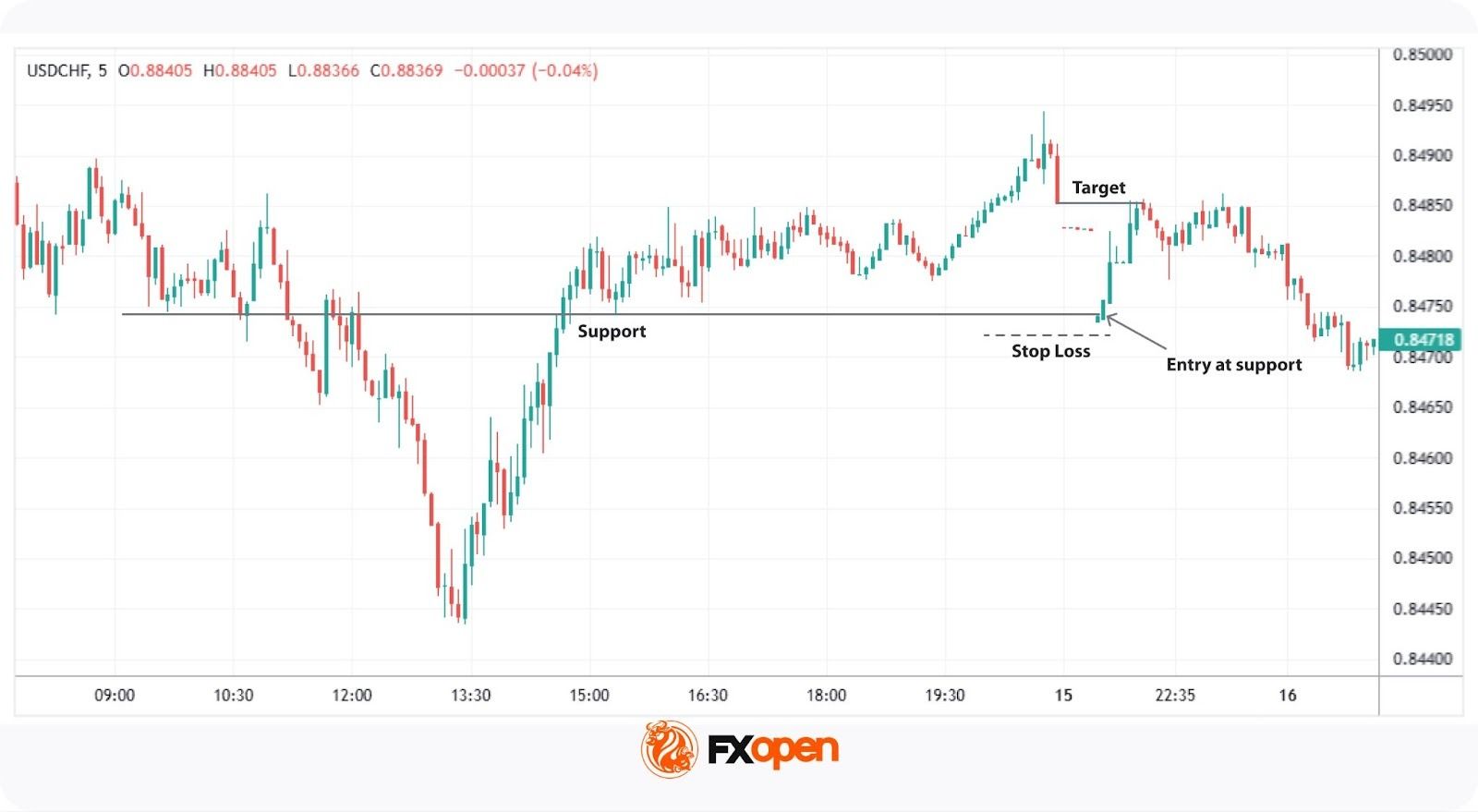
Futures data from exchanges such as the Chicago Mercantile Exchange shows that price gaps at the weekly open are common.
Weekend gap trading is based on price gaps that may occur when markets reopen after the weekend period. These gaps are typically driven by developments outside trading hours, including macroeconomic events or geopolitical factors. As a result, opening prices may differ significantly from previous closing levels observed before the weekend. A commonly observed outcome is partial or full retracement towards the prior closing price level.
In practice, instruments such as Dow futures weekend pricing or indications from DAX weekend markets are often monitored to assess potential opening gaps. These references may provide early signals of market sentiment before regular trading resumes.
Market participants often monitor key reference levels, including prior highs and lows, to assess potential scenarios. Technical frameworks such as support and resistance levels and moving averages are often used to confirm potential reversals. Execution timing remains important, as spreads at market open may be wider and liquidity conditions uneven.
Entries are typically considered after initial volatility subsides and price structure develops. Stop-loss levels are often placed beyond gap extremes. Exit levels are commonly aligned with the prior close or nearby technical levels, depending on market behaviour.
This approach can be applied to any market that closes over the weekend, meaning traders can trade FX pairs, stocks, and indices, e.g. DAX weekend movements.
Typical Workflow
Traders usually:
While weekend trading is attractive, it is not suitable for all market conditions or trading styles.
Weekend trading is characterised by limited market access and different conditions compared to standard trading sessions. Cryptocurrencies remain active, while most traditional markets are closed, with only selected CFD instruments available.
Lower liquidity and wider spreads can affect price behaviour and execution quality during this period. As a result, trading approaches often require adjustments to account for less stable market conditions. Understanding these differences may help in assessing price movements outside regular trading hours.
Yes, you can trade on weekends, but only in specific markets such as cryptocurrencies. Forex and stock markets remain closed until Sunday evening or Monday.
Can you buy stocks on the weekend? No, weekend trading in stocks is unavailable due to the hours set by stock exchanges. For example, the New York Stock Exchange operates only from Monday to Friday. However, some venues may offer after-hours trading sessions, though these end on Friday evenings and resume on Monday mornings.
Forex trading usually pauses from Friday evening to Sunday evening.
The main assets available for weekend trading are cryptocurrencies, as they trade continuously. Certain brokers also offer weekend trading in select commodities or indices, though these options may vary and come with high transaction costs.
The 24/7 nature of cryptocurrency trading has driven some brokers to offer support on Sundays, especially as demand for continuous trading access has grown.
Yes, FXOpen provides access to weekend trading cryptocurrencies. For currency pairs, shares, and commodities, trading typically resumes on Sunday evening when global markets reopen.
*Important: At FXOpen UK, Cryptocurrency trading via CFDs is only available to our Professional clients. They are not available for trading by Retail clients. To find out more information about how this may affect you, please get in touch with our team.





