CeFi vs DeFi: Decoding the Digital Finance Revolution

22-Aug-2025 Medium » Coinmonks

Unveiling the strengths, challenges, and future potential of centralized and decentralized finance in the evolving crypto ecosystem.

Difference Between CeFi and DeFi

Picture this,

On one side, traditional banks with complex procedures, on the other side, digital crypto wallets with user-friendly features on smartphones.

Which will be choosen?

Obviously, the user-friendly and enriched digital apps will be prioritized. Similarly, crypto users are opting for the easiest way to execute their transactions in the cryptocurrency market. This laid the stage for CeFi vs DeFi, where assets move at the speed of the internet.

Both CeFi and DeFi differ from each other and offer unique functionalities to provide a seamless crypto trading experience. Hence, understanding the strengths and shortcomings of both DeFi and CeFi is crucial.

I have come up with this blog where you can explore CeFi and DeFi in a broader way.

Let’s get started with the basics.

What Is CeFi?

Centralized Finance (CeFi) refers to transactions that are controlled or managed by a central authority in the cryptocurrency space. Similar to traditional banks for fiat currencies, CeFi platforms are trusted by crypto users. For instance, Binance, one of the popular centralized exchanges, facilitates crypto trading on behalf of the crypto users.

The centralized financial platforms act as the custodians and take responsibility for managing the user’s wallet and digital assets. CeFi platforms are blended with the traditional finance platform’s security with blockchain’s transparency.

It possesses a familiar structure for customer support, regulatory compliance, and a user-friendly interface. This boosts the entry of newbie crypto users globally with trust in crypto transactions. Some of the key characteristics of CeFi platforms are,

  • Central authority
  • Custodial services
  • Regulations and Compliance
  • User Support

As the CeFi platforms have grabbed the attention of global users, the creation of centralized exchange platforms has increased drastically.

What is DeFi?

Decentralized Finance (DeFi) is a blockchain-backed and smart contract-enabled platform that automates every crypto transaction effortlessly. The third-party intermediaries like banks, brokers, etc, are eliminated in the DeFi exchanges and other DeFi-based platforms.

The DeFi platforms are created by utilizing high-end smart contracts that are designed with enriched features. The conditions for crypto transactions are predefined in the smart contracts, which it executed automatically to meet the requirements.

Each blockchain possesses its unique smart contracts with high-tech features for a seamless trading experience. As the transactions are executed instantly without any approval, global users are now preferring DeFi platforms. Some of the major characteristics of the DeFi platforms are,

  • Transparency
  • Immutability
  • Global Accessibility
  • Composability

Also, the DeFi platforms are fast, borderless, and permissionless. Presently, the DeFi platforms are competing with traditional financial models by offering redefined solutions.

CeFi Vs DeFi: Which Is Better For Today’s World?

As I have mentioned about CeFi and DeFi, let’s get into their differences. Both CeFi and DeFi platforms have their unique features, functionalities, and working flows. Due to their potential, both differ in various factors. Here, I have enlisted the top factors that make them apart in detail.
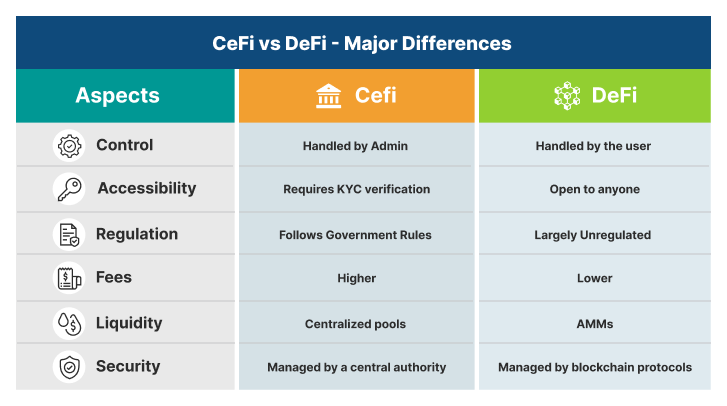
Control

  • CeFi: The centralized exchange platforms have complete ownership over the user funds and other passkeys. This increases trust and reduces unnecessary scam fears.
  • DeFi: The DeFi users of the exchange platforms have complete control over the assets by maintaining non-custodial wallets. This ensures anonymity and independence without relying on third parties.

Accessibility

  • CeFi: The crypto users have to complete a streamlined process of KYC/AML verification. Depending on the regions, the verification process may vary.
  • DeFi: The DeFi platforms are open for anyone with internet access, and it doesn’t require KYC verification.

Regulation

  • CeFi: The centralized platforms operate under strict financial regulations and provide a compliance-friendly environment for hassle-free trading.
  • DeFi: The Decentralized platforms don’t follow strict rules and regulations, which offer more freedom for self-ownership.

Fees

  • CeFi: As the platform is monitored and managed by a centralized intermediary, the service charges are slightly higher.
  • DeFi: With peer-to-peer transactions and decentralized liquidity pools, the middleman costs are drastically reduced.
CeFi vs DeFi

Liquidity

  • CeFi: The liquidity pools are managed by centralized exchanges and institutional investors that ensure higher liquidity.
  • DeFi: The decentralized platforms are powered by Automated Market Makers (AMMs), which depend on user participation.

Security

  • CeFi: With relevant regulatory features, the centralized platforms ensure impeccable security protocol integration. This reduces the large-scale risks and insider data breaches.
  • DeFi: As the DeFi platforms are embedded with blockchain platforms and smart contracts, the chances for technical vulnerabilities are low.

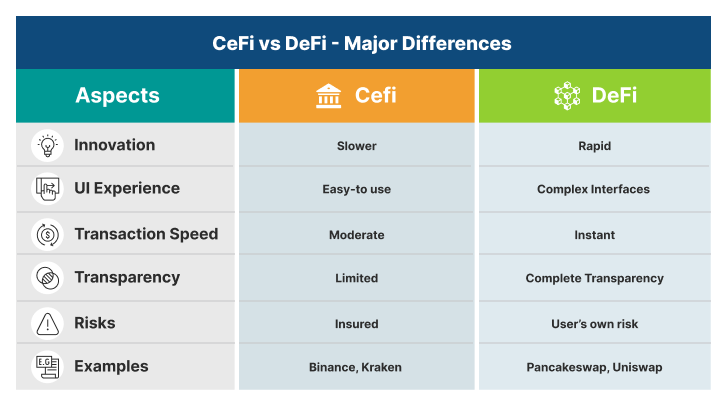
Innovation

  • CeFi: New and innovative features are integrated more slowly due to the strict compliance, regulations, and risk management.
  • DeFi: The DeFi platforms are highly innovative and experimental when it comes to integrating new features. This helps many DeFi platforms to grab attention from new users in the crypto space.

UI Experience

  • CeFi: The platforms are beginner-friendly with 24/7 customer support, which makes the user onboarding simple. Innovative yet user-appealing features are integrated for higher user engagement.
  • DeFi: Usually, the user interfaces are so complex that they require blockchain knowledge. Also, with self-custody ownership, decentralized platforms are hard for beginners.

Transaction Fees

  • CeFi: The centralized platforms possess service-based fees like trading fees, listing fees, deposit/withdrawal fees, etc. The CeFi platforms charge higher fees for operational costs and compliance measures.
  • DeFi: The decentralized finance charges gas fees that are lower on the Solana blockchain, but they may or may not spike during congestion.
CeFi vs DEFi

Transparency

  • CeFi: The operations are highly controlled by the admin, and users have to trust the centralized authorities. It is tough to get any kind of information from the admin.
  • DeFi: The operations are executed in a transparent way, where it is recorded on public blockchains. Also, the transactions can be viewed by anyone who fosters trust.

Risks

  • CeFi: The tough hurdles of the centralized platforms are exchange hacks, regulatory crackdowns, and data breaches (rare). In some cases, the user can lose access if the platforms freeze the accounts.
  • DeFi: Usually, the common issues of DeFi platforms are smart contract bugs, rug pulls, and phishing attacks. Due to the absence of a centralized authority, it is hard to recover the lost funds.

These are some of the factors that differentiate both CeFi and DeFi. But, here you may get a doubt about the importance of CeFi and DeFi. Even though both have their shortcomings, it have potential strengths that offer a hassle-free trading experience.

CeFi vs DeFi: Which is better for today’s world?

The truth behind this query is that both CeFi and DeFi comprise unique strengths that vary based on the user’s needs. The CeFi platform often mirrors the traditional financial system but with a digital twist.

They are user-friendly, regulated, and trustworthy for digital crypto transactions. On the other hand, the DeFi platforms are permissionless, open, and automatic.

In today’s fast-moving market, it is not about choosing CeFi over DeFi or vice versa. Rather, the financial future points towards hybrid modules where both platforms’ strengths are aligned equally.

With CeFi platforms’ trustworthy features and DeFi platforms’ innovation, presently, startups are focusing on creating Hybrid crypto exchange models for users.

Because the winning approach after a decade in the crypto landscape may turn into embracing both worlds. If you still have this query in your mind,

Will both CeFi and DeFi coexist?

Yes, both CeFi and DeFi are not rivals that fight for dominance. Both financial systems are shaping the future with their peculiar features. The balance allows startups and crypto users to benefit from the best of both digital finances. Some of the characteristics of Hybrid platforms with CeFi and DeFi features are,

  • Regulatory compliance — Hybrid platforms are integrated with strict KYC/AML protocols for safety purposes.
  • Fiat Integration — This enables crypto users to deposit/withdraw traditional or native fiat currencies.
  • Customer Support — The hybrid platforms offer user assistance, dispute resolution, and account recovery for DeFi platforms.
  • Decentralized Access — The platform users can interact directly with the public blockchain protocols without any dependence.
  • Non-custodial control — Users can be empowered to retain control of their private keys and assets.
  • Smart contract Automation — The crypto transactions, lending, staking, etc, are executed transparently on-chain without any interventions.

The hybrid platforms are driven by both CeFi and DeFi, which brings innovation, trust, and regulation. Startups and entrepreneurs who embrace this synergy will be at the forefront of creating secure, scalable, and inclusive financial ecosystems.

Wrapping Up,

As we have headed to the conclusion phase, it is clear that the future of finance won’t be CeFi vs DeFi. But it will be CeFi and DeFi, working together to build a more open, efficient, and inclusive digital economy. Newbie startups that are actively striving for success in the crypto market approach a potential crypto exchange development company.

With their years of experience and technical expertise, they guide you in picking the right business module for you. Start your crypto business journey to reap profits and long-term success.


CeFi vs DeFi: Decoding the Digital Finance Revolution was originally published in Coinmonks on Medium, where people are continuing the conversation by highlighting and responding to this story.


Also read: The Bitcoin Futures Sentiment Index Just Flipped Back Into Positive Territory, Is A Rebound Brewing?
About Author Lorem ipsum dolor sit amet, consectetur adipiscing elit. Nunc fermentum lectus eget interdum varius. Curabitur ut nibh vel velit cursus molestie. Cras sed sagittis erat. Nullam id ante hendrerit, lobortis justo ac, fermentum neque. Mauris egestas maximus tortor. Nunc non neque a quam sollicitudin facilisis. Maecenas posuere turpis arcu, vel tempor ipsum tincidunt ut.
WHAT'S YOUR OPINION?
Related News