The world's largest stablecoin by volume now has a hard deadline attached to its future in the U.S. market — and the clock started running a year ago.
USDT GENIUS Act compliance has become the defining question for Tether following the law's first anniversary. Offshore issuers like Tether now face a runway through July 2028 to meet the framework's standards or risk losing eligibility for listing on U.S. centralized exchanges, according to legal experts tracking the law's rollout. Compliance would require registering with the Office of the Comptroller of the Currency, honoring U.S. freeze and seizure orders, and restructuring USDT's reserves — and federal regulators still haven't finalized the rules that would make all of this official.
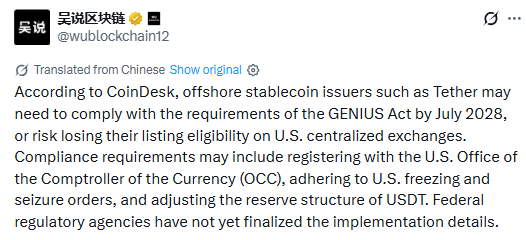 Source: X(formerly Twitter)
The GENIUS Act built in a three-year grace period for issuer compliance, but there's real disagreement over how that clock applies to foreign issuers specifically. Some attorneys read the law as giving Tether until July 18, 2028 to fully comply. Others argue foreign issuers must meet certain baseline requirements the moment the law becomes effective — likely around January 2027 — with the fuller compliance runway only applying afterward.
A Davis Polk attorney who advises stablecoin clients described the practical split: foreign issuers must immediately honor lawful freeze and seizure orders once GENIUS takes effect, but get roughly two more years to complete heavier requirements like OCC registration before losing eligibility on U.S. platforms. That registration process alone is expected to be a substantial undertaking for any offshore issuer.
GENIUS requires issuers to hold reserves almost entirely in cash and U.S. Treasuries — the most liquid, lowest-risk assets available. Tether's own recent attestations show that roughly a quarter of USDT's reserves currently sit in assets that wouldn't meet that bar, including precious metals, lending positions, and Bitcoin holdings.
Tether CEO Paolo Ardoino pledged compliance the day the law was signed a year ago, indicating the company would manage USDT to meet foreign-issuer standards while also building a separate U.S.-specific product. That product, USAT, launched in January 2026 through banking partner Anchorage Digital — but adoption has stayed relatively limited so far. Tether didn't respond to recent requests for an updated compliance timeline.
Tether's chief U.S.-based rival, Circle, has taken a visibly different approach, moving further toward pre-compliance with the framework well ahead of any hard deadline — a gap that's becoming one of the clearest competitive divides in the stablecoin sector.
Anchorage Digital's head of policy, Kevin Wysocki, put the stakes plainly: once the safe harbor expires in 2028, non-compliant stablecoins won't be usable by U.S. institutions, and he expects the market to shift toward compliant, bank-issued digital dollars well before that date arrives.
Not every platform is expected to respond the same way. A managing principal at consulting firm FS Vector predicted that smaller, risk-averse platforms will likely delist ambiguous stablecoins early, while larger exchanges with deep legal resources may keep pushing regulatory boundaries until compliance is forced on them — a pattern that's played out at nearly every prior crypto regulatory turning point. Coinbase, the largest U.S. exchange, declined to detail its stablecoin listing plans under the new framework.
Complicating matters further, the Digital Asset Market Clarity Act — GENIUS's intended legislative companion — remains unresolved in Congress, and any provisions it eventually adds could still reshape parts of the GENIUS framework itself.
USDT GENIUS Act compliance now hinges on a contested two-track timeline, a reserve structure that isn't there yet, and a regulatory rulebook that still isn't finished. Tether has two years of runway, at minimum — but the reserve gap, the OCC registration lift, and Circle's head start all suggest the countdown matters more than the calendar makes it look.
This article is for informational purposes only and does not constitute financial or investment advice. All regulatory details, deadlines, and figures are based on publicly available statements and legal analysis as of July 18, 2026, and are subject to change as federal rulemaking continues. Interpretations of GENIUS Act timelines for foreign issuers vary among legal experts and have not been finalized by regulators. Always consult official regulatory guidance before making decisions involving stablecoins.





