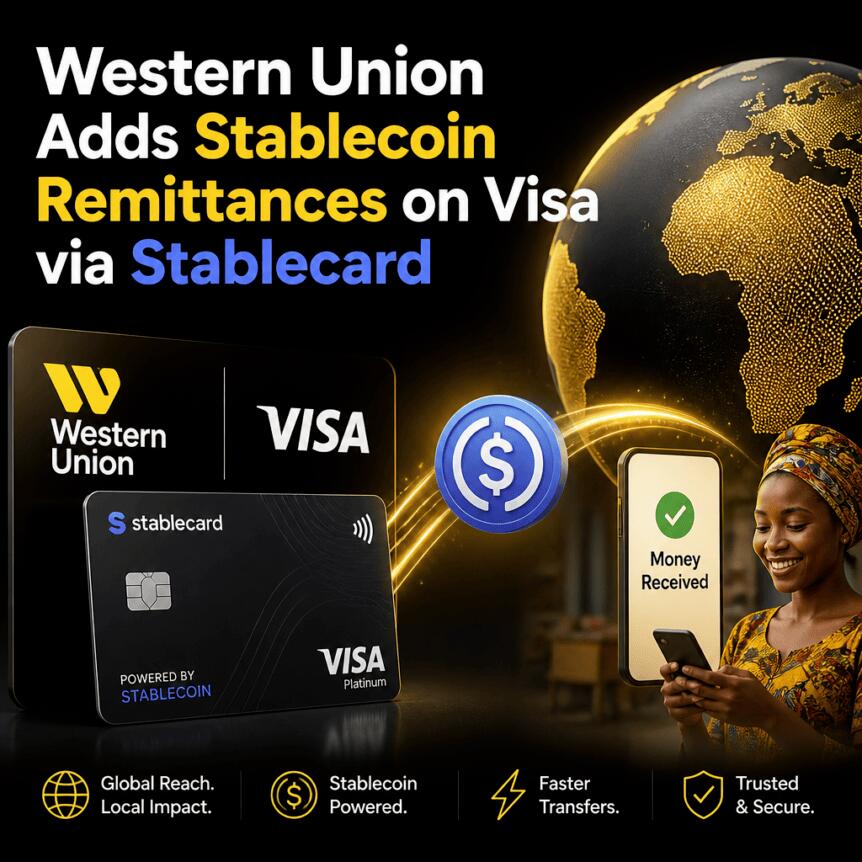
Western Union is taking a major step deeper into blockchain-based payments with the launch of Stablecard, a Visa-branded digital wallet and card that lets users hold, transfer, and spend a US dollar-backed stablecoin.
In an announcement this week, Western Union said Stablecard will support USDPT, a US dollar-pegged stablecoin issued by Anchorage Digital Bank and deployed on the Solana blockchain. The service is designed for remittance recipients and users who want to park value in a dollar-denominated digital asset while still using everyday card payment rails.
Western Union’s Stablecard combines a self-managed USDPT wallet with payment functionality built around Visa acceptance. According to the company, users can receive money transfers directly into a USDPT wallet, move those funds to compatible crypto wallets and exchanges, and pay using their USDPT balances anywhere Visa cards are supported.
The launch also extends to consumer-friendly payment methods, with Western Union stating that Stablecard balances can be spent through Apple Pay and Google Pay, which may reduce friction for users who are not actively buying or managing crypto on a daily basis.
Western Union said Stablecard is live across 37 markets and aims to broaden availability to more than 60 markets by the end of the year. That scaling effort matters for investors and builders because it indicates the company is treating the stablecoin-to-payment workflow as more than a limited pilot—at least in terms of geographic rollout.
The stablecoin at the center of Stablecard is USDPT, which Western Union introduced as part of its broader digital asset strategy. Earlier reporting from Cointelegraph noted that Western Union unveiled USDPT in May, describing it as designed to align with the framework set under the GENIUS Act, a US law that establishes federal rules for the issuance and oversight of payment stablecoins.
Those regulatory references are significant because stablecoin adoption in mainstream payment use cases depends heavily on how issuers structure compliance and how payment providers assess legal and operational risk. By aligning the rollout with a specific US regulatory framework, Western Union is attempting to reduce the “why now” uncertainty that often surrounds stablecoin products intended for consumer spending rather than purely on-exchange trading.
Western Union also pointed to growing ecosystem support for USDPT. Cointelegraph previously reported that Bybit added support for USDPT trading and transfers in June, strengthening the token’s utility beyond the wallet-to-card pathway.
Stablecoins have increasingly been discussed as an alternative set of rails for cross-border transfers—especially when traditional systems are slow or expensive. Western Union’s Stablecard launch reflects that shift: rather than treating stablecoins only as a niche transfer mechanism, the company is attempting to wrap dollar-denominated crypto value into a familiar payment experience.
That approach targets a practical pain point. In countries where local currency volatility can erode purchasing power between the time money is sent and received, users may prefer holding value in a dollar-pegged asset while still needing access to everyday spending. Stablecard’s framing—saving in USDPT and spending through Visa—maps the stablecoin use case directly onto consumer behavior.
Western Union’s move also sits alongside competitive pressure in the remittance sector. Cointelegraph reported that MoneyGram launched MGUSD, a US dollar-pegged stablecoin on the Stellar network, with integration designed to connect token use to its app via a self-custodial wallet. The parallel suggests major remittance players are exploring stablecoins not just for settlement, but for end-user workflows.
Despite the momentum, stablecoin adoption is not guaranteed to outperform traditional remittances in every scenario. A recent Bank of Italy study, as referenced by Cointelegraph, found that stablecoin-based remittances did not consistently deliver clear improvements in either cost or speed.
According to the study summary, the biggest bottlenecks remain tied to fiat on- and off-ramps—the steps required to convert between bank deposits, cash, and digital assets. The researchers attributed much of the remaining cost and delay to those conversion processes rather than to the blockchain settlement itself.
This is an important nuance for readers evaluating Stablecard and similar products. Even if stablecoins streamline cross-border value movement, the overall user experience can still depend on how efficiently local ecosystems handle conversion and settlement. Stablecard’s success in the real world will likely hinge on whether it reduces those frictions for its target markets, not only on whether the blockchain transfer is fast.
As Stablecard expands from 37 markets toward more than 60, the key questions for users and market watchers are how smoothly recipients can move from Western Union transfers into spending—and whether fiat conversion frictions meaningfully shrink compared with traditional remittance rails in the same corridors.
This article was originally published as Western Union Adds Stablecoin Remittances on Visa via Stablecard on Crypto Breaking News – your trusted source for crypto news, Bitcoin news, and blockchain updates.





