
Kill Zone trading is a method that focuses on the most liquid and volatile periods of the trading day. It aims to align trades with institutional activity during specific time windows. The concept comes from the Inner Circle Trader (ICT) method, with ICT Kill Zone times covering the Asian, London, and New York sessions. These forex Kill Zone times mark specific intraday periods when liquidity, trading volume, and institutional activity tend to increase, with the London Kill Zone time among the most active windows.
This article explains forex Kill Zone times, the main trading sessions, and the role of institutional order flow in Kill Zone trading.
A forex Kill Zone is a short, high-activity window when a currency pair tends to see higher volatility and trading volume. These windows usually align with the open of a major session or occur during forex session overlaps. The concept, popularised by Michael Huddleston, also known as the Inner Circle Trader, highlights the importance of timing in trading strategies.
These active windows sit inside the broader forex market sessions. The forex market operates 24 hours a working day across four major sessions: Sydney, Tokyo, London, and New York. Each session reflects the working hours of its regional financial centre.
A trading session and a Kill Zone are not the same thing. A session lasts around nine hours and covers a region's full trading day. A Kill Zone is a shorter window, often two to three hours, when order flow tends to concentrate. Forex Kill Zones therefore act as focused periods within these longer sessions.
Two main forces drive this concentration of activity during a Kill Zone. Liquidity rises as institutional order flow enters the market, which can tighten spreads. Volatility tends to rise as that heavier order flow moves price more quickly. A session overlap strengthens both effects, since two regions trade at once. The London and New York overlap is the clearest example, and it shapes much of Kill Zone trading.
Forex Kill Zone times group into four main windows across the trading day, each tied to the main ICT trading sessions. The table below sets out each window in GMT for winter and summer, the pairs that tend to lead it, and how the market usually behaves.
Kill Zone | GMT (Winter) | GMT (Summer) | Primary Pairs | Typical Characteristics |
Asian | 23:00–02:00 | 23:00–02:00 | AUD/USD, NZD/USD, USD/JPY | Range formation, lower volatility, liquidity builds for later sessions |
London | 08:00–11:00 | 07:00–10:00 | EUR/USD, GBP/USD | Higher volatility, breakouts, daily highs and lows often form |
New York | 13:00–16:00 | 12:00–15:00 | EUR/USD, USD/JPY, USD/CAD | USD-driven moves, overlap with London, US data releases |
London Close | 15:00–17:00 | 14:00–16:00 | EUR and GBP pairs | Declining European participation, retracements, easing volatility |
The Asian window keeps the same GMT trading times year-round, since Tokyo does not observe daylight saving. For current session times, traders often confirm the windows against a forex trading hours reference.
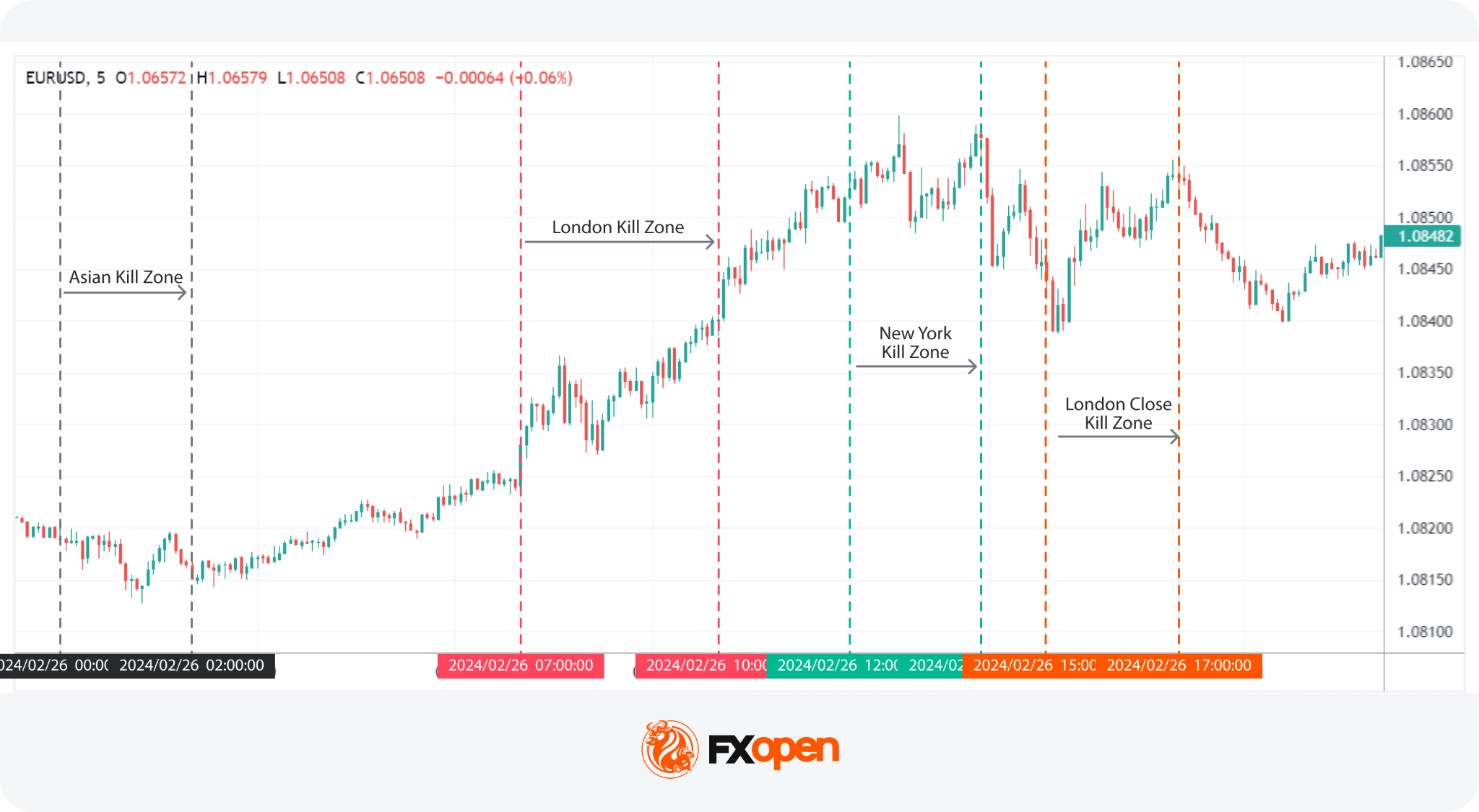
Each Kill Zone period corresponds to transitions in major forex markets worldwide. The windows differ in their typical pairs, pace, and liquidity.
Below, we’ve described each along with the key ICT Kill Zone times. You can see how currency pairs react during these times in FXOpen’s TickTrader trading platform.
Asian Kill Zone Time Period: 23:00 GMT to 02:00 GMT in winter and in summer.
This window coincides with the opening of Asian markets, primarily Tokyo. This period sees increased activity in currency pairs with AUD, NZD, and JPY.
During these hours, price tends to trade inside a tight range rather than trend strongly. This is known as the Asian range, and traders watch its high and low as reference levels. Lower participation means liquidity builds slowly rather than driving large moves. That accumulated liquidity can matter later, since the high and low of the Asian range often shape the first London moves. A break of either level after the London open can signal where larger order flow is heading.
ICT London Kill Zone Time Period: 08:00 GMT to 11:00 GMT in winter (07:00 GMT to 10:00 GMT in summer).
This window is known for its volatility and significant trading volume, particularly involving EUR and GBP. As the London session opens, it often establishes the daily highs (in bullish markets) or lows (in bearish markets).
Much of this reaction centres on the Asian session highs and lows formed overnight. Price often sweeps these levels first, taking liquidity that rested above or below the Asian range. A liquidity sweep of this kind can precede a sharper move once the level breaks. London session volatility can rise quickly as European volume enters. Traders study these conditions to prepare for potential breakouts or reversals.
New York Kill Zone Time Period: 13:00 GMT to 16:00 GMT in winter (12:00 GMT to 15:00 GMT in summer).
This window marks the overlap of the London and New York sessions, creating a critical period for USD-paired currencies.
USD pairs become more active when the New York forex session overlap occurs because American volume joins a market London is still trading. The New York Kill Zone draws traders from two continents at once, which lifts liquidity and pace. High-impact US economic data is often released during this period, including inflation and employment figures. These releases can move USD pairs sharply within minutes, so volatility tends to spike around them.
Traders seek continuation or reversal of the trends established over the London session, employing strategies that capitalise on the volatility to maximise returns.
London Close Kill Zone Time Period: 15:00 GMT to 17:00 GMT in winter (14:00 GMT to 16:00 GMT in summer).
As the London session concludes, this window typically exhibits less volatility but still offers conditions for strategic trades. Traders might observe retracements or continuations of earlier trends.
European participation declines as London desks close their books for the session. With fewer active participants, liquidity and volatility usually eases versus the London and New York windows. Moves can still occur, though they often lack the force seen during the main overlap. Strategies here often centre on trend exhaustion as European traders step back before the US close.
When engaging with Kill Zones in forex, practical considerations are important for leveraging these periods. Keep in mind these things:
High-impact data often lands during the New York Kill Zone and the London hours. Releases such as interest-rate decisions and employment figures can create market volatility. Many traders check an economic calendar before a session to see what is scheduled.
Traders account for time zone shifts such as British Summer Time (BST) and Eastern Daylight Time (EDT) when planning their trading schedules. These shifts can impact the real-time operation of forex markets by altering the relative timing of session openings and peak activity periods.
BST is GMT+1, moving the London window to an hour earlier for those trading on GMT. During BST, which typically runs from late March to late October, the London Kill Zone shifts from 07:00 to 10:00 GMT. Conversely, EDT, which is GMT-4, affects those in the US by advancing the New York window to start and end an hour earlier. This period typically extends from the second Sunday in March to the first Sunday in November.
For a quick conversion, add one hour to GMT during BST to reach local London time. Traders also confirm broker or server time, since platform clocks may differ from GMT.
Trading these windows means facing periods of rapid, hard-to-anticipate price movement. Sound risk management may potentially help traders manage that exposure.
Each Kill Zone tends to favour the major currency pairs tied to the regions trading at that hour. Matching a pair to its active window can place a trade where liquidity is deepest.
EUR/USD is most active across the London and New York windows, when European and US volume overlap. It carries some of the tightest spreads in forex, which suits the faster pace of these hours. GBP/USD also leads during the London Kill Zone, often moving further than EUR/USD on the same news.
USD/JPY draws activity in both the Asian and New York windows, since it bridges two of the regions. It tends to react sharply to US data and to shifts in risk sentiment. AUD/USD is most active in the Asian window, when Australian and regional markets set the early tone.
Liquidity differs across these pairs and across the windows themselves. The major pairs above usually trade with deeper liquidity and narrower spreads than minor or exotic pairs. That depth tends to thin outside the main ICT trading sessions as currency pair activity declines, which can widen spreads and slow fills. For this reason, traders often focus on the pairs whose home session is open.
Kill Zone strategies focus on specific periods of the trading day when liquidity and market activity tend to increase. By monitoring these windows, traders can analyse how price behaves around session opens and overlaps, where larger market participants are often most active.
The four forex Kill Zones are the Asian, London, New York, and London Close windows. Each corresponds to a key trading session or session overlap - key institutional trading hours - and ICT Kill Zone times may shift during daylight-saving periods. Understanding these time windows can help traders place market activity into context, as liquidity, volatility, and price behaviour often vary significantly from one session to another.
Those looking to refine their market timing and participate in high-impact trading sessions may consider opening an FXOpen account to access a wide range of currency pairs during these critical periods of volatility.
Traders use a Kill Zone to time entries and exits during periods of high volatility and liquidity, capturing significant price movements during specific time windows — usually at the beginning or end of a trading session or when sessions overlap.
Traders can engage by monitoring price action, identifying high-probability setups, and executing trades on currency pairs during major institutional trading windows.
Forex Kill Zone times are specific periods during major trading sessions when liquidity and trading activity tend to increase. They are commonly associated with the Asian, London, New York, and London Close sessions.
The London Kill Zone time generally occurs around the opening hours of the London session. It is commonly referenced as 07:00 to 10:00 GMT in summer or 08:00 to 11:00 GMT in winter.
Kill Zone trading is a session-based approach that focuses on trading during periods when market participation and liquidity are typically higher.
The New York Kill Zone refers to the period when New York trading overlaps with London. This overlap often creates increased activity in USD-related currency pairs. It is commonly referenced as 13:00 GMT to 16:00 GMT in winter and 12:00 GMT to 15:00 GMT in summer.
Yes. ICT Kill Zone times can shift when London or New York move to daylight saving time. For example, the London Kill Zone typically occurs one hour earlier in GMT during British Summer Time (BST). Traders should check current session schedules and their broker’s server time to ensure they are using the correct timings.
EUR/USD, GBP/USD, USD/JPY, AUD/USD, and other major pairs often show increased activity during their respective regional sessions.





