
Arbitrage is an attractive trading strategy in financial markets because its concept is simple — buy an asset where it’s cheaper and sell it where it’s more expensive. In crypto trading, this might mean buying BTC on one exchange for $67,800 and selling it on another for $68,100 — a $300 spread that seems promising at scale.
According to analytics platform Kaiko, the average intraday price difference between major exchanges such as Binance, OKX, Bybit, and Coinbase in 2024–2025 was around 0.2–0.4%. Even with moderate trading volumes, that margin appears significant — but taking advantage of it in practice is far from easy.
A common challenge is liquidity limitation. For instance, a 0.7% price gap might appear, but there aren’t enough orders to fill a large position — a typical issue for lesser-known assets.
 Futures) — Exploiting price differences between spot and futures markets. Requires awareness of funding rates and contract expirations. Futures) — Profiting from futures price discrepancies across exchanges. Balances risk and reward potential. DEX) — Arbitrage between liquidity pools on decentralized exchanges like Uniswap and PancakeSwap, typically offering higher margins but also higher network fees.
In theory — yes. In practice — only a few do.
The reason is simple: arbitrage margins are minimal, while competition and automation are enormous. Most arbitrage trades are executed by bots reacting within milliseconds.
According to Chainalysis, arbitrage trading accounted for around 3% of total crypto volume in 2024, with nearly 80% of transactions executed automatically. Manual arbitrage is virtually impossible today, as traders rely on scanners to identify opportunities before evaluating risk based on experience.
Myth 1: “It’s a risk-free strategy.”
While risks can be partially mitigated through hedging, multiple factors remain:
Myth 2: “Anyone can do it.”
Arbitrage requires not only familiarity with exchange interfaces but also awareness of market trends and project fundamentals — understanding teams, token utilities, and credibility. Guidance from experienced mentors is often essential to avoid early mistakes.
Myth 3: “It’s quick money.”
While it may seem that profit comes within minutes, timing rarely works so neatly. Some opportunities close within seconds, while others last for hours but require patience to realize gains between long and short positions.
Suppose you choose not to open multiple exchange accounts but instead use a single platform for funding rate arbitrage.
Bybit, one of the top three derivatives exchanges, is suitable for such strategies. Using a free tool like Coinglass, you might find BOBA offering a 0.05% funding rate every 8 hours. Buying on spot and shorting the futures could yield about $30 in three days on a $10,000 position — though results may vary if funding rates change.
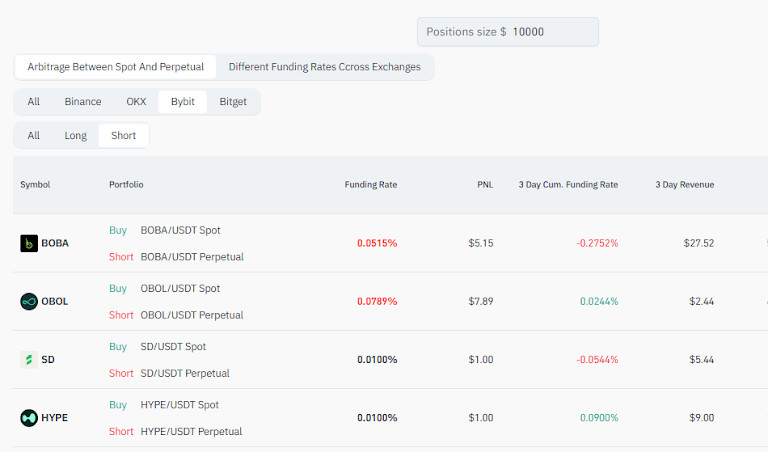
This example shows that crypto arbitrage is less lucrative than it appears and requires deeper market understanding, continuous research, and the use of advanced tools.
Crypto arbitrage isn’t a “holy grail” of easy profit — it’s a tool for those who understand market dynamics and can calculate precisely.
Today, arbitrage is mostly automated and integrated into complex trading systems, but its essence remains the same: where there’s a price difference, there’s an opportunity — however brief.
If you’re interested in arbitrage, start with small amounts to understand the details and risks before scaling up. Arbitrage can be profitable, but it’s a discipline for traders who can handle competition and stay methodical under pressure.
Author Bio: Alexander Baldwin — senior analyst and trading consultant with 15 years of experience. Former broker with expertise in banking and capital management, currently trading cryptocurrencies using proprietary strategies. In his free time, he collects NFT digital art, focusing on works by contemporary artists creating unique digital pieces.
The post What Is Cryptocurrency Arbitrage in Trading appeared first on Metaverse Post.