What Is Decentralized Identity (DID)? A Beginner-Friendly Guide for Every Industry
15-Dec-2025
Medium » Coinmonks
What Is Decentralized Identity (DID)? A Beginner-Friendly Guide for Every Industry
🧩 The Digital Identity Revolution
In today’s highly connected world, digital identity is more than just a username or password — it is the key to secure access across online platforms, services, and transactions. Traditional identity systems rely heavily on centralised databases controlled by third-party institutions. This centralized approach often leaves users with limited control over their personal data, resulting in identity theft, data breaches, slow verification processes, and compliance challenges.
Decentralized Identity (DID) represents a transformative solution. Leveraging blockchain technology, DIDs allow users to control, manage, and share their identity information securely, eliminating reliance on centralized authorities. By combining self-sovereign identity (SSI) with verifiable credentials (VCs), individuals and organizations gain complete autonomy over digital identity, while enterprises streamline verification, reduce fraud, and ensure regulatory compliance.
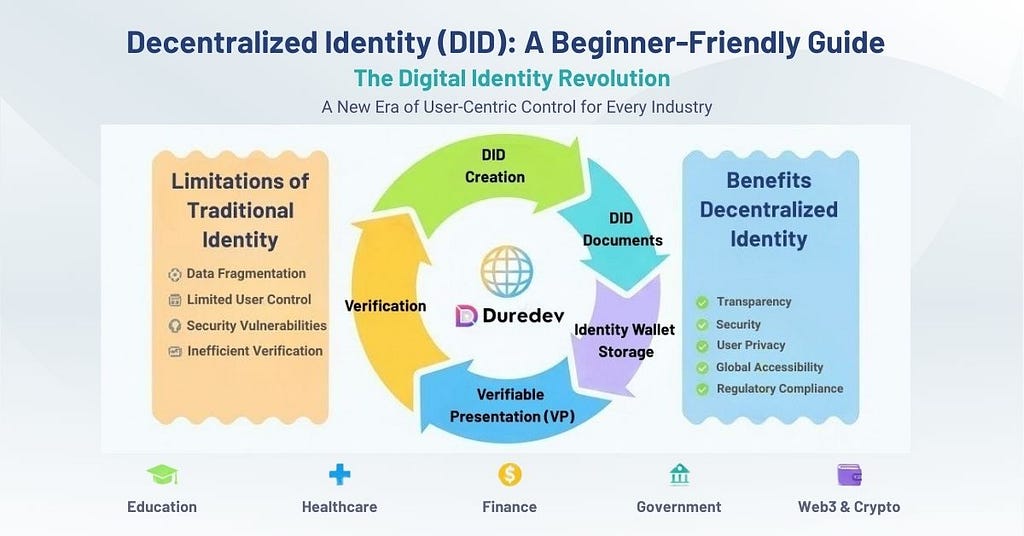
Data Fragmentation: Personal and organizational information is scattered across multiple platforms.
Limited User Control: Users cannot manage who accesses their data.
Security Vulnerabilities: Centralized databases are prime targets for hackers.
Inefficient Verification: Cross-border verification processes are slow, costly, and prone to errors.
Regulatory Compliance Challenges: Meeting global privacy and data security standards is complex.
By implementing decentralized identity solutions, Duredev ensures that organizations can maintain secure, user-centric, and fully compliant identity systems, bridging the gaps left by traditional frameworks.
🔄 How Decentralized Identity Works
A Decentralized Identity (DID) system is built on four fundamental components:
DID Creation: Unique identifiers (e.g., did:ethr, did:key) are registered on a blockchain.
DID Documents: These store public keys, service endpoints, and verification metadata, enabling third parties to authenticate credentials.
Verifiable Credentials (VCs): Digital proofs that can be verified without a central authority, ensuring authenticity, integrity, and non-repudiation.
Identity Wallets: Secure apps that allow users to manage, share, or revoke credentials in a controlled manner.
With Duredev Decentralized Identity Services, enterprises and platforms can issue, manage, and verify credentials efficiently, ensuring security, compliance, and user trust.
🏗️ Applications Across Industries
Decentralized Identity is creating value across multiple sectors:
1. Education
Issue digital diplomas, degrees, and certificates that are verifiable worldwide.
Reduce administrative costs and eliminate the risk of fake academic records.
Enable cross-institution verification in real-time for admissions or recruitment.
2. Healthcare
Securely share patient records, medical licenses, and prescriptions.
Ensure HIPAA-compliant handling of sensitive data.
Simplify verification of practitioners across hospitals, clinics, and insurance providers.
3. Finance & Fintech
Streamline KYC/AML compliance using blockchain-based verifiable credentials.
Implement passwordless login for banking, payment apps, and DeFi platforms.
Reduce fraud and onboarding time for new customers.
4. Government & Public Services
Issue digital passports, national IDs, and voter IDs that are tamper-proof.
Improve accessibility while ensuring privacy and regulatory compliance.
5. Web3 & Crypto Platforms
Onboard users with interoperable blockchain-based identity systems.
Enhance security for wallets, DAOs, and NFT marketplaces.
Digital Identity Solutions from Duredev provide end-to-end infrastructure for these use cases and more, offering global compliance and real-time verification.
Transparency: Every credential verification is immutable and auditable.
Security: Blockchain-backed verification prevents tampering and fraud.
User Privacy: Individuals control what information is shared.
Efficiency: Verification is faster and more reliable across borders.
Global Accessibility: Anyone with a digital wallet can participate in digital ecosystems.
Regulatory Compliance: Aligns with GDPR, HIPAA, and other global standards.
Duredev Enterprise Solutions provide scalable, secure, and privacy-focused systems that meet modern business needs.
🔮 The Future of Digital Identity
The future of identity is user-owned, privacy-first, and globally interoperable. Enterprises, governments, and Web3 platforms are increasingly adopting DIDs and VCs for secure, passwordless, and fraud-resistant identity systems.
Emerging trends include:
Cross-border verification using blockchain-based credentials.
Integration of AI-driven fraud detection with decentralized identity.
Expansion of digital identity for IoT and metaverse platforms.
Duredev is at the forefront of this digital identity revolution, helping organizations design, implement, and scale secure and privacy-first identity systems worldwide.
🏁 Final Thoughts: Secure, User-Centric Digital Identity
Decentralized Identity (DID) is redefining digital trust. By combining self-sovereign identity, verifiable credentials, and passwordless authentication, organizations can simplify verification, reduce fraud, and build confidence among users.
At Duredev, we provide end-to-end, privacy-first identity solutions for enterprises, governments, and Web3 platforms. Building on expertise from Digital Signatures on Blockchain: Legality, Compliance & Zero-Fraud Verification, Duredev ensures your digital identity infrastructure is secure, reliable, and scalable.
From enterprise-level DID integration to global credential verification, partnering with Duredev helps organizations build the future of digital trust. Start your journey toward secure, user-controlled, and globally interoperable digital identity today with Duredev.
Digital Signatures on Blockchain: Legality, Compliance & Zero-Fraud Verification
What Is Decentralized Identity (DID)? A Beginner-Friendly Guide for Every Industry was originally published in Coinmonks on Medium, where people are continuing the conversation by highlighting and responding to this story.