What does it look like when a government and the world's largest stablecoin issuer build a national digital currency together?
You're about to find out. Tether announced plans to launch GEL₮ — a digital token backed directly by the Georgian lari — with full support from the Georgian government. The Tether Georgia stablecoin isn't a pilot programme or a sandbox test. It's a joint initiative between Tether, the issuer behind the world's most traded digital asset USDT, and a sovereign government that has already built a legal framework to support it.
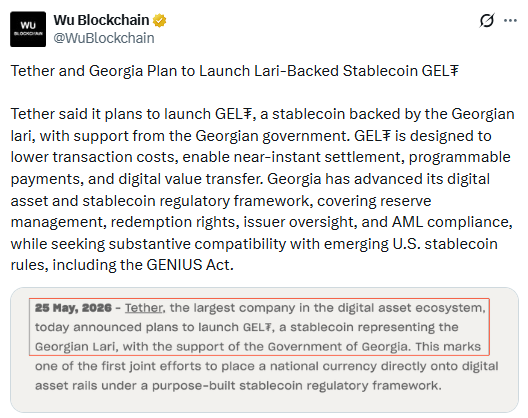 Source: X(formerly Twitter)
This is the first government-backed, local-currency token Tether has committed to in a European-adjacent market. Here's what it means — for Georgia, for payments, and for the broader digital currency landscape.
The Tether Georgia stablecoin will trade under the ticker GEL₮. Every token is backed one-to-one by the Georgian lari — the national currency. One GEL₮ equals one lari, held in reserve.
GEL₮ is designed to do four things the traditional banking system in Georgia does slowly and expensively:
Lower transaction costs — domestic and cross-border payments currently carry bank fees the tokens eliminates at the settlement layer
Near-instant settlement — traditional wire transfers take hours to days; GEL₮ settles in seconds on-chain
Programmable payments — businesses can set automatic payment triggers without manual processing, using smart contracts
Digital value transfer — GEL₮ moves across wallets and platforms without requiring a bank account at either end
Tether's existing relationship with the country gave this project its foundation. The company signed a Memorandum of Understanding with the government in 2023, focusing on blockchain infrastructure, Bitcoin education, and peer-to-peer payment development. The announcement is the direct commercial outcome of that partnership.
Irakli Nadareishvili, Georgia's Deputy Minister of Economy and Sustainable Development, confirmed that the collaboration aims to develop local blockchain technologies and introduce companies operating in this sector to the Georgian market.
The Tether Georgia stablecoin sits alongside Tether's broader expansion. The firm launched USA₮ in January 2026 — a federally regulated, dollar-backed token issued by Anchorage Digital Bank, designed to operate under the GENIUS Act framework in the United States. GEL₮ follows a different model: local currency, local government, local framework — not a dollar-pegged product.
Most countries launch a token and write the rules afterward. This country did it the other way around.
The National Bank of Georgia already published a regulatory framework covering exactly what the Tether Georgia stablecoin requires. The framework addresses four pillars:
Reserve management — issuers must hold 100% reserves against all tokens in circulation
Redemption rights — any holder can convert it back to lari at any time, on demand
Issuer oversight — companies need National Bank permission, virtual asset provider registration, and minimum capital of 500,000 lari ($182,000), scaling to 50 million lari ($18.2 million) as reserve assets grow
AML compliance — anti-money laundering requirements aligned with international standards
The National Bank introduced rules that allow companies to issue digital currency linked to the Georgian national currency, with a mandatory 100% reserve requirement and a tiered capital structure based on issuance volume.
This framework was also designed with US rules in mind. The country is seeking compatibility with the GENIUS Act — the United States' federal law. The GENIUS Act passed with a 68-30 Senate and 308-122 House vote, with additional regulations specifying issuer licensing, capital standards, and AML requirements arriving on July 18, 2026.
This move toward GENIUS Act compatibility matters for one reason: it signals the country wants its infrastructure recognised by US financial partners, not just domestic ones. That's a rare level of regulatory ambition for a country of Georgia's size.
The Tether Georgia stablecoin framework also covers programmable payment rules — meaning GEL₮ can automate government disbursements, salary payments, and merchant settlements without additional legal uncertainty.
The Tether stablecoin is more than a payment upgrade. It's a template.
No other country in the South Caucasus or Eastern European region has paired a government stablecoin framework with a Tier-1 token issuer at this level. If GEL₮ launches successfully, it becomes the reference model for how sovereign-currency stablecoins get built — with legal clarity, private sector infrastructure, and US regulatory alignment built in from Day 1.
Tether's track record supports the execution. Tether's USDT is the most traded cryptocurrency by volume globally, used by hundreds of millions of people in emerging markets, according to Tether CEO Paolo Ardoino. Applying that infrastructure to a local currency brings the same settlement speed and cost structure to a market where traditional banking fees remain a genuine barrier.
Three things analysts tracking the Georgia stablecoin will watch:
Launch timeline — no official launch date has been confirmed as of May 25, 2026. The regulatory framework is in place, but a live issuance date is still pending.
Reserve audits — the 100% lari reserve requirement needs independent verification at launch. Tether's reserve transparency practices on USDT have improved significantly since 2022, but the token will face its own audit standard.
Adoption by local merchants and banks — near-instant settlement only delivers value if the receiving end accepts GEL₮. Merchant and banking integration will determine whether it becomes a daily payment tool or a blockchain proof of concept.
All projections and adoption timelines are based on public market sources and government announcements. No guaranteed outcomes are provided.
The Tether Georgia stablecoin GEL₮ is a rare combination: government backing, a proven issuer, a ready legal framework, and GENIUS Act compatibility built in before launch. The country didn't wait for rules — it wrote them first. Watch for the official GEL₮ issuance date and the first reserve audit. Those two events will tell you whether this is a working payment infrastructure or a press release.
YMYL Disclaimer
The information provided in this article is based on publicly available sources as of May 2026. Cryptocurrency investments carry significant risk, including possible loss of capital.





