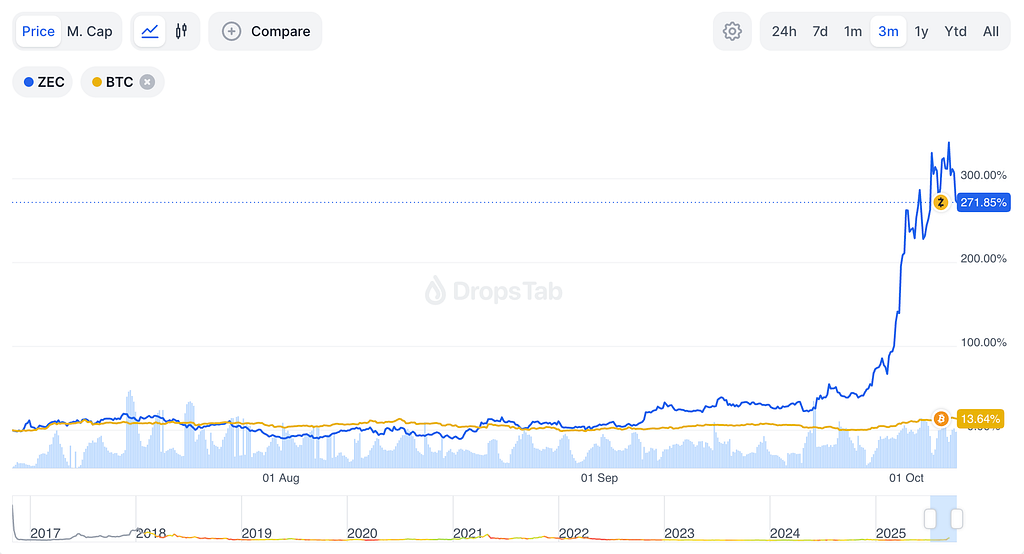
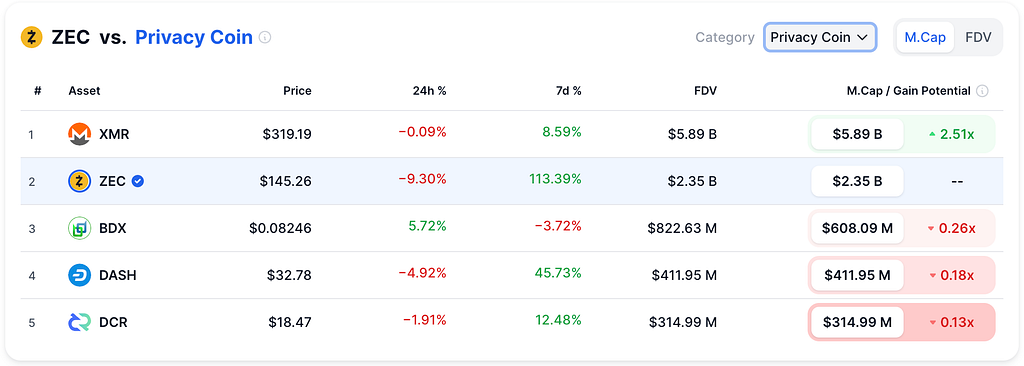
Zcash wasn’t supposed to outshine Bitcoin in 2025 — yet for a few wild weeks, it did. After years of drifting in obscurity, ZEC exploded 300 % in October 2025, climbing past $160 and hitting a $2.5 billion market cap.
Bitcoin, the heavyweight, moved in its usual institutional rhythm: calm, steady, and enormous around $125 000 BTC and $2.5 trillion in total value. That contrast set up one of crypto’s most interesting storylines of the year:
Can a privacy-focused network still thrive in an era obsessed with regulation?
Several factors lined up almost perfectly.
Even builders outside the Zcash world took notice.
“Recent buzz around Zcash is one of the first times I’ve seen legit collaboration across ecosystems,” wrote @0xMert, founder of helius.dev. “NEAR devs are building intents DEXs, Cosmos and ETH folks are excited about privacy, Solana guys are helping with marketing — even old-school BTC traders are getting involved.”
Trading volume told the same story: $1.1 billion in 24 hours, up from under $100 million — a ten-fold surge in activity that marked Zcash’s first true speculative revival in years.
Bitcoin still owns the title of the world’s most secure blockchain, running above 975 EH/s in hashrate with mining difficulty near 150 trillion.
That scale delivers unmatched protection — but demands colossal energy and specialized ASIC hardware that squeezes out smaller miners.
Zcash sits at the opposite end of the spectrum.
Its 7.9 GH/s hashrate and Equihash algorithm let GPUs and ASICs coexist, keeping mining accessible and community-based. It sacrifices brute-force defense for flexibility: less fortress, more agility.
Where Bitcoin’s top two pools control nearly 47 % of hashrate, Zcash remains more dispersed — a quiet win for decentralization, even if total power is lower.
Here’s the philosophical fork in the road. Bitcoin was built for transparency; Zcash was built for choice.
Zcash’s zk-SNARK-based shielded transactions allow users to hide sender, receiver, and amount while keeping everything cryptographically valid.
Adoption is rising fast: shielded transactions jumped 15.5 % month-over-month in September 2025, totaling 3.06 million ZEC.
The privacy stack keeps maturing.
“Onramp onto Solana or whatever chain, use Zashi to bridge to ZEC, shield it, let it sit, then bridge out again — you’ve just seeded a new wallet with zero traceability,” explained @0xMert.
Bitcoin’s Taproot (activated 2021) gave minor camouflage — making complex scripts look like normal payments — but still leaves balances and flows public.
As of 2025, about 20 % of ZEC supply sits in shielded addresses.
In short: Bitcoin obscures; Zcash conceals. One trusts simplicity; the other, mathematics.
Bitcoin has become the establishment’s favorite rebel.
Spot ETFs, government recognition, and custodial infrastructure have turned it into a legitimate macro asset.
Under the Trump administration’s crypto-friendly policy wave, regulators treat BTC less like a threat and more like a strategic reserve.
Zcash faces the opposite trend. Global regulators tightened privacy-coin rules in 2025:
Zcash’s saving grace is its optional privacy — transparent transactions can still meet compliance tests, unlike always-private coins such as Monero. But Europe’s 2027 ban on anonymous wallets over €1 000 could still limit access, even as Switzerland and Singapore experiment with friendlier sandboxes.
For Bitcoin, regulation means acceptance. For Zcash, it means adaptation.
By now, Bitcoin hardly resembles its cypherpunk origin story — it’s a financial instrument. ETF expansion, corporate treasuries, and even central-bank interest have made it the bridge between crypto and capital markets.
Zcash, meanwhile, keeps pushing into the space between privacy and compliance — territory few projects dare to occupy. Short-term targets of $185–$200 by year-end mirror the upcoming November 2025 halving and surging narrative demand.
“Hyperliquid adding Zcash makes it structurally easier to onboard and access the token. We should be able to set new all-time highs in market cap,” said @0xTulipKing.
Liquidity, accessibility, and story — when those three align, markets move. Bitcoin measures success in ETF inflows and corporate holdings; Zcash measures it in zk-proof innovation and regulatory survival.
Both share the same DNA: 21 million supply caps, Proof-of-Work security, and the idea of monetary sovereignty. One thrives through scale; the other through secrecy. Different paths, same purpose — financial freedom on one’s own terms.
For deeper token analytics and launch data, check the full report on DropsTab Research.
Zcash vs Bitcoin: Privacy, Power, and the Great Divide was originally published in Coinmonks on Medium, where people are continuing the conversation by highlighting and responding to this story.