SpaceX (NASDAQ: SPCX) is having a brutal start to the week. On Monday the stock fell as much as 10% intraday, its third straight session of losses, trading back down toward the $165 area after closing the prior week near $185.
That puts SPCX roughly 27% below its all-time high of $225.64, set just days earlier on June 16. The slide follows a retreat of more than 8% across the previous Wednesday and Thursday, before US markets paused for the Juneteenth holiday. In other words, much of the euphoric post-IPO rally has now been unwound — though the stock still trades comfortably above its $135 IPO price.
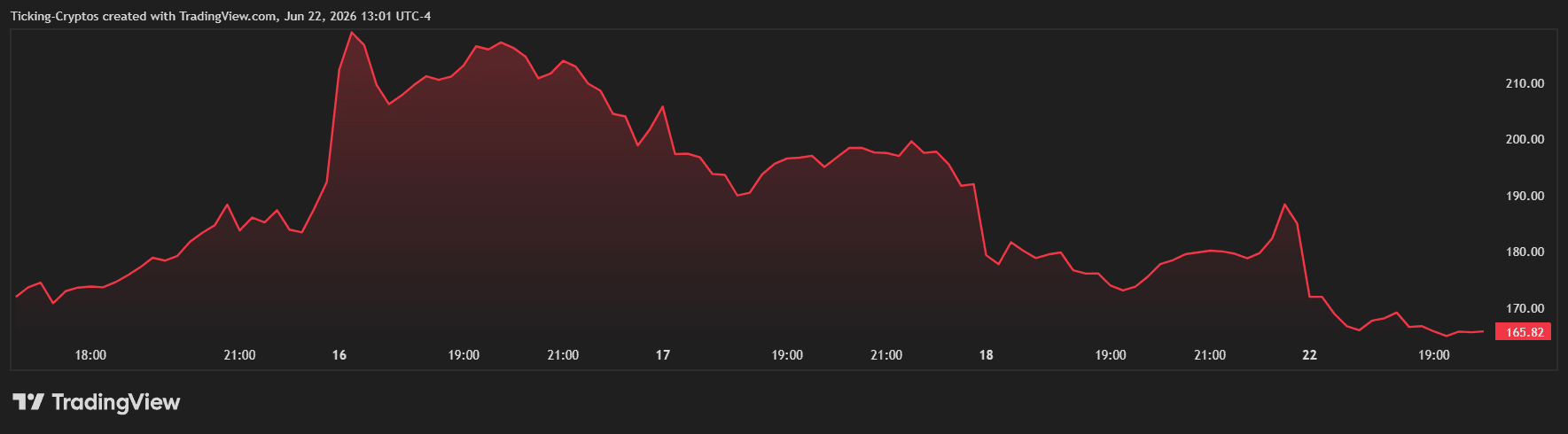
SpaceX listed on the Nasdaq on June 12 in the largest IPO in history, raising about $75 billion at a $135 offer price and debuting at a valuation near $1.77 trillion. The first week was pure mania: shares popped 19% on day one and ripped to $225.64 by June 16, briefly vaulting SpaceX past Amazon and Microsoft to become the world's fifth-most-valuable company.
Retail investors drove the move, buying more SPCX than any other stock on the market for several consecutive sessions. Then the music stopped — and a thin, sentiment-driven stock started falling as fast as it rose.
The decline isn't a single scandal. It's a stack of pressures hitting a richly valued stock at the same time.
Not in the underlying business, according to most analysts. Starlink remains profitable and growing, with over 10 million subscribers, $11.4 billion in 2025 revenue and a 63% adjusted EBITDA margin, while the launch business set records in 2025. The pullback reflects an expensive stock and a tiny float — not a deterioration in operations.
That said, the caution is real. One widely-shared note this week projected SPCX could fall 50% or more by year-end as the hype fades. Morningstar's fair value estimate sits near $63, while the Wall Street consensus average is around $164 — close to where the stock trades today.
**Investments carry risks. Trade responsibly.
Two mechanical catalysts dominate the near-term picture. Around early July, expected Nasdaq-100 inclusion could trigger an estimated multi-billion-dollar wave of forced passive buying from index funds — demand driven by rules, not sentiment. Then the first post-IPO earnings report, due in early September, will deliver the market's first hard fundamental checkpoint, alongside the end of the underwriters' quiet period and a flood of fresh analyst coverage.
Until those arrive, expect more of the same: a thinly-floated, sentiment-led stock capable of swinging double digits in a single session — in either direction.
While SPCX bleeds, the crypto market is holding up far better — a useful contrast for anyone weighing where to put risk capital. As of Monday, June 22, the picture looks like this:
The total crypto market cap sits near $2.21 trillion, up about 0.4% over 24 hours, with $Bitcoin dominance remaining strong as investors favor the larger caps.
The takeaway for investors is the difference in character. SpaceX is a brand-new, thinly-floated single stock swinging 10% in a session on bond-sale headlines and lockup fears. Crypto majors — far more mature markets with deep liquidity — are absorbing the same hawkish-Fed macro backdrop with relative calm. Both are volatile asset classes, but right now the volatility is concentrated in SPCX, not in BTC or ETH. For those building a diversified risk book, that contrast matters: a falling stock and a steady crypto tape can present very different entry points at the same moment.
For long-term investors, a sharp pullback in a high-conviction name is often where opportunity lives. The logic of buying the dip is simple: if your thesis on the underlying business hasn't changed, a lower price means you're buying the same company for less. SpaceX's pullback hasn't been driven by a broken business — Starlink is profitable and scaling, the launch business is setting records, and the AI segment is expanding. What's fallen is the price, not the fundamentals.
Several factors make this dip worth a closer look:
That said, dip-buying is not risk-free. SPCX remains expensive on any traditional metric, and lockup expirations later in 2026 could add supply. The point isn't to catch a falling knife — it's to accumulate a quality asset at a discount if you believe in the long-term story.
If you want to act on the dip, XTB is one of the most accessible ways to do it — offering real SpaceX (SPCX) shares, not synthetic exposure, so you actually own the equity listed on the Nasdaq.
Here's why XTB stands out for trading SpaceX:
Getting started is simple:
👉 Buy SpaceX (SPCX) shares on XTB →
**Investments carry risks. Trade responsibly.





