The primary driver behind the XLM price increase is the news that US President Donald Trump has officially extended the 48-hour deadline previously given to Iran to reopen the Strait of Hormuz. Instead of immediate military action, the administration has granted an additional five-day window for negotiations, citing "productive conversations" with regional leaders. Investors have interpreted this as a cooling of the "war premium," rotating capital back into high-utility assets like Stellar.
Stellar is a decentralized, open-source network designed to facilitate fast, low-cost cross-border payments. Its native token, $XLM (Lumens), acts as a bridge currency to swap different fiat and digital assets. In times of geopolitical uncertainty involving trade routes (like the Strait of Hormuz), payment networks that offer "borderless" efficiency often see increased speculative interest and utility-driven demand.
The XLM/USD chart highlights a sharp vertical move following the news. After languishing near the $0.155 support level during the height of the crisis, XLM has successfully breached its immediate resistance.
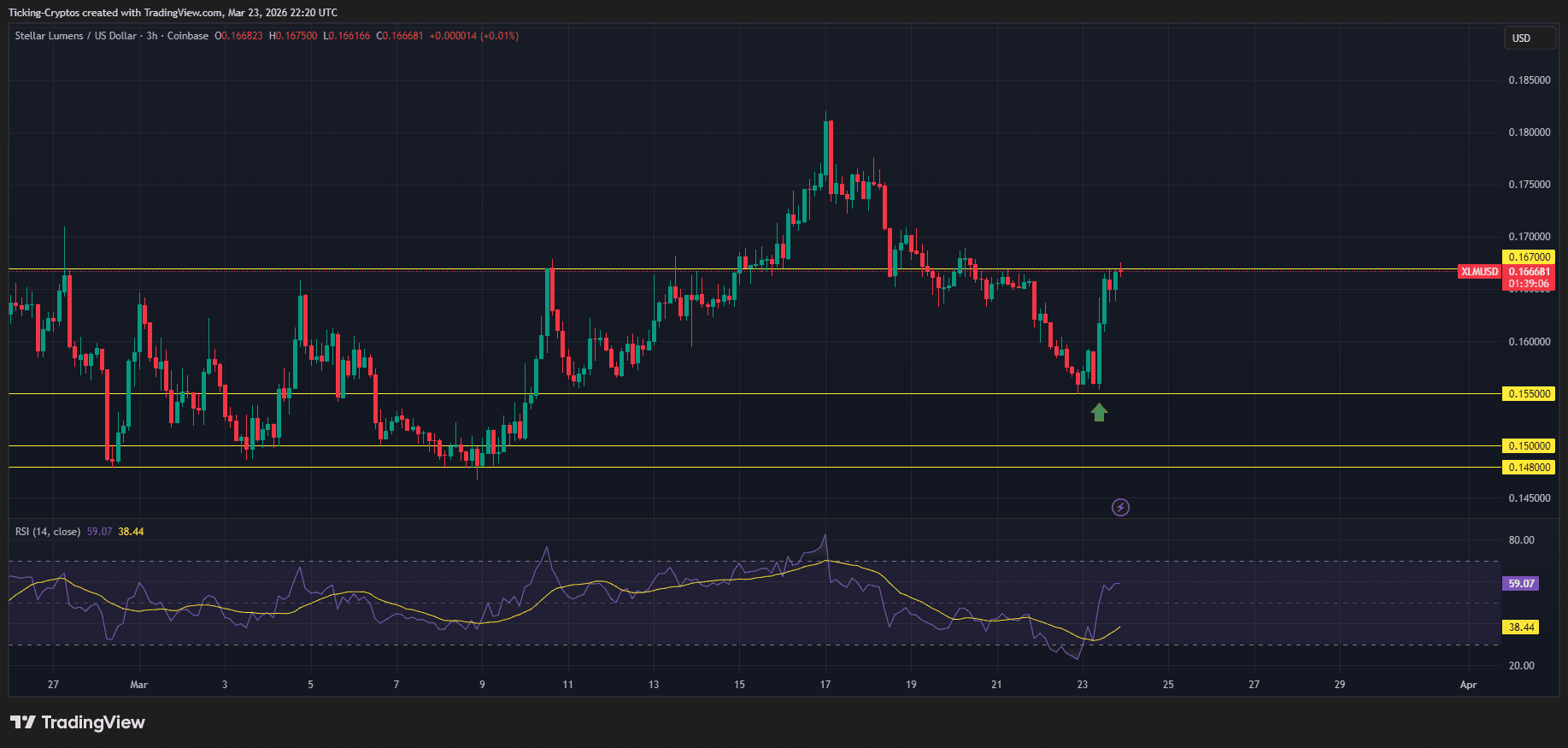
Target Levels: If the diplomatic momentum continues, the next major hurdle for the XLM price sits at $0.182. Conversely, if talks break down, a retest of the $0.145 zone is highly probable.
The Strait of Hormuz is a vital artery for 20% of the world's oil and liquefied natural gas. The threat of its closure last weekend sent energy prices skyrocketing and forced a crypto market sell-off. Trump’s decision to extend the deadline to March 28, 2026, has allowed markets to breathe.
According to reports from The Guardian, the shift toward "escorted tankers" and political risk insurance has mitigated the immediate fear of a global energy shock. For XLM, which thrives in a stable global trade environment, this reprieve is a major fundamental tailwind.
While the 7% jump is encouraging, the situation remains fluid. The "five-day extension" is a temporary bridge, not a permanent resolution. Traders should monitor:





