
Tether’s dollar token, USDT, remains the largest stablecoin in the world by a wide margin. Recent market data put its circulating supply close to 180–185 billion dollars, representing well over half of all stablecoin value and an even larger share of trading volume.
USDT is:
That central role is exactly why traders get nervous whenever questions arise about its reserves or stability: a serious USDT problem would not be a niche issue, it would be a system‑wide shock.
The latest wave of concern started when S&P Global Ratings updated its stability assessment on USDT.
In late November 2025, S&P lowered USDT’s ability to maintain its dollar peg from 4 (“constrained”) to 5 (“weak”) – the lowest score on its five‑point scale.
A news report and a more detailed analysis highlight several key reasons:
A separate commentary underlines that Bitcoin alone now makes up several percent of reserves – more than the overcollateralization margin – which means a large drawdown in volatile holdings could, on paper, erase most of the buffer.
S&P also stresses that USDT has remained close to its peg through past bouts of volatility. The downgrade is less about recent price behaviour and more about how the reserve mix and disclosures have evolved.
At almost the same time, Arthur Hayes – co‑founder and former CEO of BitMEX – published a blog and X thread that went viral in crypto circles.
Drawing on Tether’s latest attestation, Hayes argues that the company is no longer running a simple “cash and T‑bills” book but has effectively turned its balance sheet into a macro trade.
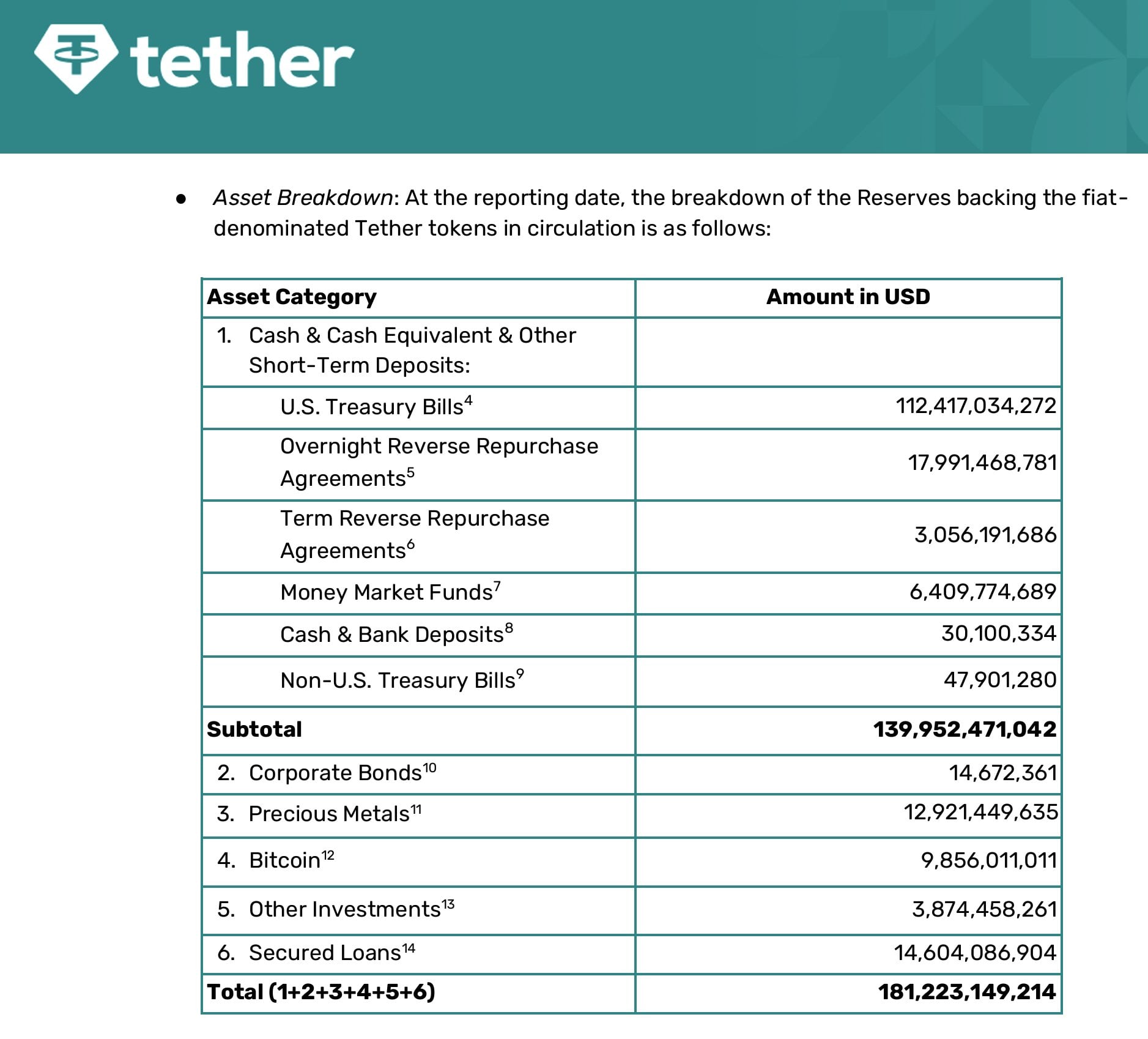
He frames Tether’s strategy as a bet that future Federal Reserve rate cuts will hurt interest income on Treasuries but send Bitcoin and gold higher. If that bet works, Tether’s profits and equity grow. If it fails, the reserve cushion shrinks.
Hayes is not claiming that Tether is currently bankrupt. His point is that a structure of this size, with this much embedded market risk, is sitting on “thin ice” if conditions turn.
Tether’s CEO Paolo Ardoino has pushed back hard against both the S&P downgrade and the alarmed interpretations of Hayes’ analysis.
In a post on X that has been widely quoted, Ardoino wrote that Tether would “wear [S&P’s] loathing with pride” and argued that traditional rating models had steered investors into supposedly safe institutions and assets that later collapsed.
It highlights several counterpoints:
Not everyone agrees with Hayes’ worst‑case framing, even among critics of Tether.
An ex‑Citi analyst, cited in a rebuttal and a separate report, argues that:
However, even these more optimistic takes concede that:
So far, USDT itself has remained stable. Price data from major exchanges show trading tightly around one dollar, with only very small intraday deviations. Arbitrage desks continue to swap USDT against dollars or other stablecoins when minor gaps appear.
Nonetheless, the headlines have had visible effects around the edges:
In other words, the peg is holding, but the risk narrative around USDT has clearly shifted.
S&P’s assessment is an opinion, not a regulatory order. It does not force exchanges or funds to stop using USDT. Yet it still matters for several reasons:
Even if USDT continues to function smoothly, these shifts can change how liquidity is structured across the market over the next few years.
Behind the social‑media noise, most professional traders are not betting on an immediate Tether collapse. They are weighing a few broad scenarios.
Tether continues to generate large profits on its Treasury portfolio, keeps a modest equity buffer and gradually leans reserves back toward safer assets under regulatory and market pressure.
USDT maintains its peg through occasional stress, and the main change is a slow rebalancing of long‑term holdings toward other stablecoins at the margin.
A sudden risk‑off event or wave of redemptions pushes USDT materially below one dollar on major venues. Arbitrageurs buy discounted USDT and redeem it at par; Tether sells a slice of its liquid reserves to meet outflows.
The peg is restored, but the episode leaves scars: tighter rules, bigger risk premiums and a faster shift toward alternatives for savings‑type use cases.
This is the tail risk that fuels the most anxious commentary.
In this path, either a large undisclosed loss comes to light or a combination of asset‑price moves and legal constraints makes it impossible for Tether to honour redemptions fully. USDT trades at a persistent discount, redemptions are gated or halted, and regulators intervene.
The result would be a severe liquidity shock across crypto, forced deleveraging and a likely redesign of stablecoin rules worldwide.
Crypto traders are suddenly worried about Tether not because USDT has already failed, but because new information has sharpened questions about how thin its visible buffer is relative to its growing bets on volatile assets.
An S&P downgrade to “weak”, detailed reserve breakdowns showing tens of billions of dollars in Bitcoin and gold, and high‑profile warnings from Arthur Hayes have all highlighted the downside of running a giant stablecoin with a riskier reserve mix.
Paolo Ardoino’s response – dismissing S&P’s model, stressing profits and overcapitalisation, and saying Tether will “wear [traditional finance’s] loathing with pride” – shows that the company is not backing away from its confrontational stance.
For traders and institutions, the most realistic approach is neither blind trust nor constant panic. USDT remains a crucial piece of crypto plumbing that currently works, but it is also a non‑trivial source of systemic risk. Its reserves, disclosures and regulatory treatment will stay under a microscope until the structure either proves itself through future crises or is reshaped by market and policy pressure.
The post Why Crypto Traders Are Suddenly Worried About Tether’s USDT appeared first on Crypto Adventure.





