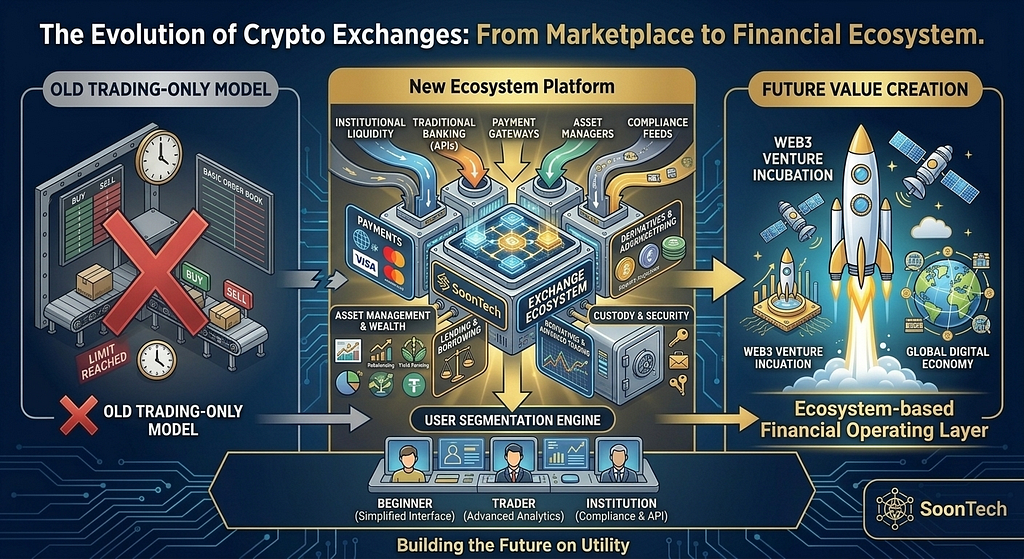
For years, crypto exchanges had one primary purpose:
Buy and sell digital assets.
Users opened accounts.
Deposited funds.
Placed orders.
Completed trades.
The exchange was simply a marketplace.
But the industry is entering a new phase.
The future of crypto exchanges may not be defined by trading volume alone.
It will be defined by one bigger question:
How much financial value can an exchange provide beyond trading?
In the early crypto market, attracting users was relatively simple.
More tokens.
More trading pairs.
Lower fees.
More promotions.
This strategy worked when the market was expanding rapidly.
But competition has changed.
Today, almost every major exchange can offer:
The difference between platforms is becoming smaller.
When every exchange offers similar functions, the next competition is no longer about features.
It is about ecosystems.
Traditional financial institutions have never been just transaction platforms.
Banks provide:
They become part of users’ financial lives.
Crypto exchanges are moving toward a similar direction.
Future digital asset platforms may combine:
The ability to access global markets.
Helping users manage their digital portfolios.
Enabling faster global transactions.
Connecting users with new digital financial products.
The exchange becomes more than a place to trade.
It becomes a financial operating layer.
Crypto has always been a technology-driven industry.
But technology alone does not create adoption.
Most users don’t care about:
They care about simple questions:
“Can I use it easily?”
“Can I trust it?”
“Can it solve my problem?”
The next generation of exchanges will win by hiding complexity.
Just like people use the internet without understanding servers, future users will interact with digital assets without needing to understand blockchain.
Traditional exchanges provide the same experience to millions of users.
But users have different goals.
A beginner.
A professional trader.
An institution.
A business.
They all need different solutions.
Future platforms will likely become more personalized:
A beginner may need education and simple guidance.
A trader may need advanced tools and analytics.
An institution may need compliance, reporting, and enterprise features.
The exchange experience will become smarter and more adaptive.
Another important shift is happening:
Businesses are entering Web3.
However, building a complete digital asset platform requires significant resources:
Many companies do not want to spend years developing everything from scratch.
They want reliable solutions that allow them to focus on customers, markets, and business growth.
This creates a growing demand for enterprise-ready Web3 platforms.
The future winners in crypto may not simply be the exchanges with the highest volume.
They will be the platforms that build stronger ecosystems.
An ecosystem where users can:
The question is changing.
The old question:
“How many users trade on your platform?”
The new question:
“How much value can users create within your ecosystem?”
Crypto exchanges started as marketplaces.
But they are evolving into something much bigger.
The next generation of platforms will not only connect buyers and sellers.
They will connect people, businesses, and financial opportunities in a global digital economy.
The future of exchanges is not just about trading.
It is about becoming the foundation of digital finance.
At SoonTech, we believe the future of Web3 platforms will be built around scalability, flexibility, and better user experiences — helping businesses create the next generation of digital asset solutions.
#SoonTech #CryptoExchange #Web3 #Blockchain #DigitalFinance #FinTech
Crypto Exchanges Are Becoming Financial Platforms — Trading Is Only the Beginning was originally published in Coinmonks on Medium, where people are continuing the conversation by highlighting and responding to this story.





