For years, the crypto industry has debated one question:
CEX or DEX?
Centralized exchanges provide:
Decentralized exchanges provide:
The industry has spent years comparing which model will win.
But the future may not be about choosing one.
It may be about combining both.
Every technology has trade-offs.
Centralized exchanges solved one of crypto’s biggest challenges:
Making digital assets accessible.
A beginner can create an account, deposit funds, and start trading within minutes.
However, users must trust the platform to manage:
Decentralized exchanges solve this problem differently.
Users maintain control of their assets.
Transactions happen transparently on-chain.
Anyone can participate.
But DEX platforms still face challenges:
Neither model is perfect.
The future of crypto trading may combine the strengths of both systems.
Imagine a platform where users experience:
Easy onboarding.
Simple interfaces.
Fast execution.
Professional trading tools.
On-chain settlement.
Greater visibility.
Non-custodial options.
Open liquidity access.
This hybrid approach could become the next evolution of digital asset platforms.
Technology enthusiasts often focus on decentralization.
But mainstream users focus on something simpler:
“Does it work?”
Most people do not want to think about:
They want a smooth financial experience.
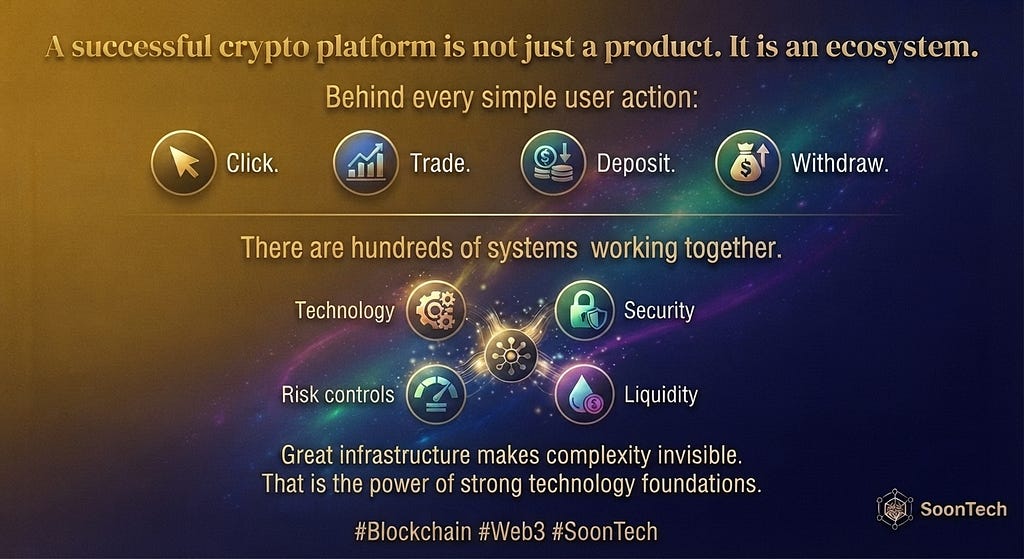
The winners of the next crypto cycle will be platforms that make blockchain technology invisible.
Liquidity has always been one of the biggest challenges in crypto markets.
Traditional exchanges usually manage liquidity internally.
DEX platforms rely on:
The future may involve smarter liquidity aggregation.
Platforms will increasingly connect:
Creating deeper and more efficient markets.
As crypto platforms become more complex, security becomes even more important.
Future exchanges need to focus on:
✅ Asset protection
✅ Smart contract security
✅ Risk monitoring
✅ Transparent operations
✅ Compliance frameworks
Innovation attracts users.
Security keeps them.
More companies are exploring opportunities in digital assets.
But launching an exchange requires much more than a trading interface.
A successful platform needs:
This is why enterprise-ready exchange solutions are becoming increasingly important.
Businesses want to enter the market faster without rebuilding everything from zero.
The future of exchanges is not about whether CEX or DEX wins.
It is about how digital assets become easier, safer, and more accessible.
The next generation of platforms may combine:
Centralized efficiency.
Decentralized transparency.
Intelligent technology.
Together, these elements could create a more mature financial ecosystem.
The CEX vs DEX debate may eventually become outdated.
The future of crypto trading will not be defined by one model replacing another.
It will be defined by integration.
The platforms that succeed will be those that understand one key principle:
Users don’t care about technology battles. They care about better financial experiences.
At SoonTech, we help businesses build scalable Web3 trading solutions, supporting the evolution of digital asset platforms through flexible CEX, DEX, and blockchain technologies.
#SoonTech #DEX #CEX #CryptoExchange #Web3 #Blockchain #DeFi
CEX vs DEX Is No Longer the Real Debate — The Future Belongs to Hybrid Exchanges was originally published in Coinmonks on Medium, where people are continuing the conversation by highlighting and responding to this story.





