
Won-denominated crypto trading now accounts for roughly 30% of global spot volume, making South Korea the second-largest fiat-to-crypto market after the U.S. dollar. The scale is striking for a country of about 52 million people, with local exchanges generating around $26 billion in weekly turnover so far this year.
The activity is concentrated in a small number of domestic exchanges. Upbit and Bithumb dominate Korean crypto trading, together handling nearly all local spot volume. That concentration gives listing decisions, compliance actions, banking access, and retail sentiment on the two platforms an outsized impact on Korean crypto flows.
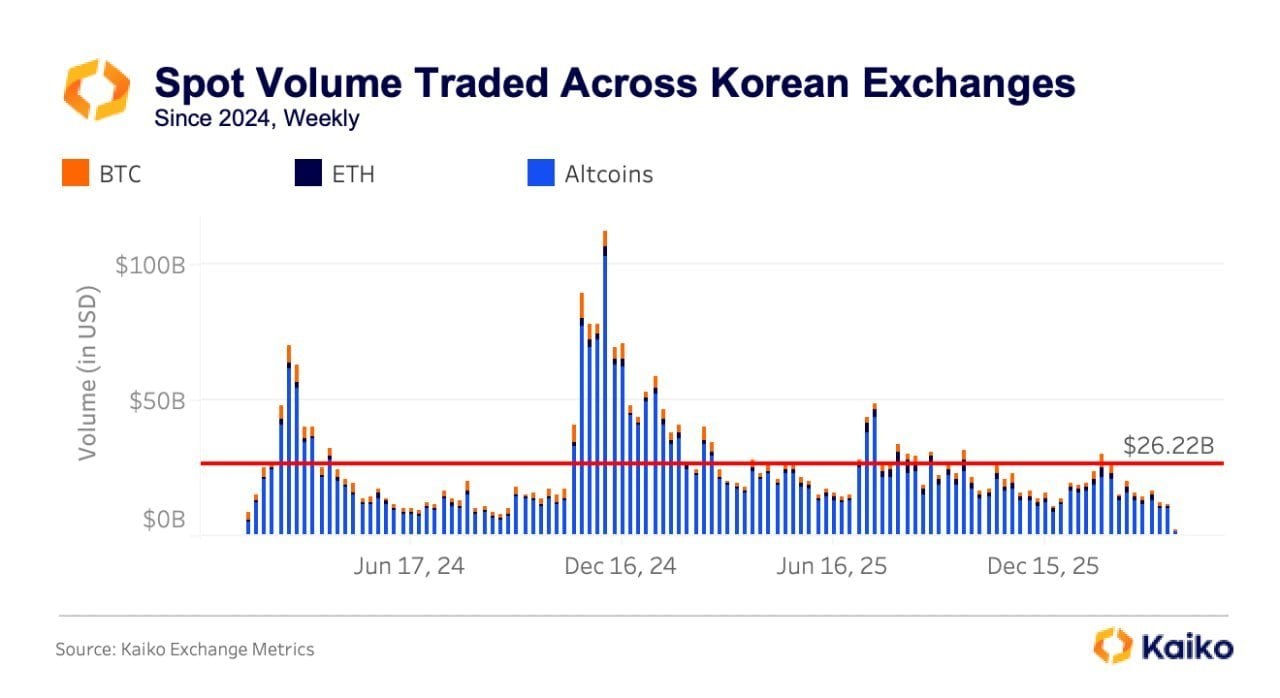
Altcoins remain the core of the market. Around 85% of weekly Korean crypto volume has flowed into assets outside Bitcoin, with BTC and ETH making up a much smaller share of activity. That mix reinforces South Korea’s role as one of the world’s highest-velocity retail crypto markets, where traders often rotate aggressively into higher-beta tokens rather than staying concentrated in majors.
Korea’s turnover is large, but liquidity depth tells a more complicated story. Korean exchanges can produce heavy volume without always matching Japan’s deeper Bitcoin order books. Upbit has shown roughly $1 million to $1.2 million in BTC market depth in some Kaiko samples, while Bitflyer in Japan has been closer to $3.5 million.
The contrast shows the difference between high-velocity retail participation and deeper institutional-style liquidity. Korea trades more aggressively, especially in altcoins, while Japan has tended to show steadier but smaller yen-denominated turnover with stronger depth in major assets.
That structure also explains why Korean exchange activity can move tokens quickly. A local listing or a shift in sentiment can create fast turnover, while thinner depth can amplify price moves when traders crowd into the same asset.
The crypto surge is moving alongside a powerful Korean equity rally. The iShares MSCI South Korea ETF posted a 69.14% year-to-date NAV total return as of May 4, with Samsung Electronics and SK Hynix forming the core of the trade. Those companies sit at the center of the high-bandwidth memory cycle powering AI data centers.
The same AI demand has already pushed South Korea and Taiwan higher in global stock-market rankings, while the broader AI capex trade has pulled capital into chip exposure. For Korean retail traders, crypto and AI equities are not separate stories. Both reflect a market willing to chase growth, volatility, and liquidity when the macro backdrop supports risk-taking.
There is also a policy layer. South Korea’s crypto market remains active while regulators tighten compliance, as seen in the recent Bithumb court fight over a six-month partial ban. The country is still trying to balance retail access, exchange supervision, stablecoin policy, and investor protection without weakening one of Asia’s most active digital-asset markets.
South Korea’s crypto market now combines three powerful ingredients: heavy won-based spot turnover, altcoin-heavy retail demand, and an AI equity boom centered on Samsung and SK Hynix. The risk is thin depth and regulatory pressure, but the flow is already large enough to move global crypto liquidity. A market producing about $26 billion in weekly crypto turnover can turn Korean exchange screens into one of the first places traders watch when altcoin momentum returns.
The post South Korea Drives 30% Of Global Crypto Trading As AI Boom Fuels Risk Appetite appeared first on Crypto Adventure.





