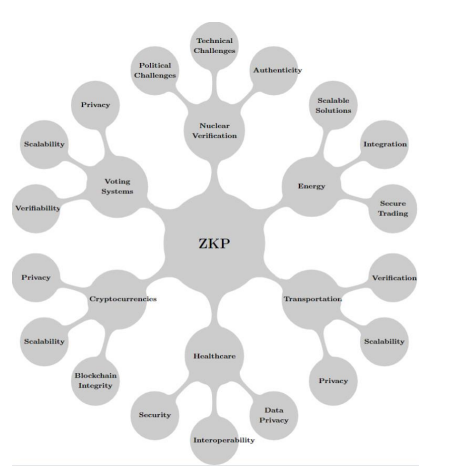
Zero-knowledge proofs (ZKPs) are cryptographic methods that enable one party to prove the validity of a statement to another party without revealing any additional information. This technology has significant implications for enhancing security and privacy across various domains, including cybersecurity, blockchain, cloud computing, and privacy-preserving data exchange.
The paper discusses various ZKP protocols, highlighting their trade-offs between security and efficiency. Key protocols include:
The paper identifies several unresolved research issues and potential future prospects for ZKPs in cybersecurity. These include improving the efficiency and scalability of ZKP protocols, developing new applications in emerging fields, and addressing the challenges of integrating ZKPs into existing systems.
Zero-knowledge proofs are a powerful tool for enhancing security and privacy in the digital age. By enabling trust without requiring the disclosure of sensitive information, ZKPs are poised to play a pivotal role in the advancement of cryptographic practices and digital privacy across many applications.
Zero-Knowledge Proofs: Enhancing Security and Privacy in the Digital Age was originally published in Coinmonks on Medium, where people are continuing the conversation by highlighting and responding to this story.





