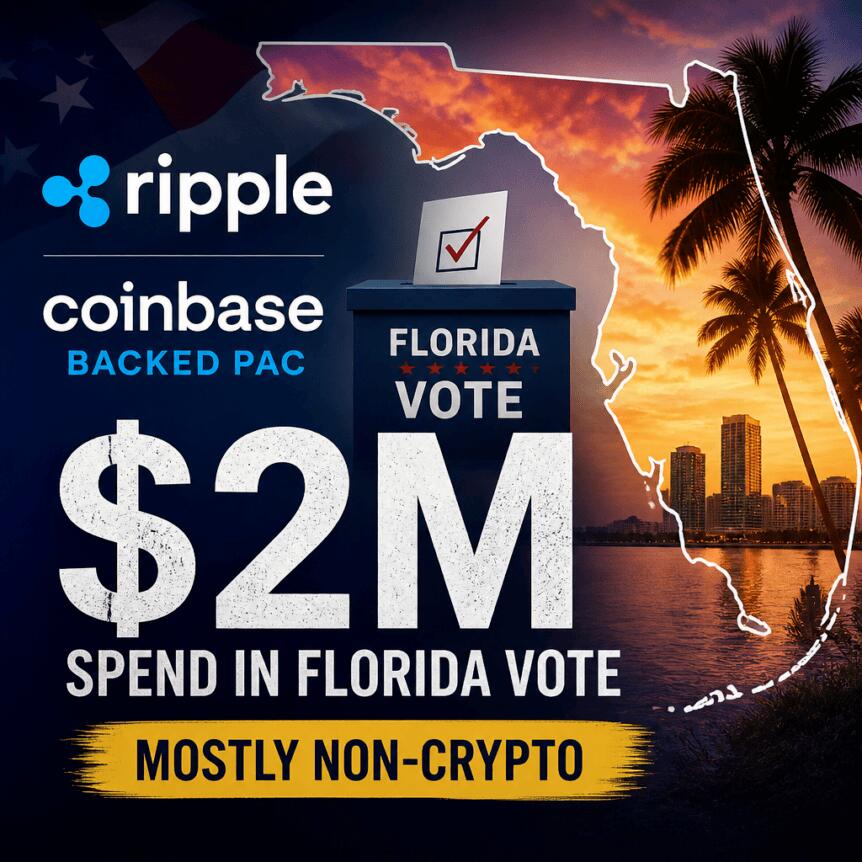
A political action committee tied to crypto industry heavyweight Fairshake has spent more than $2 million on ads targeting an early Democratic primary in Florida’s 24th congressional district, according to Federal Election Commission (FEC) records.
Coinbase and Ripple Labs have been identified as primary backers of Fairshake, and Protect Progress PAC—an affiliate described as operating in line with the group’s political strategy—has directed the funds against Democratic candidate Oliver Gilbert while the state’s primary field was still taking shape.
As of Tuesday, FEC filings for Protect Progress PAC indicated it had spent over $2 million on media opposing Oliver Gilbert in Florida’s 24th congressional district. The race pits candidates for a seat currently held by Representative Frederica Wilson.
FEC-linked reporting highlighted a notable aspect of the timing: no candidate in the Democratic primary was described as having taken a clear, prominent public position on digital assets prior to Protect Progress’s involvement.
Wilson has endorsed Gilbert. The incumbent has also been associated with legislation opposed by critics in the crypto policy space, including the Digital Asset Market Clarity (CLARITY) Act and the Guiding and Establishing National Innovation for US Stablecoins (GENIUS) Act.
Among the Democratic field, Shevrin Jones—a Florida state senator and a Democratic candidate who, according to an early August poll, had been ahead of Gilbert—has completed a questionnaire with Stand With Crypto.
Following the questionnaire, Stand With Crypto assigned Jones a “strongly supports” rating, according to the advocacy organization’s public materials. That rating places him closer to the preferences of crypto-focused political actors than the campaign trail appears to have shown for Gilbert before Protect Progress’s spending entered the race.
According to reporting, Gilbert said the advertising campaign was driven by “Donald Trump’s tech billionaire buddies,” characterizing the effort as a bid to influence a Democratic primary. He also alleged that “crypto con artists” were behind the ads.
The ad content included fabricated Miami Herald-style headlines that were not tied to reported policy positions on digital assets, a detail that has raised skepticism among opponents of the PAC’s approach.
Fairshake spokesperson statements, provided to Cointelegraph, pushed back on the characterization. The spokesperson said: “The facts are the facts, and, as the Miami Herald stated, the underlying facts in our ad are true.” The spokesperson did not address the specific rationale for the level or timing of the PAC’s expenditures.
Cointelegraph reports it reached out to Gilbert’s campaign for comment but did not receive an immediate response.
This Protect Progress activity comes as Fairshake and its affiliates continue to deploy large sums across federal primaries and general election races. Cointelegraph previously reported that Fairshake held a reported $193 million war chest as of January, and that the group has used affiliate organizations—such as Protect Progress and Defend American Jobs—to back candidates of different parties for the 2026 midterm elections.
In June, Cointelegraph reported that Protect Progress and related efforts had already “poured more than $82 million” into primaries and special elections using ads to influence voters, reflecting a sustained strategy rather than a one-off ad buy.
Further evidence of the breadth of this approach shows other spending during current federal nomination periods. On Tuesday, voters in Alaska, California, Florida and Wyoming were set to decide congressional candidates who would face off in November’s general election.
Cointelegraph noted additional Protect Progress spending: more than $150,000 on media supporting the re-election of Lois Frankel in Florida’s 23rd district.
For Defend American Jobs, Cointelegraph reported a combined $1.5 million across multiple races, including ads backing Representative Nick Begich in Alaska’s at-large congressional district, Republican candidate Sydney Gruters in Florida’s 16th district, and Representative Harriet Hageman for a Wyoming Senate seat.
The immediate question for voters in these primaries is less about day-to-day crypto market mechanics and more about which congressional candidates are positioned to advance or block crypto legislation. The Protect Progress ad strategy suggests crypto-aligned political groups are focused on reshaping candidate expectations early—before general-election coalition building locks in nominees.
There’s also a legislative timeline embedded in the broader political context. Cointelegraph reports that Congress is on recess until September, when the Senate is expected to vote on the CLARITY Act. For investors and industry participants watching regulatory direction, the selection of committee-minded candidates during primaries can be as consequential as the final votes themselves.
Readers should watch how subsequent FEC updates evolve—especially whether Protect Progress’s Florida spend expands into other races—and whether the outcome of the 24th district primary changes the balance of candidates most publicly aligned with digital-asset policy priorities.
This article was originally published as Ripple and Coinbase-Backed PAC Spend $2M in Florida Vote, Mostly Non-Crypto on Crypto Breaking News – your trusted source for crypto news, Bitcoin news, and blockchain updates.





