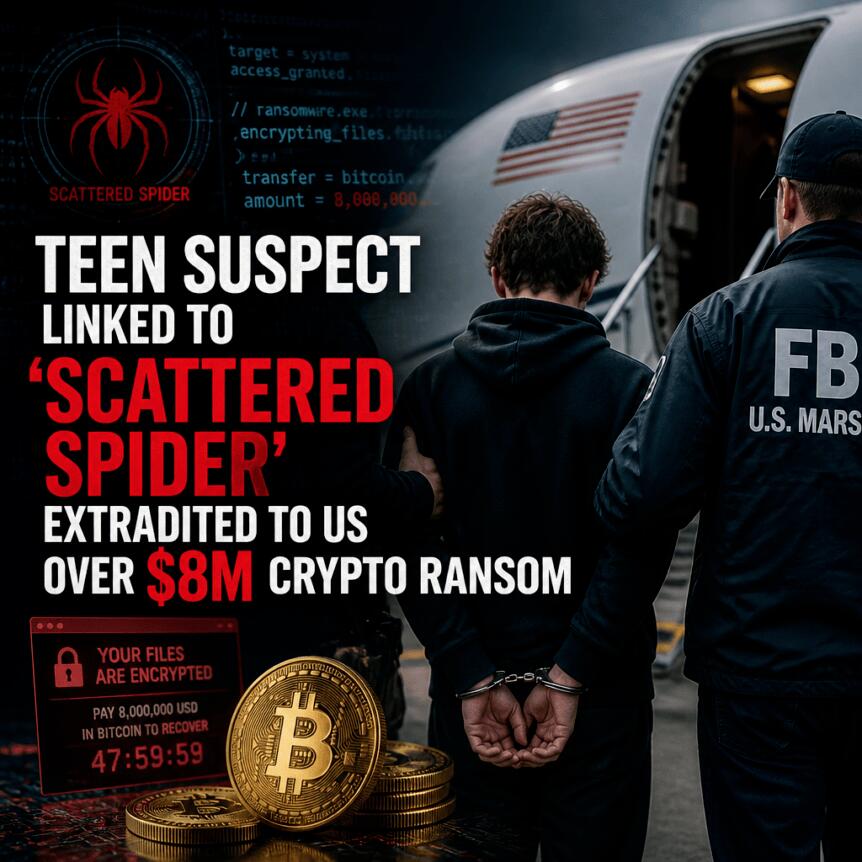
A teenager suspected of helping the “Scattered Spider” hacking group has been extradited to the United States to face charges tied to an alleged cryptocurrency ransom scheme worth $8 million. The case highlights how ransomware crews increasingly lean on social engineering, stolen credentials, and fast escalation from initial access to extortion demands.
The U.S. Department of Justice said Wednesday that Peter Stokes, 19, a dual U.S.-Estonian national, was arrested in Finland in April after an Interpol Red Notice and was extradited to the United States last week. He is expected to appear in federal court in Chicago on Tuesday.
The indictment and unsealed criminal complaint, as described by the DOJ, accuse Stokes and others of breaching a luxury jewelry retailer’s computer system in May 2025. Prosecutors allege the intrusion involved stealing data and issuing a demand for an $8 million ransom paid in cryptocurrency.
According to the complaint, the retailer managed to remove the attackers from its network and did not pay the ransom. Even so, the DOJ states the company incurred approximately $2 million in disruption damages, reflecting the cost of incident response, operational downtime, and the business impact that can follow an intrusion—regardless of whether attackers receive payment.
The DOJ also framed Stokes as one of the limited number of arrests it has directly connected to Scattered Spider, a group commonly associated with ransomware and crypto-based extortion.
Prosecutors allege the attack chain began with phishing calls to the retailer’s technology help desk. Stokes and others reportedly posed as employees to request resets of login credentials, a common tactic that turns administrative workflows—designed to restore access for legitimate users—into a shortcut for attackers.
In the complaint, authorities state the hackers compromised three employee accounts in as little as two hours. Two of those accounts belonged to IT administrators, giving the intruders access to higher-privilege systems. Prosecutors further allege those higher-privilege accounts were themselves breached and used to reach deeper into the retailer’s environment.
Within days, the complaint says the attackers sent a ransom note from a compromised company email account, demanding funds or threatening to publish credit card and payment information. The retailer, according to the complaint, resisted the intrusion and later experienced separate outreach from the attackers repeating the $8 million demand.
For defenders, the alleged sequence underscores why help desk and identity processes are a frequent focal point in real-world intrusions: once a reset request is accepted, the attack can progress quickly to privilege escalation and broader system access.
The complaint characterizes Stokes as a member of Scattered Spider who allegedly engaged in “numerous intrusions, or assisted in them” across multiple companies that prosecutors did not name in the filing. According to the DOJ, an examination of a storage device attributed to Stokes contained downloads from a virtual private server that Microsoft had identified as being used to carry out intrusions.
The complaint also alleges the device held “exfiltrated records from multiple victim-companies,” suggesting the attacker infrastructure was used not only to gain access, but also to extract data—an essential ingredient for ransomware-style pressure campaigns, including data-leak threats.
Authorities further pointed to Stokes’ social media activity as circumstantial evidence of involvement. The complaint claims his Snapchat account showed signs of substantial wealth for a person his age, and that he reportedly boasted about international travel and wealth. Prosecutors also allege he shared media related to apprehended Scattered Spider members.
The Justice Department said Scattered Spider—also described by multiple aliases, including “Octo Tempest,” “UNC3944,” and “0ktapus”—has been involved in more than 100 network intrusions. The DOJ estimates those intrusions resulted in over $100 million in ransom payments and millions of dollars in damages.
Stokes faces six counts tied to alleged hacking, cyber extortion, fraud, and conspiracy.
While this matter involves a claimed $8 million demand, it lands in a broader ransomware pattern that authorities and analysts have reported: total payments may be declining even as attacks increase.
According to figures cited by the DOJ, ransomware actors received more than $820 million in payments last year, an 8% decline compared with 2024. At the same time, attacks rose by 50%, as referenced in coverage linked to Chainalysis data. Taken together, the numbers suggest that victims are not necessarily paying as often or as much, but ransomware groups remain active and effective at reaching targets.
The filing’s allegations about the retailer evicting the attackers and refusing the ransom illustrate why: even when payments fail, attackers may still profit indirectly through disruption costs, data theft, reputational harm, and follow-on damages. For organizations, the practical takeaway is that “no payment” does not mean “no impact”—it often signals more urgent remediation work and financial exposure after incident response.
Readers should watch how the case develops in Chicago federal court, particularly whether the defense challenges the alleged linkage between Stokes and the intrusions described in the complaint. Equally important is what prosecutors emphasize next about the help-desk phishing phase and the role of stolen credentials, since that early foothold remains a central vulnerability for many companies targeted by ransomware crews.
This article was originally published as Teen Suspect Linked to ‘Scattered Spider’ Extradited to US Over $8M Crypto Ransom on Crypto Breaking News – your trusted source for crypto news, Bitcoin news, and blockchain updates.





