The global financial system is undergoing a profound transformation, driven by the rise of programmable money, tokenized assets, and real-time settlement networks. While blockchains have been at the center of this evolution, most existing networks still face trade-offs in speed, cost predictability, compliance readiness, and interoperability.
Arc, a new open, EVM-compatible Layer-1 blockchain, is designed to solve these challenges head-on. Built on a high-performance Byzantine Fault Tolerant (BFT) consensus known as Malachite, Arc offers deterministic sub-second finality, native stablecoin transaction fees, and a privacy-first, compliance-friendly architecture. It aims to combine the innovation of public blockchains with the security, stability, and trustworthiness required by regulated finance.
Read Arc blockchain whitepapre here.
Arc is not “just another” blockchain. It is a purpose-built financial settlement layer engineered to serve as the backbone for stablecoin finance, tokenization of real-world assets (RWAs), and institutional-grade payments.
Unlike most Layer-1s that rely on probabilistic finality and volatile gas fees, Arc delivers
In short, Arc is designed for a world where global-scale finance meets blockchain programmability.

One of Arc’s most distinctive features is its native stable gas model. Transaction fees are paid in USDC by default, eliminating the volatility risk that plagues many other blockchains that use their own native tokens.
For businesses and institutions, this simplifies accounting, reduces exposure to crypto price swings, and allows for predictable operational budgeting. The architecture also supports other fiat-backed stablecoins via a paymaster mechanism, enabling localized payment options in markets worldwide.
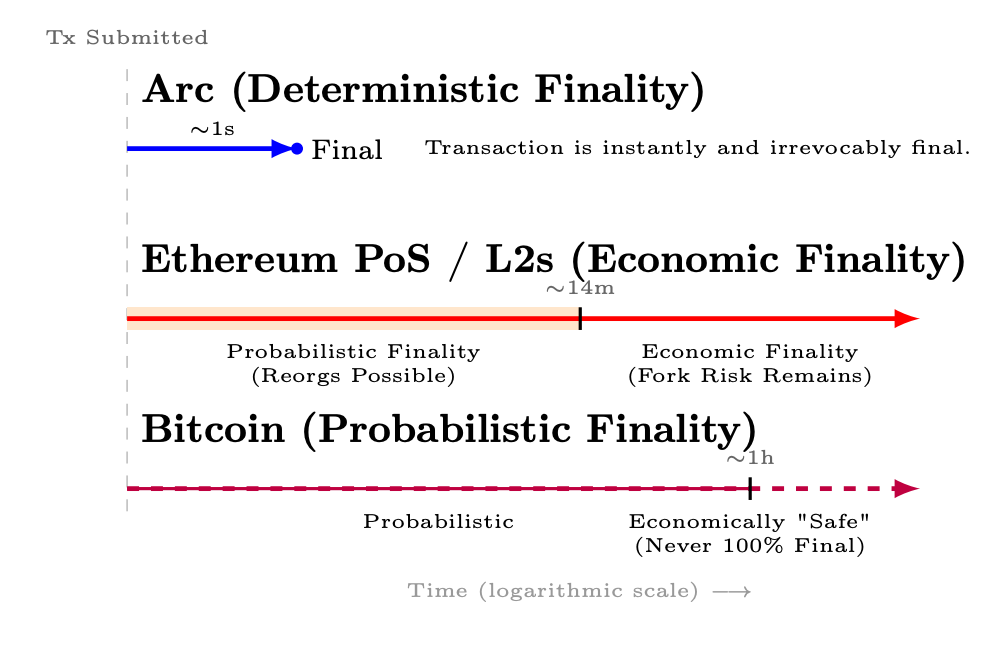
In traditional proof-of-work and even many proof-of-stake chains, transaction finality can be probabilistic, meaning users must wait for multiple block confirmations before considering a transaction irreversible.
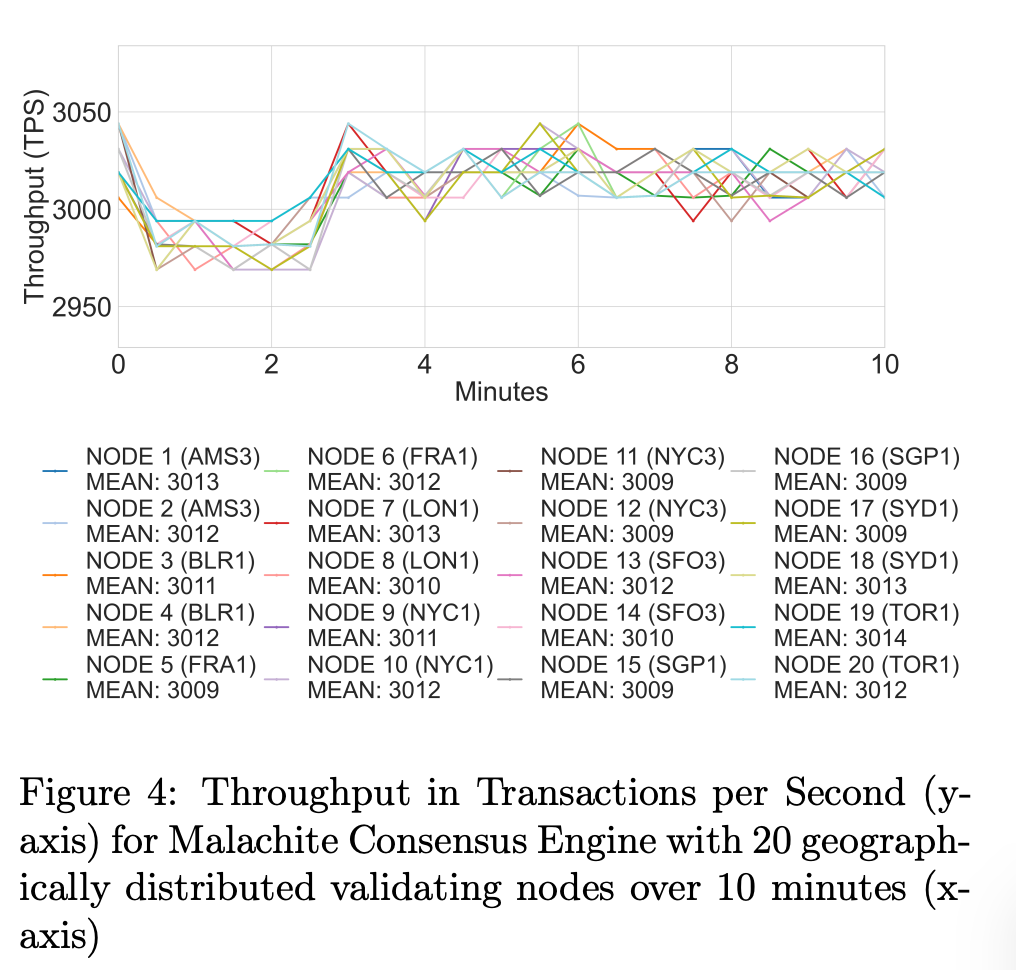
Arc’s Malachite consensus delivers deterministic finality in less than one second. With 20 validators, the system reaches ~3,000 transactions per second (TPS) and ~350 milliseconds to finality. With just 4 validators, it can exceed 10,000 TPS with finality under 100 milliseconds — all on standard, commodity hardware.
This level of speed and certainty is critical for high-value financial transactions, cross-border settlements, and real-time capital markets.
Arc is built to handle institutional-scale transaction volumes without sacrificing security. The architecture supports throughput levels competitive with major payment processors, paving the way for integration into existing banking, trading, and payment infrastructure.
The permissioned validator model allows Arc to meet compliance requirements while maintaining high performance. Over time, governance will expand to a broader permissioned Proof-of-Stake framework to further distribute trust.
Miner/Maximal Extractable Value (MEV) — the practice of reordering, inserting, or censoring transactions for profit — has been a persistent challenge in blockchain networks.
Arc takes a nuanced approach, allowing beneficial MEV (such as arbitrage that improves market efficiency) while mitigating harmful practices like front-running and sandwich attacks. Planned solutions include:
Arc introduces privacy features that are configurable and auditable — striking a balance between user confidentiality and regulatory transparency.
The initial implementation will feature confidential transfers, where transaction amounts are hidden from public view but addresses remain visible. Institutions can selectively disclose transaction data to authorized parties via “view keys,” enabling compliance with KYC/AML obligations.
Future enhancements will incorporate advanced privacy technologies including:
Arc’s architecture enables a wide range of high-value applications for both traditional finance and Web3-native ecosystems.
Arc supports the issuance and transfer of leading stablecoins such as USDC, EURC, and USYC (interest-bearing USDC). Through its programmable FX engine, Arc allows for
This allows financial institutions to move funds globally with near-instant settlement and predictable costs.
Arc provides a compliant infrastructure for the issuance, transfer, and settlement of tokenized assets — from equities and fixed-income instruments to private credit and real estate.
By enabling interoperability with DeFi protocols, Arc creates opportunities for on-chain liquidity, collateralization, and secondary market trading of assets that have traditionally been illiquid.
Arc integrates seamlessly with Circle’s product suite, including Mint, Cross-Chain Transfer Protocol (CCTP), Gateway, and wallet services. This makes Arc a high-speed liquidity bridge between blockchains, enabling:
Arc’s on-chain payment primitives are built for modern enterprise finance:
These capabilities allow businesses to manage global payments, receivables, and liquidity in a unified, programmable environment.
Arc’s development roadmap is structured to deliver core functionality quickly while progressively enhancing capabilities.
Fall 2025 — Public Testnet
The first public network will feature:
Mainnet Beta
Following the testnet phase, Arc will launch its mainnet with:
Future Upgrades
Planned enhancements include:
Arc’s design choices address the key limitations of many current blockchains:
These features make Arc especially compelling for regulated finance, where predictability, trust, and compliance are non-negotiable.
As the worlds of traditional finance and decentralized technology converge, the infrastructure underpinning this new era must be fast, predictable, secure, and interoperable.
Arc is built from the ground up to meet those demands. By combining stablecoin-native gas fees, ultra-fast deterministic finality, institutional-grade privacy, and seamless cross-chain integration, it positions itself as a next-generation financial settlement layer capable of powering programmable money, tokenized capital markets, and real-time global payments.
If the 20th century was defined by national payment networks, the 21st century will be defined by global, open, programmable financial networks. Arc’s vision — and its architecture — put it firmly in the race to be the backbone of that future.
Arc Blockchain by Circle — An Overview was originally published in Coinmonks on Medium, where people are continuing the conversation by highlighting and responding to this story.





