
Bitcoin shows mixed signals as it trades near $65,000, holding key support while struggling below resistance. Recent drops, including a fast intraday sell-off and a broader ~50% decline from 2025 highs, highlight volatility. However, strong rebounds and institutional demand suggest recovery potential. In this guide, you will learn key levels, crash triggers, and actionable strategies for navigating the current market.
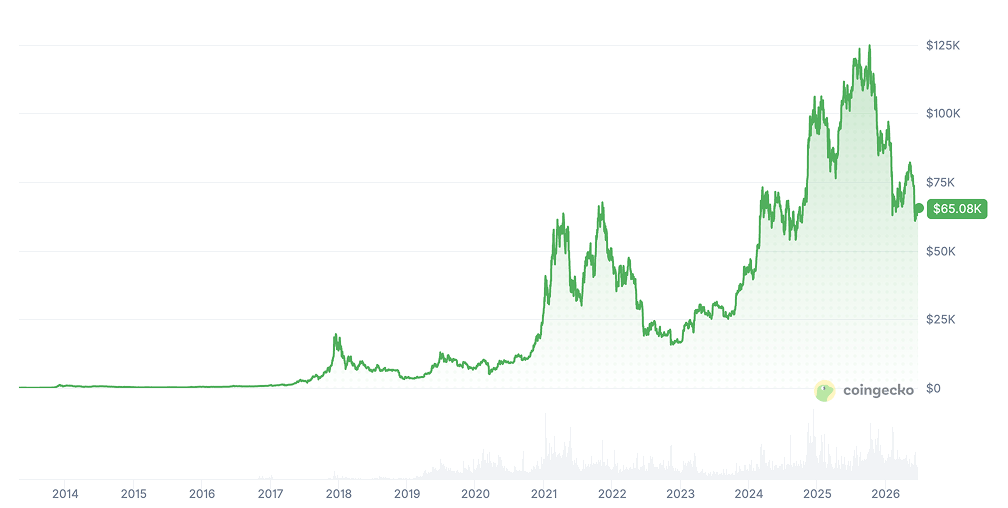
CoinGecko, June 22, 2026
Bitcoin technical analysis currently highlights a market at a critical turning point. Bitcoin is trading near $65,000, while several key technical indicators on the daily and weekly timeframes continue to signal bearish pressure. Traders are closely monitoring whether BTC can hold above major support zones or regain momentum toward higher resistance levels.
The daily and weekly charts remain the primary focus for market participants because they provide a clearer picture of the broader trend. With Bitcoin trading well below its 2025 all-time high, support levels around the recent lows and resistance near the mid-$60,000 range are becoming increasingly important. By combining price action, moving averages, and momentum indicators, traders can better assess potential breakout or breakdown scenarios and manage risk more effectively.
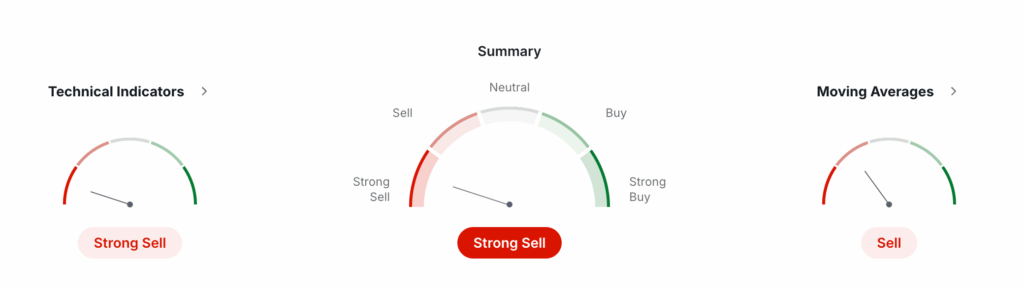
Monthly technical analysis from Investing.com, June 22, 2026
Understanding BTC support and resistance levels helps you spot where price may react. These zones form from volume clusters, past consolidations, and repeated tests. Here are support and resistance monthly data from Investing.com.
| Level Type | Price Point (USD) | Technical Rationale |
| Primary Resistance | $86,587 | Classic R2 pivot level |
| Immediate Resistance | $80,123 | Classic R1 pivot level |
| Pivot Level | $76,327 | Classic pivot point (key equilibrium zone) |
| Immediate Support | $69,863 | Classic S1 pivot level |
| Strong Support | $66,067 | Classic S2 pivot level |
| Current Price | ~$65,000 | Trading between S2 and S3 levels |
| Critical Support | $59,603 | Classic S3 pivot level |
Bitcoin continues to react to established support and resistance levels, as traders concentrate their buy and sell orders around these zones. Resistance areas typically signal stronger selling pressure, while support levels attract demand and can help stabilize price action. Currently, the region around $60,000 serves as a critical support zone. A decisive break below this level could weaken the market structure and increase the risk of a deeper correction, while holding above it would support the broader bullish outlook.
Current Bitcoin price action points to a period of consolidation as the market stabilizes around the $65,000 level. Rather than establishing a clear directional trend, BTC is trading within a defined range, suggesting that buyers and sellers remain in balance while the market searches for its next catalyst.
A bullish breakout above key resistance levels could open the door for a move toward the $70,000–$75,000 region, especially if accompanied by rising trading volume and sustained buying pressure. Confirmation would come from a series of higher lows and a strong daily close above resistance. On the downside, a break below the $60,000 support zone could weaken market sentiment and increase the likelihood of a deeper correction, shifting the short-term outlook in favor of the bears.
The current Bitcoin market update shows that recent crashes were sharp but short-lived. On February 5, 2026, Bitcoin dropped around 20% in one week, falling toward the mid-$60,000 range due to massive liquidations and leverage unwinding. Shortly after, the broader cycle decline deepened, with BTC falling over 50% from its $126,000 peak to near $60,000.
More recently, on June 5, 2026, Bitcoin fell again after touching $59,100, driven by profit-taking and geopolitical tension impacting risk assets.
Despite negative headlines, strong institutional demand helped stabilize the market. Notably, ETF inflows of $53M absorbed selling pressure, which explains why the crash quickly turned into consolidation instead of a prolonged downtrend.
| Metric | Recent Value | Market Impact |
| Spot ETF Daily Flow | +$53 Million | Strong recovery after geopolitical shock |
| Exchange Reserves | ~2.7M | Supply shock – less BTC available for sale |
| Whale Net Change | +12k BTC (7-day) | Accumulation by large holders (1k+ BTC wallets) |
| Short Liquidation Risk | High above $67k | Potential short squeeze if resistance breaks |
The current Bitcoin price recovery analysis shows a pattern similar to previous cycles. After sharp corrections, Bitcoin often recovers within 4–12 weeks, especially when strong demand appears. Right now, the market forms higher lows, which signals growing buyer strength.
At the same time, exchange outflows remain high, meaning investors move BTC into cold storage instead of selling. In addition, whale accumulation continues, with large holders increasing positions during dips. Finally, ETF inflows support the trend, as institutional capital absorbs selling pressure.
The Bitcoin price recovery forecast 2026 depends on how price reacts to key resistance levels. In the short term (1–4 weeks), Bitcoin may target $80,000–$85,000 if momentum builds above resistance. Over the medium term (1–3 months), a move toward $90,000–$100,000 becomes possible in a base scenario. In a bullish case, strong inflows and breakout structure could push BTC toward $110,000+. However, a bearish scenario appears if price loses support, which could send BTC back to $60,000–$59,000.
| Indicator | Current Status | Market Signal |
| MA50 | $59,249 (Buy) | Support – Long-term trend remains bullish |
| RSI (14) | 43.095 (Sell) | Weak Trend – Market lacks strong direction |
| MACD (12,26) | 2739.9 (Buy) | Positive – Early bullish momentum building |
| Stoch RSI (14) | 0 (Oversold) | Reversal Signal – Potential bounce zone |
| ADX (14) | 28.413 (Neutral) | Neutral – No strong momentum in either direction |
| Bull/Bear Power | -27,188.4 (Sell) | Bearish Pressure – Sellers still active |
A strong Bitcoin trading strategy starts with patience and clear levels. Right now, traders focus on accumulation near support zones such as $69,000–$66,000, where demand historically appears.
Instead of entering all at once, many investors use a dollar-cost averaging (DCA) approach, which spreads entries over time and reduces risk. In addition, smart position sizing helps protect capital, so traders avoid overexposure in volatile conditions.
Risk management remains essential, therefore placing a stop-loss below key support, for example under $66,000, limits downside. At the same time, waiting for confirmation above resistance improves entry quality.
StealthEX allows users to trade Bitcoin quickly and without complexity. The platform offers no registration, which means you can start instantly without KYC. In addition, users benefit from competitive rates, fast transaction processing, and access to 2000+ cryptocurrencies. The process stays simple and clear.
Bitcoin holds above key support at $66,000, which keeps the bullish structure alive despite recent volatility. Resistance near $80,000–$86,000 still blocks further upside. However, strong ETF inflows and steady accumulation suggest growing demand. Therefore, the market now shows consolidation, not collapse. Traders should stay cautious and manage risk.
Below you will find answers to the most common questions about current Bitcoin market conditions and price behavior.
Bitcoin is falling due to a mix of short-term factors. Recent declines followed profit-taking after rallies, combined with geopolitical uncertainty and market-wide risk-off sentiment. In addition, technical rejection near resistance triggered liquidations. The drop reached double-digit percentages in recent weeks, however it still looks like a short-term correction rather than a long-term reversal.
A true crash usually means a decline of 30–50% in a short time with panic selling. Bitcoin already dropped around 50% from its peak, but the current structure shows stabilization. Therefore, the latest move looks more like a correction within a larger cycle, not a fresh crash phase.
The answer depends on your strategy. Bitcoin trades close to key support zones, which often attract buyers. At the same time, indicators show mixed signals, so timing matters. Long-term investors may consider gradual accumulation, while short-term traders should wait for confirmation. Risk tolerance and timeframe play a key role in this decision.
A bear market requires a clear downtrend with lower highs and lower lows. Currently, Bitcoin still forms higher lows, which suggests consolidation rather than a full bear market. In addition, long-term moving averages remain bullish, which supports the broader uptrend.
Bitcoin trades around $65,000, with a 24-hour gain of 1%. The market tests resistance near recent highs, while support remains below.
Make sure to follow StealthEX on Medium, X, Telegram, YouTube, and Publish0x to stay updated about the latest news on StealthEX and the rest of the crypto world.
Don’t forget to do your own research before buying any crypto. The views and opinions expressed in this article are solely those of the author.
Bitcoin Bitcoin BTC Bitcoin price prediction BTC BTC price prediction




