Bitcoin’s price is experiencing one of its steepest declines ever for this cycle, after falling by nearly 50% from its all-time high of $126,000. The decline has ultimately triggered a crucial shift in the sentiment of BTC large holders and retail investors, who appear to be moving on separate trajectories.
While the price of Bitcoin has fallen sharply towards the $73,000 mark, a key divergence has emerged among BTC investors, which could play a role in its next direction. Specifically, this ongoing divergence is being observed among large BTC holders or whales and retail holders.
A recent analysis by Joao Wedson, a market expert and founder of Alphractal, shows that whales are starting to close their long positions in BTC while retail traders move in the opposite direction. Looking at the chart, the high-net-worth investors are closing their longs opened around the $75,000 price level.
Wedson’s research is primarily centered on the Bitcoin Whale vs Retail Delta metric, which is a powerful tool as it typically anticipates what price will do next. The trend suggests that large players are reducing risk and locking in gains. Meanwhile, smaller traders are increasing their bullish exposure in anticipation of a potential rebound.
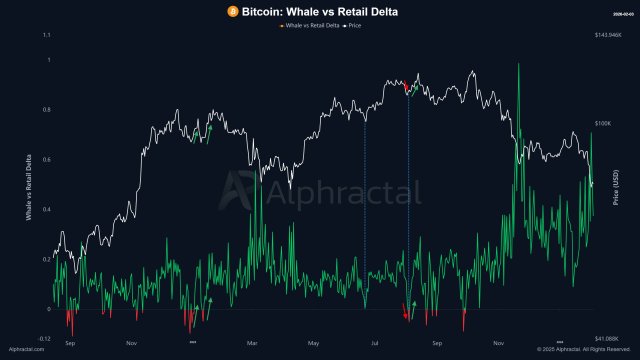
This is a typical trend in a highly volatile market, as institutional traders are often opportunistic. During periods like this, these major investors tend to hunt for volatility, open longs and shorts aggressively, and later reduce exposure.
On the other hand, retail investors tend to be stubborn, which is evidenced by them holding positions longer than they are supposed to. A key driver of this action from the investors is greed rather than structure. According to the expert, two scenarios appear extremely likely now that whales are closing longs or starting new shorts at these levels.
The first scenario is that Bitcoin will experience steady sideways movement for a few days before deciding its next trajectory. For the second scenario, the price of BTC may continue to move lower. In the meantime, the imbalance raises questions about the short-term viability of the current market structure.
Given the ongoing decline in the Bitcoin price, Joao Wedson shared in another post on X that many BTC wallet addresses appear to be shifting toward a distribution mode. Such a development directly contradicts what most market participants believe in.
In the past, addresses holding 0.1 BTC to 100 BTC have been the most effective group. When prices are low, this group tends to build up and then disperse into strength when prices are higher.
Furthermore, this trend challenges a common misconception that relying solely on mega-whale addresses is an unreliable tactic. However, market structure is shaped by coordinated behavior across cohorts, not by isolated large wallets.





