In an era where every online click leaves a digital footprint, cryptocurrency promised something revolutionary: financial freedom with true privacy. Yet as the industry matures in 2026, that promise sits in tension with growing regulatory demands. Are we building a more private financial system or one where every transaction is traceable? Many of us who entered crypto for its libertarian roots now find ourselves asking a harder question: Can privacy and regulation coexist?
This article explores the delicate dance between anonymity and oversight in crypto. We’ll look at why privacy matters, how regulations are reshaping the space, the tools fighting for user sovereignty, and practical ways to navigate this evolving landscape.
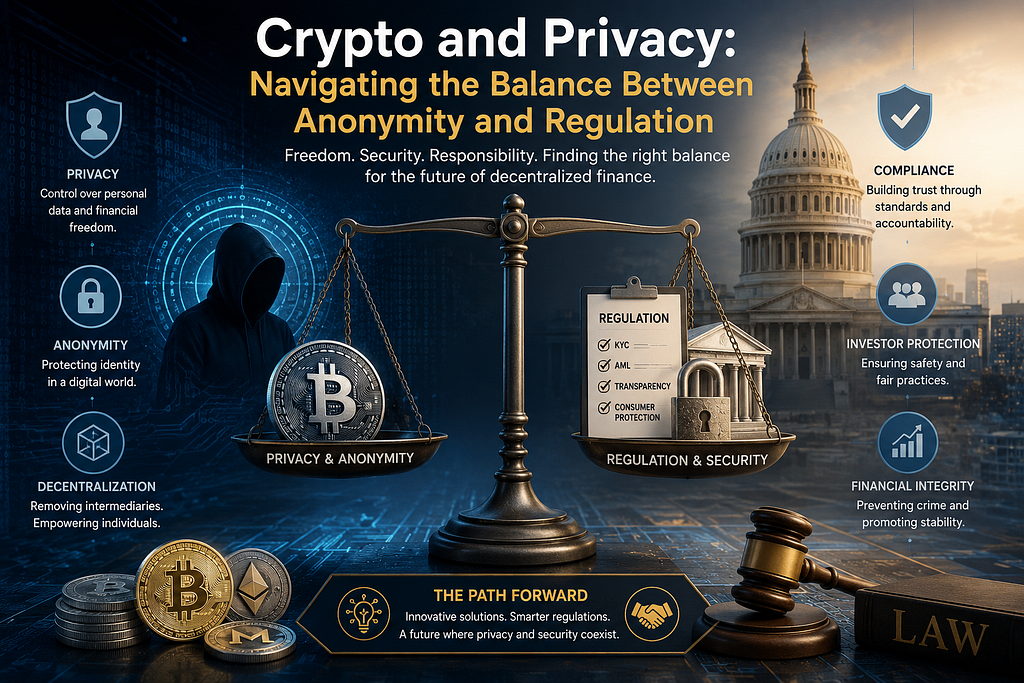
For many, crypto wasn’t just about making money it was about taking control. Traditional banks and governments can freeze accounts, track spending, or censor transactions. Bitcoin offered a glimpse of an alternative, but even Bitcoin isn’t fully private. Every transaction lives forever on a public ledger.
Privacy protects fundamental freedoms. It shields activists in oppressive regimes, journalists, and everyday people from surveillance capitalism. In 2026, with data breaches and identity theft at record highs, the desire for financial privacy feels more urgent than ever.
Yet privacy also creates challenges. Criminals have exploited anonymous tools for money laundering, ransomware, and sanctions evasion. Regulators argue that unchecked anonymity undermines the very trust needed for mainstream adoption.
This tension isn’t theoretical. It’s playing out in boardrooms, courtrooms, and code repositories worldwide.
2026 marks a turning point. The era of “regulation by enforcement” is giving way to structured frameworks.
Exchanges now demand robust KYC. Privacy coins face delisting risks from major platforms. Many users feel the walls closing in: “I came for freedom, not another form to fill out.”
The human cost is real. Small traders worry about overreach, while regulators point to billions in illicit flows stopped through better compliance.
At the heart of the privacy debate are specialized cryptocurrencies designed for anonymity:
These coins have outperformed the broader market recently, as demand for privacy grows amid tightening rules. Yet their success invites scrutiny. Some platforms hesitate to list them due to compliance fears, creating a cat-and-mouse dynamic.
Beyond coins, technologies like zero-knowledge proofs (ZKPs), mixers, and layer-2 solutions offer hope for privacy-preserving compliance proving you’re not on a sanctions list without revealing everything about yourself.
The ideal path forward isn’t pure anonymity or total surveillance it’s privacy with accountability.
Pros of stronger regulation:
Cons:
Many experts believe hybrid solutions will win: regulated on-ramps and off-ramps with private on-chain activity where appropriate. Zero-knowledge tech could let platforms verify compliance without exposing user data.
As one developer put it, “Privacy isn’t the opposite of regulation it’s a feature that makes the system more resilient and human.”
Navigating this world doesn’t require choosing sides. Here’s how to stay safe and sovereign:
Crypto’s privacy battle reflects a deeper societal question: In our hyper-connected world, how much of ourselves should remain ours alone?
As we move through 2026, the most successful projects and users will likely be those who embrace transparency where required while fiercely protecting core privacy rights. Regulation will continue evolving, but so will the technology often faster.
The future probably won’t be fully anonymous nor completely transparent. It will be nuanced, with tools that let individuals choose their privacy level while maintaining enough oversight to prevent systemic abuse.
What do you think? Are we heading toward a golden balance or forced compromise? Share your experiences with privacy coins or regulatory changes in the comments I read them all.
Crypto and Privacy: Navigating the Balance Between Anonymity and Regulation was originally published in Coinmonks on Medium, where people are continuing the conversation by highlighting and responding to this story.





