Cardano ADA broke past the $0.23 level this week, riding a broader boom across the crypto market and fresh momentum inside its own ecosystem. The ADA price surge added roughly 30% over seven days at its peak, pulling the coin back into the top 15 by market cap in the CoinMarketCap chart.
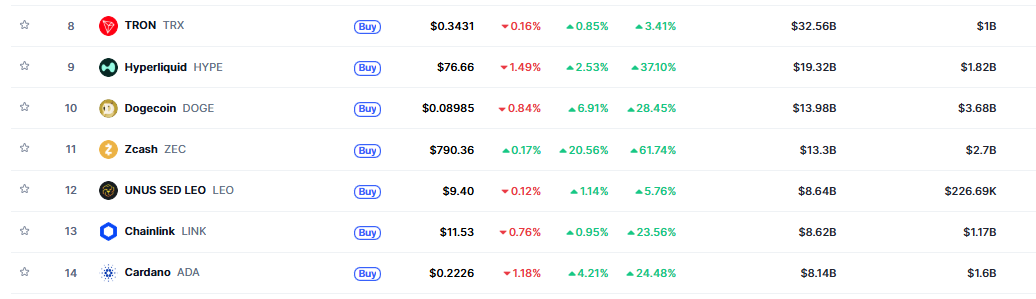
The ADA update today shows a calmer picture. $ADA is trading near $0.2237, up about 5% in the past 24 hours, after touching a high of $0.2577 and a low of $0.2097 in that window.
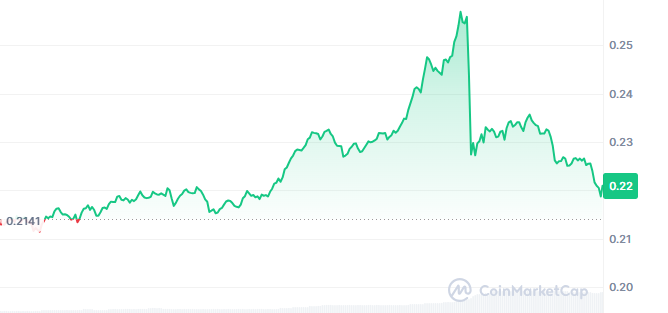
Current price : near $0.2267, up roughly 8% in 24 hours
24-hour range: $0.2097 to $0.2577
Weekly move: close to 30% at the top of the run
Trading volume: doubled to more than $1.6 billion in a day
Cardano ADA trading has slowed from its fastest pace, which is normal after a sharp climb. Fast gains tend to bring profit taking, and that looks like exactly what happened here.
The overall crypto market today is performing steadily. Total market cap sits near $2.59 trillion, up 1.13%.
The CMC20 index, which tracks the twenty largest coins,stands near $160.34.
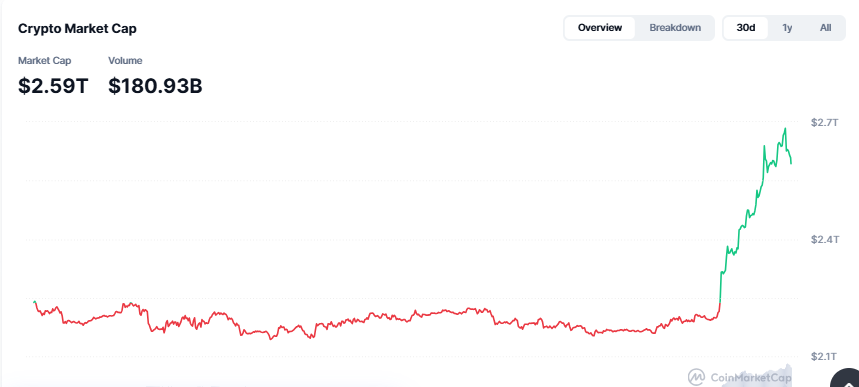
Liquidations over the past day fell more than 41% to $1.32 billion, easing the risk of sudden swings, and the Fear and Greed Index reads 76, firmly in Greed territory.
(Digital asset prices are volatile and this section reflects market data at the time of writing, not investment advice or a guaranteed outcome.)
The bigger question behind the $ADA price surge is whether it marks a genuine recovery or a short-lived bounce tied to the wider market mood.
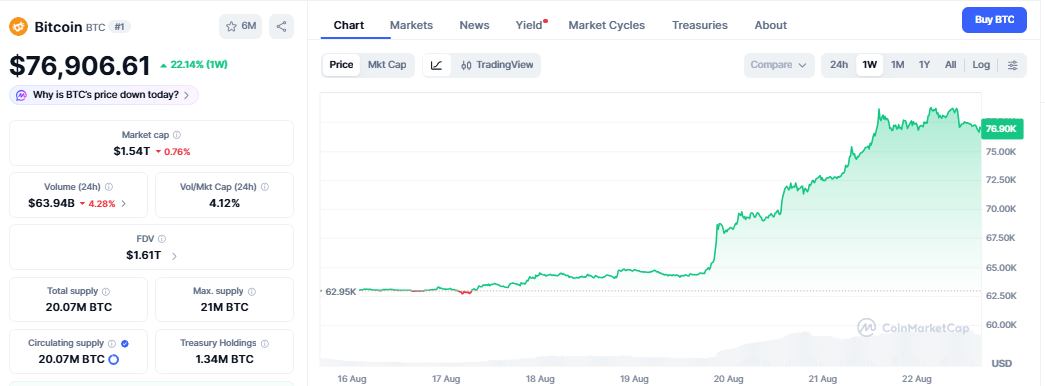
Much of the move traces back to Bitcoin recovery. The largest coin trades near $76,906, up more than 22% over seven days, and Ethereum sits near $2,424, up close to 29%. When the two biggest coins run this hard, altcoins usually follow, and that pattern lines up with what in Cardano ADA news today.
But the rally is not purely a Bitcoin story.
$ADA's own network showed real activity during the same window. Onchain transactions nearly doubled within 48 hours, with daily throughput topping 32,000 transactions. A hard fork earlier in the year, new privacy tool, cross-chain transfers all added fresh reasons for attention.
That mix of a strong macro backdrop and genuine network usage is what separates a real recovery signal from pure hype.
For now, the honest read is that both forces are at work. Bitcoin's surge opened the door, and the ecosystem 2026 progress gave traders a reason to walk through it.
(This is a general market observation, not a forecast, since digital asset prices can move sharply in either direction and carry real financial risk.)
The $ADA ecosystem has had a full year of development, not just a good week of $ADA coin price action.
Van Rossem Hard Fork: The Van Rossem hard fork activated on July 18, 2026, the first major upgrade approved and carried out entirely through on-chain governance, without direction from a central team.
The upgrade lowered smart contract execution costs and added new coding tools for builders.
Cardano–Midnight Rollout: Midnight, a privacy-focused partner network, launched its mainnet in late March 2026 with early institutional participants onboard, including Google Cloud and eToro.
Cross-chain transfers between Cardano and Midnight went live in August, linking the network into a wider group of connected blockchains.
$ADA Treasury Funding: Project Catalyst approved a 2.5 million $ADA funding round to support oracles, stablecoins, programmable tokens, and identity tools.
Governance: Governance has also kept functioning smoothly, with treasury spending, committee elections, and upgrade votes all running through the community rather than a single company.
The $ADA roadmap 2026 centers on the Dijkstra upgrade, a new ledger phase built to raise how many transactions the network can handle.
Phase one of Dijkstra activates Ouroboros Linear Leios, a new block structure designed to multiply current capacity without requiring larger blocks or faster block times. Mainnet-readiness targets late 2026. Testing under the name Musashi has moved through several public phases with steady results so far.
Phase two of the roadmap, called Peras, targets a shorter wait for transaction finality, cutting it from hours down to around two minutes. That piece is aimed at Q2 2027 and still needs a community vote before it can activate.
Other Cardano ADA upgrades in progress include:
Alternative node software built for wider network resilience
Continued improvements to Hydra, the project's layer-two scaling tool
Deeper integration between Cardano and the Midnight privacy network
Ongoing funding rounds through the community treasury for builders and infrastructure
Institutional attention is building alongside the technical work.
T. Rowe Price added $ADA to its active crypto ETF fund, a positive signal for regulated exposure to the coin. That came even after Grayscale withdrew its filing for a dedicated spot $ADA ETF in early August 2026. The move still left the door open for other issuers to pursue a similar product.
Disclaimer: This article is for informational purposes only and does not constitute financial or investment advice. Crypto markets carry significant risk. Always do your own research before making any investment decisions.





