CLARITY Act news has taken a tense turn this week as Republican senators openly question whether the bipartisan crypto market structure bill can survive its return to the Senate floor.
What was once framed as a rare bipartisan win on digital asset policy is now caught in a standoff over ethics language tied directly to the president. With a vote scheduled for September 15, lawmakers, the White House, and the crypto industry are all watching closely to see whether a deal can still be reached.
At a Glance
Republican senators warn the bipartisan CLARITY Act may fail when the Senate returns next week.
The central dispute is a Democratic demand for ethics language covering President Trump and his family.
The Senate vote is set for September 15 and requires 60 votes to advance debate.
The White House says Trump is "unequivocal" about wanting the bill passed.
Sen. Cynthia Lummis notes the bill cleared the Banking Committee 15-9, showing bipartisan groundwork already exists.
Paradigm's Alexander Grieve says the bill is "not dead, not by a long shot."
According to a Semafor report, Republican senators say the CLARITY Act is likely to fail when Congress returns. The bill needs 60 votes to advance debate, meaning it cannot pass on Republican support alone.
At the heart of the impasse is a proposed ethics provision covering the president and his family, an issue that has seen little movement between the White House and Democratic negotiators.
The outcome matters well beyond Capitol Hill, since the bill represents the most comprehensive attempt yet to create a formal market structure framework for digital assets in the United States.
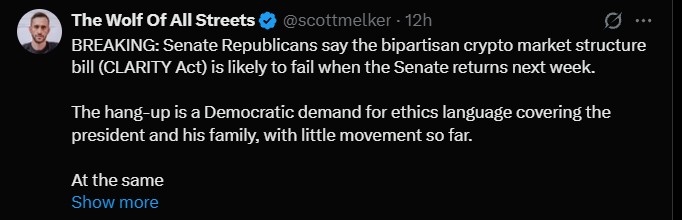
Source: Scottmelker X Post
Sen. Mike Rounds of South Dakota was blunt, saying the bill's outlook "does not look good right now." Sen. Thom Tillis of North Carolina went further, warning that without White House engagement on the ethics gap, "it is going to fail." Sen.
Roger Marshall of Kansas added a different angle, noting he has heard little pressure from constituents on the issue, saying, "nobody back home is asking about it."
Taken together, these comments show that even within the Republican conference, enthusiasm and urgency vary, and that reaching the 60-vote threshold will require real Democratic cooperation, not just internal GOP unity.
The dispute centers on whether the bill should include specific ethics safeguards applying to the president and his relatives. Reports note that Trump's personal financial exposure to crypto has been substantial, which Democrats argue makes ethics language especially necessary in any law governing the industry. Republicans, including Sen.
Cynthia Lummis, contend that Democrats are using the ethics demand as a bargaining tool to extract broader regulatory concessions that could hand future regulators expansive authority over the crypto sector. This section stays strictly factual: no wrongdoing has been established, and the debate remains a policy and political disagreement rather than a legal finding.
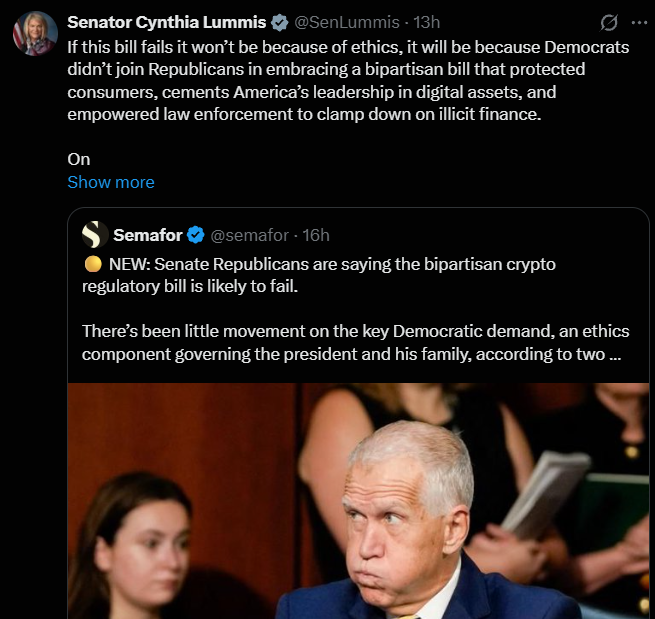
Source: Cynthia Lummis X Post
Despite the pessimism from Capitol Hill, a White House spokesperson said the administration has worked "tirelessly" with Congress and has already agreed to what it describes as the most comprehensive ethics provision in history.
The spokesperson added that Trump is "unequivocal" that Congress must pass the bill to keep the US ahead of foreign competitors in digital asset innovation.
This stands in direct contrast to Tillis' warning that further White House involvement is still needed to close the ethics gap, highlighting a clear disconnect between the administration's public messaging and senators' private assessments.
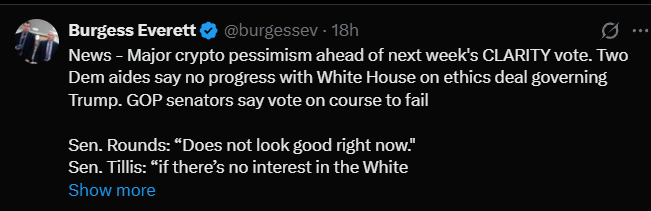
Source: Burgess Everett
Beyond ethics, disagreements persist across other parts of the bill. Lummis has pointed to the Banking Committee's 15-9 bipartisan vote as proof that a solid foundation already exists.
At the same time, she argues that Democrats are pushing for changes elsewhere in the bill that Republicans believe would give regulators too much power to restrict the industry.
Both sides publicly say compromise is necessary, but each expects the other to move first, leaving the bill in a holding pattern just days before the scheduled vote.
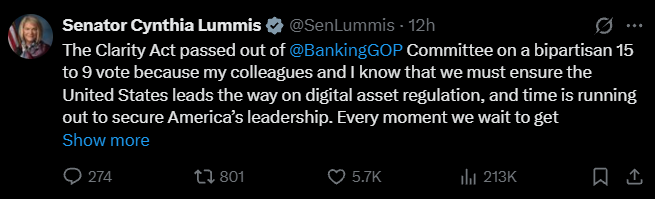
Source: Sen Lummis
Supporters argue that passing the crypto laws would deliver long-sought regulatory clarity, protect consumers, and give crypto businesses a clear incentive to stay and grow within the US rather than relocate overseas.
Lummis has repeatedly warned that every delay increases the risk of ceding leadership in digital assets to other countries that are moving faster on their own regulatory frameworks.
In simple terms, a market structure law would define which agency oversees which type of crypto asset, reducing the current regulatory ambiguity that has frustrated the industry for years.

Source: CoinMarketCap
The Act needs 60 senators to agree just to advance debate, a high bar in the current political climate. If that threshold isn't met, the immediate legislative timeline would likely be pushed back, though the rulebook would not necessarily be dead permanently.
Some reports suggest a failed vote could motivate the crypto industry to increase political spending in upcoming Senate and House races, using the outcome as a rallying point heading into the next election cycle.
| Date | Development | Why It Matters |
| Earlier stage | CLARITY Act advances through Congress | Establishes the framework for US crypto market regulation |
| Committee stage | Banking Committee approves the bill 15-9 | Demonstrates bipartisan committee support |
| Sept. 8, 2026 | Republican senators warn the bill may fail | Highlights growing uncertainty before the Senate vote |
| Sept. 9, 2026 | White House reiterates support for passage | Shows the administration remains publicly committed |
| Sept. 15, 2026 | Senate vote scheduled | Bill needs 60 supporters to advance debate |
| After vote | Negotiations or further legislative action | Outcome could determine the next phase of US crypto regulation |
With just days left before the September 15 vote, the central question is whether Democrats and the White House can close the gap on ethics language without derailing the broader bill.
Despite the wave of pessimistic statements from GOP senators, Paradigm's Alexander Grieve maintains the bill is "not dead, not by a long shot."
Whether that optimism holds will depend on last-minute negotiations, and the outcome will shape the near-term future of US crypto market structure regulation regardless of which way the vote goes.
The CLARITY Act news remains genuinely unpredictable. Republican senators are sounding alarms, the White House insists it remains committed, and Democrats continue to hold firm on ethics protections tied to the president and his family. Whether lawmakers can bridge these gaps before September 15 will determine not just the fate of this bill, but the broader trajectory of crypto regulation in the United States for months to come.
Disclaimer: This article is for informational purposes only and does not constitute financial, legal, or investment advice. Cryptocurrency markets and related legislation are subject to rapid change; readers should conduct their own research and consult a qualified professional before making financial or legal decisions.





