Bernstein Research , the Wall Street research firm, has issued a fresh Clarity Act Update warning that the bill's odds of passing before the Senate's summer recess are fading fast.
The firm, in a private research note, says a failed vote could spark another pullback across Bitcoin and the broader crypto market, though it still expects a recovery by late Q3 or early Q4.
This Clarity Act news today cycle centers on that risk window closing fast.
However, at the same time, not everyone reads the stakes the same way. Phong Le, chief executive of Strategy, has offered a notably calmer take just as Bernstein's warning circulates.
The contrast between the two views says a lot about how the market should weigh this week's Senate CLARITY Act activity.
Bernstein's position centers on market psychology. A stalled vote removes an expectation the market has partly priced in. As a result, an initial negative reaction hits first, and Bernstein's own note treats that dip as short-term rather than a sign of deeper trouble.
A Clarity Act failure this month, in the firm's view, would sting but not derail the broader recovery already underway.
Le starts from a different premise entirely: the outcome isn't really in question, only the path there. He argues that clearer regulatory is coming regardless of whether Congress acts, which shifts the entire risk calculus away from a single vote and toward a broader, slower-moving process that doesn't hinge on one Senate session.
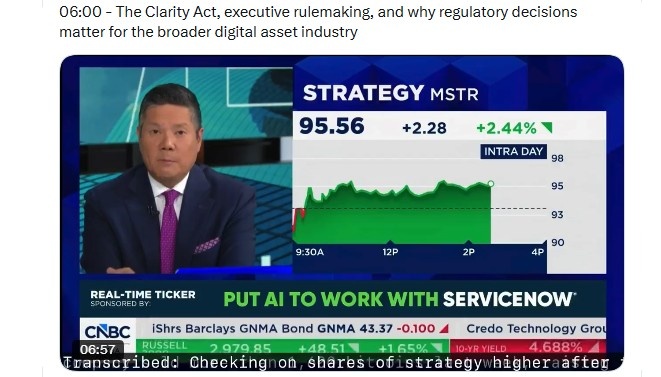
Phong Le points to three specific officials as evidence. He names
SEC Chair Paul Atkins, who took over the securities regulator earlier this year with a more crypto-friendly mandate than his predecessor,
The Commodity Futures Trading Commission, and
Treasury Secretary Scott Bessent, a former hedge fund manager now overseeing the administration's economic policy.
All three, Le says, already have rules "ready to go."
His framing is direct: rules arrive either with legislative backing behind them or through executive branch authority if the bill stalls again.
That view doesn't dismiss Bernstein's short-term concern so much as sidestep it. If the policy certainty arrives through agency action either way, a failed vote becomes a timing issue rather than a structural risk, a meaningfully different read than one built around near-term price reaction.
Separately, Brian Armstrong, co-founder and CEO of Coinbase, has echoed the broader stakes on X. He noted that one in four Americans hold crypto and that voters run twice as likely to back a candidate supporting the bill, regardless of party.
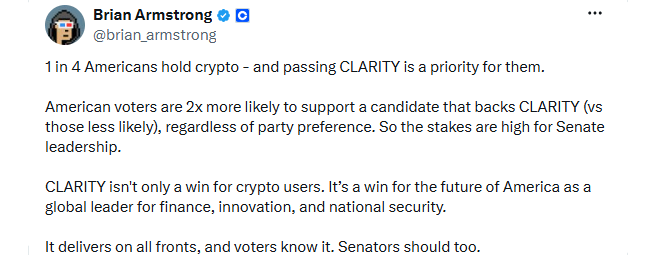
His framing sits closer to Bernstein's in urgency, treating Clarity Act voting this week as a real test rather than a formality.
The bill, formally the Digital Asset Market Structure (H.R. 3633), a crypto market structure bill meant to split oversight between the SEC and CFTC.
It passed the House in July 2025 by a 294-134 vote, then cleared the Senate Banking Committee in May 2026 by 15-9. Most recently, a merged Senate text combining Banking and Agriculture Committee versions landed on the calendar around July 22.
Since then, floor time has gone elsewhere. Senate Majority Leader John Thune, has kept nominations, sanctions measures, and funding bills ahead of it.
The bill was missing from the early August schedule, putting real weight behind the August deadline as recess begins around August 7-10, leaving no realistic runway for cloture and floor debate before the break.
The bill needs roughly seven Democratic votes on top of the 53-seat Republican majority
An ethics provision covering federal officials, including the president and Congress members, remains contested over scope, enforcement, and a 2029 sunset clause
Open questions on stablecoin yield treatment, AML rules, and SEC-CFTC jurisdiction still need resolution
If the bill misses this window, the next real shot comes in a short September session, though midterm campaigning and appropriations deadlines will compress that timeline further.
Polymarket prediction-market odds for Clarity Act 2026 passage have already dropped to roughly 27%, pushing more attention toward a possible Clarity Act 2027 timeline instead.
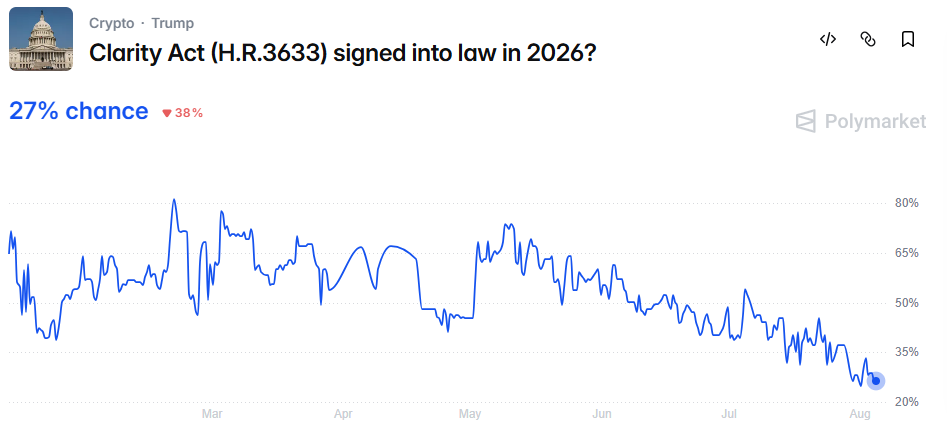
What Clarity Act Failure Would Mean For US Crypto Regulation Ahead
Both views end up pointing at the same underlying fact: agency-led guidance from the SEC and CFTC is already moving in parallel with the legislative process. Where Bernstein and Le diverge is on what that means for near-term price action versus long-term structure.
What agency action can't deliver is permanence. Executive branch rules can shift with a new administration, while a statute locks classification and registration standards into US crypto regulation for good.
That gap is likely why support for the bill remains strong across the White House, most Republicans, and a portion of Senate Democrats who backed the committee draft, even as the timeline keeps slipping.
Disclaimer: This article is for informational purposes only and does not constitute financial or investment advice. Crypto markets carry significant risk. Always do your own research before making any investment decisions.





