Ethereum ($ETH) has found itself under intense selling pressure over the past few weeks. Despite several attempts by bulls to push the asset back into higher trading tiers, market dynamics have shifted drastically in favor of the bears.
According to current technical structures on the chart and broader market indicators, there is a substantial risk that the Ethereum price could break below $2,000. The asset is currently facing strong overhead resistance and a lack of immediate buy walls. Market data confirms that whale distribution has accelerated, heavily impacting spot market liquidity.
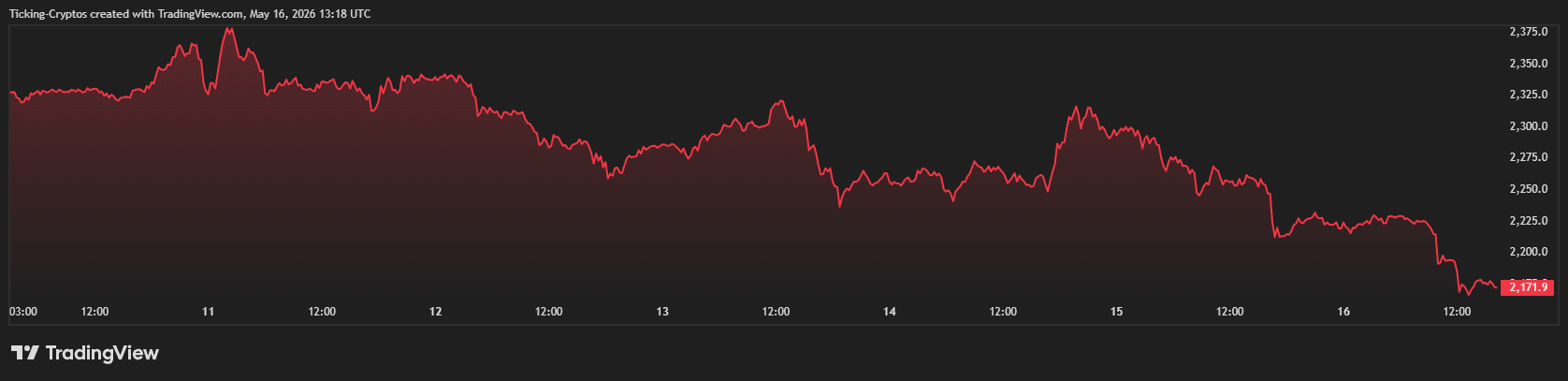
While short-term relief bounces are always possible in derivatives-driven markets, the overarching multi-week trend highlights a series of lower highs and lower lows. If the current support zones fail to hold back the bears, a continuation toward the next major demand zone below $2,000 appears highly probable before the end of the second quarter.
A detailed examination of the weekly ETH/USD chart reveals a distinct breakdown of the mid-term bullish structure.
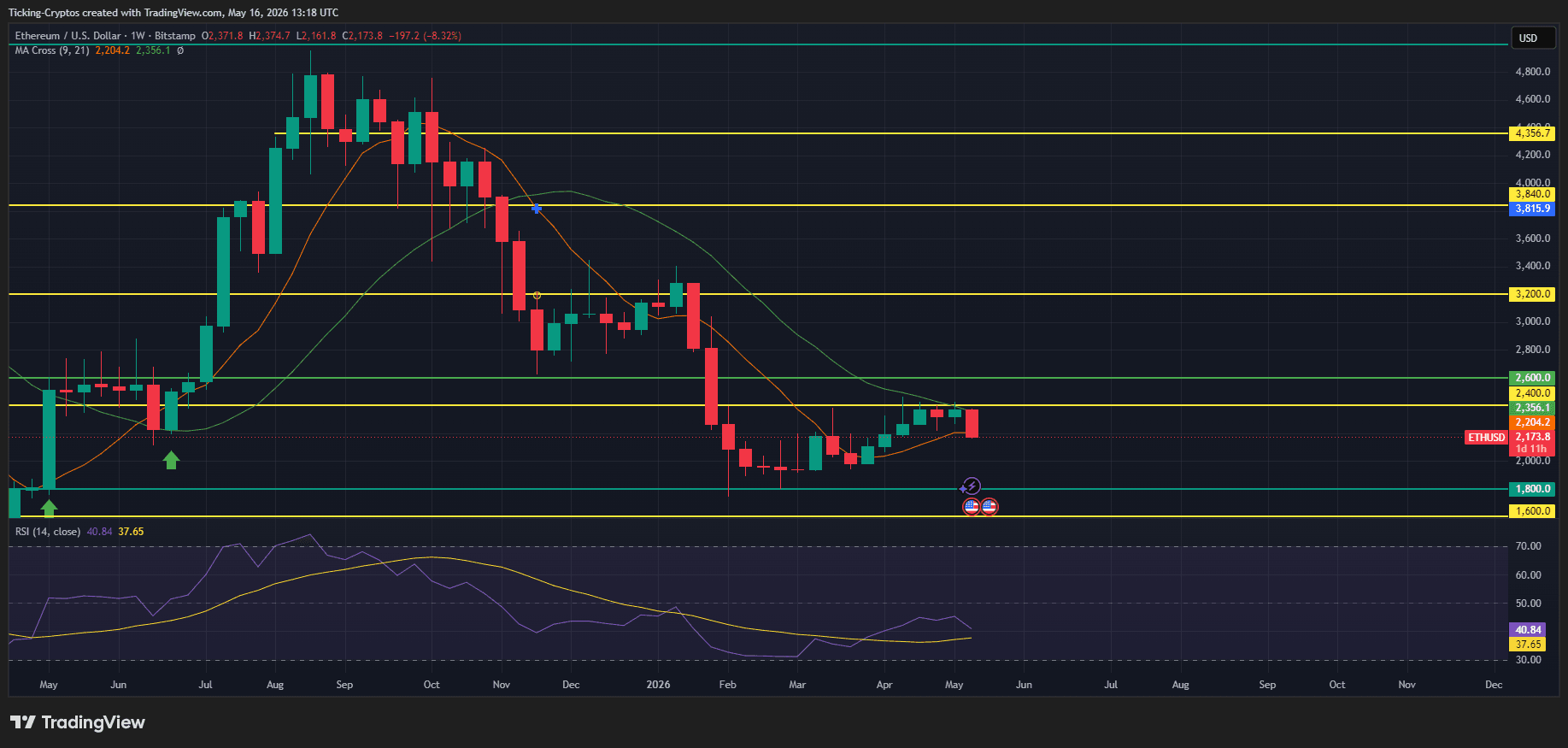
Several key horizontal zones are mapped out on this weekly timeframe:
At the bottom of the chart, the Relative Strength Index (RSI) with a 14-period setting is currently printing at 40.86, with its signal line at 37.66. While an RSI reading near 40 shows that the asset is approaching an oversold territory, it has not yet hit the traditional extreme oversold threshold of 30. This implies that there is still ample room for a downward extension before the market forces a structural, momentum-based trend reversal.
Data from blockchain analytics platforms highlights a worrying trend for Ethereum bulls. Over the past two weeks, exchange reserves for ETH have risen dramatically. Hundreds of thousands of ETH have been transferred onto centralized trading venues, heavily noting an intent to liquidate assets.
This distribution is primarily led by large-scale institutional wallets and "whales" holding between 10,000 and 100,000 ETH. When large entities transfer their holdings onto exchanges, it floods the order books with supply that retail buyers struggle to absorb.
The institutional narrative that pushed Ethereum upward throughout the previous quarters has cooled down. Net outflows from US spot $Ethereum ETFs have added pressure onto the market, dampening overall spot demand. Concurrently, major treasury firms have reported lower staking rewards and decreased yield revenue due to compressed network valuations, pushing institutional players to adjust their portfolios for maximum capital flexibility rather than long-term holding.
To invalidate this highly bearish scenario, Ethereum buyers need to step up immediately and force a daily close back above the 9-period moving average at $2,204. Reclaiming this minor level would signal that local demand is active. However, a full macro trend invalidation requires a strong push past the $2,335–$2,400 resistance cluster. Only a weekly close above $2,400 would reliably turn the structural bias back to neutral or bullish.
As macro asset trends undergo these aggressive distribution phases, securing digital assets off centralized exchanges becomes highly recommended. Utilizing cold storage options, which can be explored in detail through our hardware wallets comparison, guarantees that market volatility won't affect asset custody.





