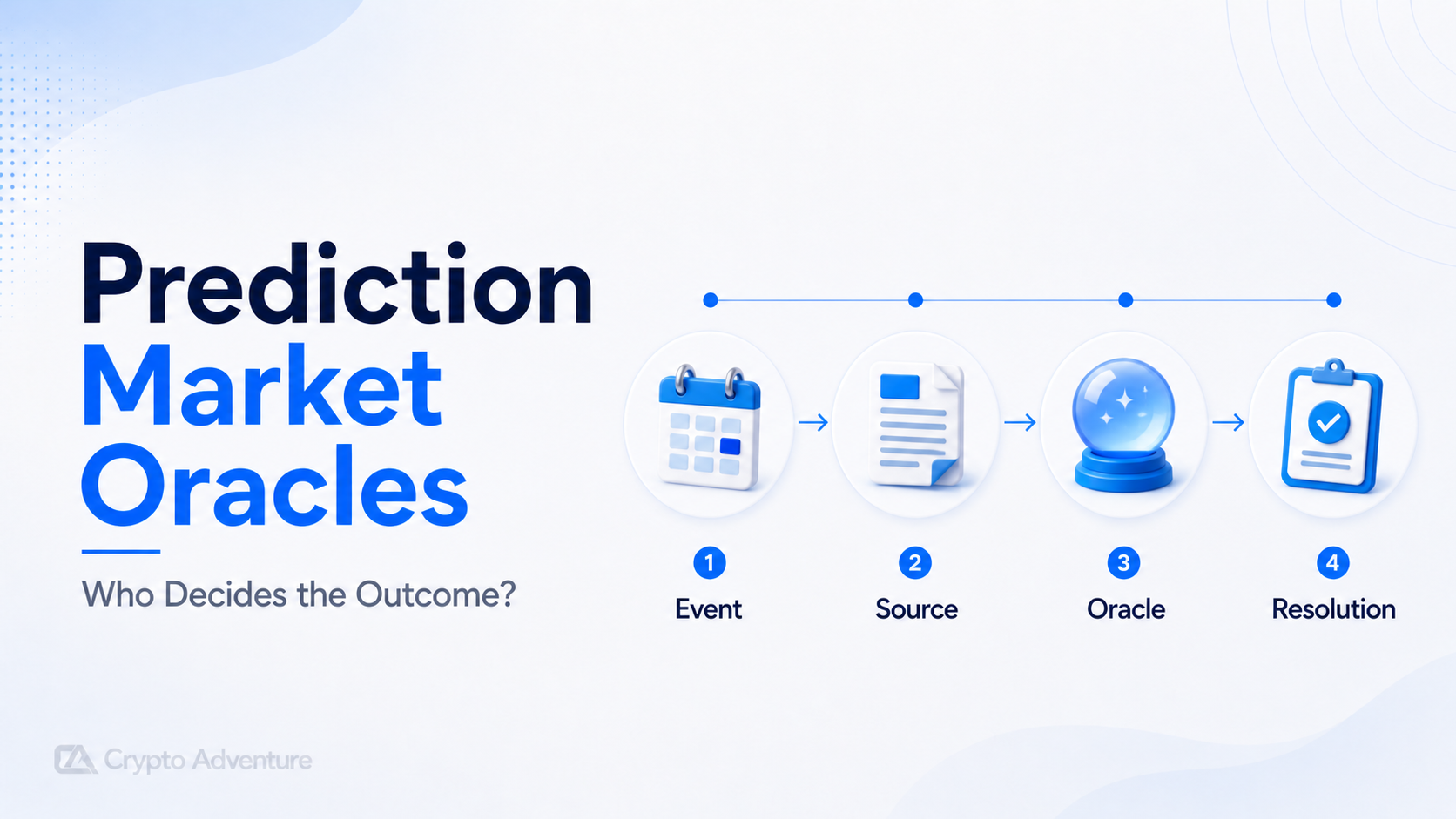
Prediction markets turn real-world events into tradable contracts. That creates one unavoidable problem: a blockchain or trading engine cannot automatically know who won an election, whether a court ruling happened, whether a sports result counted, or whether Bitcoin touched a specific level before a deadline. An oracle connects the market to the outside world.
In prediction markets, the oracle is not only a price feed. It is the settlement layer. It determines which outcome wins, when trading stops, which tokens or contracts pay out, and how disputes are handled. A strong oracle process makes markets credible. A weak one can destroy trust even if the trading engine is fast and liquid.
This is why users should read resolution rules before trading. The market title gives the headline. The resolution criteria decide the payout.
A prediction market oracle performs three main jobs. First, it connects the contract to an external source of truth. Second, it turns that external event into a machine-readable result. Third, it provides a process for disputes, corrections, or ambiguous cases.
A good oracle path starts before the market opens. The market should define the question, the end date, the settlement source, edge cases, and what happens if the expected source is unavailable. A market asking “Will Candidate X win?” is not enough. It needs to define which election, which office, which date, which certification or reporting source, and how recounts or delays are handled.
Bad oracle design usually begins with vague wording. If traders disagree about what the question meant after the event happens, the market has already failed at the design layer.
Polymarket uses outcome tokens, order-book trading, and a resolution process built around UMA’s Optimistic Oracle. When a market becomes eligible for resolution, an outcome can be proposed. If nobody disputes it during the challenge period, the market resolves. If the proposal is disputed, the process can escalate, and a deeper voting mechanism can decide the result.
UMA is built for optimistic data verification, which means the system assumes a proposed answer is correct unless someone challenges it. This can make uncomplicated outcomes resolve quickly while still giving disputed markets a path for review.
The incentive structure matters. Proposers and disputers post bonds, which creates a cost for careless or dishonest behavior. That does not guarantee perfect outcomes, but it makes resolution a market-based process rather than a purely centralized decision.
Polymarket’s resolution model also allows rare clarifications when unforeseen circumstances appear after trading begins. Clarifications should not change the core intent of the question, but they can guide resolution when events become messy. That is useful, but it also shows why market wording is so important from the start.
Kalshi uses a regulated exchange model for event contracts. A market settles when the official outcome is confirmed and winning contracts pay out to users’ cash balances. Market rules and contract terms define the criteria that decide whether the outcome resolves YES or NO.
This model is more centralized than Polymarket’s oracle path, but it comes with a different trust structure. Kalshi operates as a CFTC-regulated Designated Contract Market, so its market settlement process sits inside an exchange-rule and regulatory-surveillance framework. Users are trusting an exchange process rather than a crypto-native optimistic oracle.
That does not make every resolution simple. Official data can be delayed. A market can require manual review. Edge cases can arise. The important difference is that Kalshi’s settlement flow is tied to exchange rules, market teams, regulatory obligations, and official sources rather than an open onchain dispute game.
Hyperliquid HIP-4 brings outcome markets into a trading-native onchain environment. That changes the oracle problem because outcome contracts can sit next to spot and perpetual markets, where traders expect speed, tight execution, and clean settlement.
For crypto-linked outcomes, settlement can be more mechanical when the outcome depends on a market price inside the same trading environment. A daily BTC binary outcome can resolve against a clearly defined mark price at a defined time. That is cleaner than resolving a messy political or legal market.
Broader HIP-4 markets will still need strong oracle design. If a contract depends on a real-world event, someone or something must define the source, time, dispute path, and settlement logic. The more subjective the event, the more difficult the oracle problem becomes.
Prediction-market oracle systems usually fall into three broad models.
| Oracle Model | How It Works | Main Strength | Main Risk |
|---|---|---|---|
| Optimistic Oracle | Outcome is proposed, then disputed only if challenged | Fast for simple markets, open dispute path | Ambiguous markets can escalate or become controversial |
| Exchange Settlement | Platform settles based on rules and official sources | Clear operational accountability | More centralized trust assumption |
| Programmatic Price Settlement | Contract resolves from a defined price or data input | Fast and mechanical for numeric events | Oracle manipulation or bad data source design |
None of these models is perfect. The right model depends on the market type. A BTC price market can use a price-based settlement path. A political result needs official election criteria. A court case needs legal-source clarity. A cultural market may be much harder because “winning” can depend on subjective rules.
Most oracle disputes do not begin with bad technology. They begin with bad wording. A market may ask whether a person “will be removed,” whether a company “will launch,” whether a country “will invade,” or whether a team “will win” without defining enough conditions.
Ambiguous wording creates several problems. Traders may price different interpretations. Market makers may withdraw liquidity near settlement. Losers may dispute because the outcome feels unfair. The oracle then becomes a courtroom for wording that should have been clearer before trading started.
Good markets define the outcome narrowly. They use objective sources, hard deadlines, and edge-case rules. A well-written market can still be wrong, but it gives the oracle less room to interpret.
Oracle manipulation becomes a serious risk when the market payout is large enough to justify attacking the data source or influencing the event. A trader may not need to manipulate the whole world. They may only need to affect the data point used for settlement.
This risk appears in price markets, sports markets, small-cap asset markets, and thin data environments. If the settlement source is weak, a well-capitalized trader can try to move the reference price, influence the official feed, or create confusion around the outcome.
Oracle design therefore has to consider economic security. The cost of manipulating the outcome should be higher than the profit from doing so. That is the same logic behind broader smart contract security, but with a real-world data layer added on top.
Users should check the market rules before entering. The most important details are the resolution source, deadline, settlement time, edge cases, dispute path, and whether the event depends on subjective judgment. If the market title and rules seem inconsistent, the rules matter more.
Liquidity also matters. A trader may be right about the final outcome but unable to exit early at a fair price if the order book is thin. That is why prediction markets should be evaluated with the same execution lens as onchain trading: spreads, depth, settlement, and platform rules all shape the real result.
The safest markets are usually the ones with objective criteria, reliable sources, clear deadlines, strong liquidity, and a tested resolution path. The riskiest markets are subjective, emotional, highly political, insider-sensitive, or based on data that can be delayed or manipulated.
Prediction market oracles decide who gets paid. They turn real-world uncertainty into final settlement, whether through an optimistic oracle, exchange-led settlement, or programmatic price input.
Polymarket’s UMA-based model gives users an open proposal and dispute path. Kalshi’s regulated exchange model relies on market rules, official outcomes, and exchange settlement. Hyperliquid HIP-4 points toward a trading-native version where some outcomes can resolve mechanically, while broader event markets still need careful oracle design.
The best prediction markets are not only liquid. They are well-written, clearly sourced, and hard to manipulate. Traders should never treat a market title as enough. The oracle path, resolution rules, dispute process, and settlement source decide whether the contract is actually worth trading.
The post Prediction Market Oracles: Who Decides The Outcome? appeared first on Crypto Adventure.





